
Key Takeaways
- Canada's 2019 continental shelf submission covers 1.2 million square kilometres of Arctic seabed, including the North Pole, and overlaps with Danish and Russian claims
- The Arctic Council's official meetings have been paused since 2022, with the Kingdom of Denmark chairing from 2025 to 2027
- About 5,640 Canadian Rangers maintain a presence in 205 remote communities, including over 1,500 in 60 Arctic communities
Sovereignty you can measure in square kilometres
Canada's Arctic sovereignty, in Ottawa's own framing, "encompasses land, sea and ice" and extends to the coasts of the Arctic islands and beyond — the islands understood as joined, not divided, by the waters between them. Canada also maintains that the waters of the archipelago, including the channels of the Northwest Passage, are its internal waters.
But the part of sovereignty that is actively being built today is not the islands. It is the seabed.
The North Pole filing
On May 23, 2019, Canada filed its Arctic Ocean submission with the UN Commission on the Limits of the Continental Shelf: 2,100 pages of science, built on 17 Arctic research expeditions since 2006. It claims 1.2 million square kilometres of continental shelf — the seabed and what lies under it — including the North Pole.
Two things about the filing matter. First, it is not a boundary: under the UN Convention on the Law of the Sea (which Canada joined in 2003), the Commission judges the science of where a country's shelf extends; final boundaries between neighbours are negotiated afterwards. Second, Canada is not alone out there. Denmark, together with Greenland, filed its own northern shelf claim in 2014, and Russia's overlaps Canada's too — in December 2022 Canada filed an addendum after a Russian filing tripled the area of overlap. All three states are committed, on the record, to resolving the overlaps peacefully under international law.
The table that went quiet
The Arctic's diplomatic forum is the Arctic Council, founded in Ottawa on September 19, 1996 — eight member states deciding by consensus, with six Indigenous organizations, including the Inuit Circumpolar Council, as Permanent Participants. Canada was the leading voice in giving Indigenous peoples that seat.
Since 2022, after Russia's invasion of Ukraine, the Council's official meetings have been paused. The chairship still rotates — Norway held it 2023–25, and the Kingdom of Denmark chairs from 2025 to 2027 — but the political-level forum that managed the Arctic for a quarter century is running in a reduced format.
Presence: the Rangers and the radar line
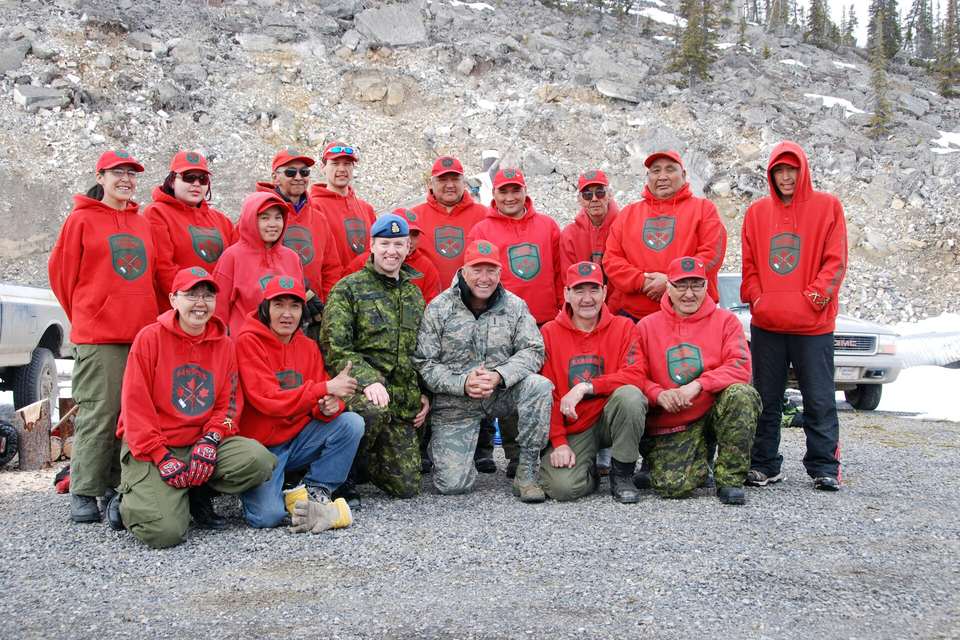
Sovereignty is also exercised by being there. About 5,640 Canadian Rangers maintain a military presence in 205 remote and isolated communities, including over 1,500 Rangers in 60 Arctic communities. The Forces' permanent northern anchor is Joint Task Force North in Yellowknife, and Operation NANOOK is the signature annual exercise of sovereignty in the region.
Overhead, the North Warning System — 47 radar sites from the Yukon to Labrador, monitored from North Bay, Ontario — watches the northern approaches under NORAD, and is maintained under contract by Nasittuq Corporation, an Inuit-owned company. Canada has committed $38.6 billion over 20 years to modernizing NORAD.
The foundation is Inuit
None of this rests on paperwork alone. Inuit Nunangat — the Inuit homeland across four treaty regions — covers about 40% of Canada's land area and roughly 72% of its coastline, all of its Arctic coastline. Ottawa's Arctic Foreign Policy states it directly: Indigenous peoples have used and occupied the ice and waters for thousands of years, and "sovereignty and sovereign rights in the Arctic are inextricably linked to issues of Indigenous self-government."
The Twikup Take
Canada's Arctic sovereignty is three things at once: a science case being argued in New York, a presence maintained by Rangers and radar, and a claim whose deepest roots are Inuit. The paperwork gets the headlines, but the policy itself says the foundation was never the paperwork.
Image: Members of the Canadian Ranger Patrol Inuvik with NORAD and Joint Task Force North commanders, 2009. Photo by Wendy Gilmour, via Wikimedia Commons (public domain).