
Key Takeaways
- Canada and Austria committed in Ottawa on November 6, 2026 to deeper cooperation on critical minerals, semiconductors, advanced manufacturing and innovation,with talks on a science
- Austria reaffirmed its support for a deeper Canada-EU partnership and full implementation of the CETA trade agreement.
- Canada will coordinate closely with Austria during its 2027–2028 term on the UN Security Council, and both countries restated unwavering support for Ukraine.
Canada and Austria Are Building a Partnership That Goes Beyond Trade
Computer chips. Critical minerals. Military cooperation. And a seat at one of the world's most powerful diplomatic tables.
Canada and Austria have a surprisingly long to-do list.
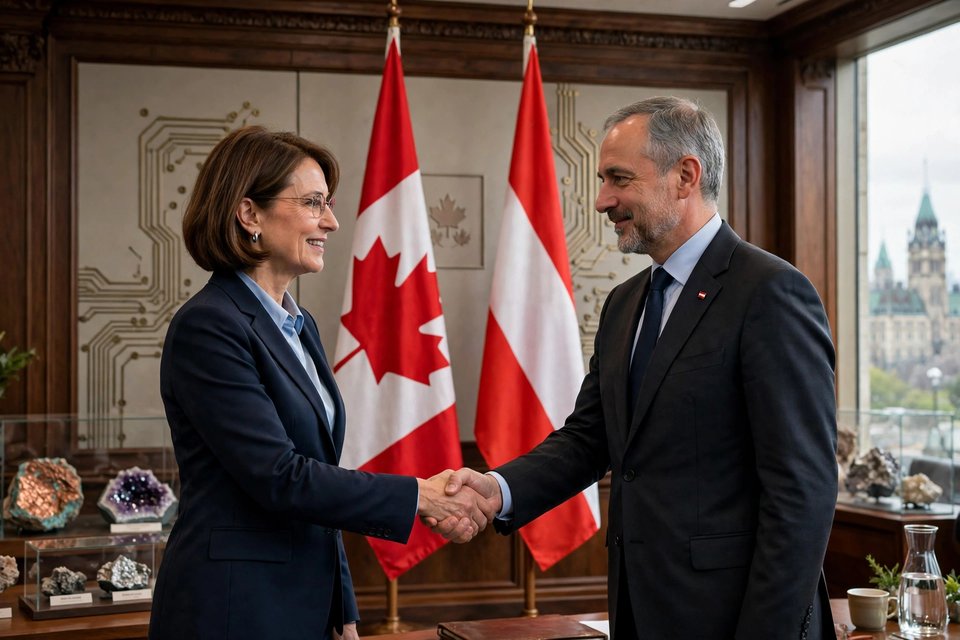
On November 6 in Ottawa, Foreign Affairs Minister Anita Anand welcomed Austria's Federal Minister for European and International Affairs, Beate Meinl-Reisinger.
The two ended the visit with a joint statement covering trade, defence and the United Nations.
Their reason for getting closer? The statement points to a world facing "increasing geopolitical uncertainty."
First Up: Minerals, Chips and Technology
The economic agenda goes straight to industries that matter for the future.
Canada and Austria committed to deeper collaboration on critical minerals, semiconductors, advanced manufacturing, science, technology and innovation.
And the next step is already on the calendar.
Officials will begin exploratory talks in Vienna next week on a bilateral science, technology and innovation agreement.
Both countries also want stronger, more resilient supply chains across the Atlantic.
The message: cooperation isn't just about selling goods. It's also about strengthening the networks that produce them.
Austria Wants a Stronger Canada-EU Partnership
The relationship doesn't stop at Austria's borders.
Austria reaffirmed its support for a deeper, more ambitious partnership between Canada and the European Union.
It also backed full implementation of the Comprehensive Economic and Trade Agreement (CETA).
For Canada, that means another European partner publicly supporting closer economic ties.
A UN Security Council Seat Changes the Conversation
Here's where the partnership moves beyond economics.
Austria has been elected to the United Nations Security Council for 2027–2028.
Anand congratulated Austria on the election, and both ministers agreed to coordinate during its term.
Their priorities include protecting civilians caught in armed conflicts and advancing the Women, Peace and Security agenda.
In other words, the two countries are planning cooperation in a forum where major international security questions are debated.
Ukraine Is Also on the Agenda
Both ministers reaffirmed their unwavering support for Ukraine.
They condemned Russia's attacks on civilian infrastructure and committed to cooperation on reconstruction.
They also pledged to work together on the return of Ukrainian children forcibly transferred by Russia.
The joint statement places these commitments alongside the countries' broader security cooperation.
This Partnership Has Been Building for Months
The November 6 meeting wasn't a sudden diplomatic handshake.
A high-level political dialogue took place in Ottawa last month.
This week, Vienna hosted the first Canada-Austria Political-Military Dialogue.
And in 2027, the countries will mark 75 years of diplomatic relations.
Three milestones, one direction: closer cooperation on economics, security and international affairs.
The Twikup Take
Austria might not be the first country Canadians think of when discussing global power.
But it has something Ottawa values: a voice inside the European Union and an upcoming seat on the UN Security Council.
Add critical minerals, semiconductors and defence cooperation, and this becomes more than another diplomatic visit.
Canada isn't just strengthening one relationship. It's building partnerships that could matter when the next global crisis arrives.
Image: AI-generated illustration.