
Key Takeaways
- Qubits use superposition and interference to explore many possibilities at once, giving quantum computers an edge on a narrow set of problems such as modelling molecules.
- The machines are fragile: decoherence destroys their calculations, so error correction — encoding information across extra qubits — is the field's central challenge.
- NIST finalized its first three post-quantum encryption standards (FIPS 203, 204 and 205) on August 13, 2024, because a future quantum computer could break today's widely used encry
Imagine a computer that makes wrong answers disappear
Flip a coin. While it's in the air, it's neither heads nor tails. It could land either way. That's how a classical bit works — once it settles, it's either 0 or 1. Now imagine a coin that stays spinning. Welcome to quantum computing.
A quantum computer uses qubits instead of ordinary bits. And unlike a classical bit, a qubit can exist in a superposition of 0 and 1. That means its quantum state combines possibilities rather than being locked into one value. Two qubits can exist in a superposition of all four possible two-bit strings. Three qubits? Eight. With 100 qubits, IBM notes, the possibilities become astronomical.
Sounds like unlimited computing power? There's a catch. Measure a qubit, and you get just one ordinary answer: 0 or 1. So how does a quantum computer turn all those possibilities into something useful?
The secret: make the wrong answers cancel themselves out
Imagine trying to solve a problem by arranging for the wrong answers to disappear. That's the strange power of quantum interference. Every possible outcome has a wave-like amplitude. A quantum algorithm can manipulate those amplitudes so that waves associated with wrong answers cancel one another, while those associated with right answers reinforce each other. IBM calls interference the engine of quantum computing. Without it, superposition alone would simply leave you with a random measurement outcome.
Then there's entanglement, another quantum effect that links qubits so measuring one can reveal information about the others. That mystery deserves its own explanation, which we cover in our quantum entanglement explainer.
A different kind of computer, not a faster one
Quantum computers aren't simply faster versions of the computers we use today. IBM is blunt: this technology is "not ideal for every (or even most) problems." Classical computers will remain the best tool for most tasks.
Quantum computers are expected to be useful for specific challenges — especially modelling physical systems. Chemistry, materials science and drug discovery involve physical systems that are extraordinarily difficult to simulate. A quantum computer could model a molecule directly, rather than brute-forcing every possible permutation. It may also help identify patterns and structures in information. In practice, quantum and classical computers are expected to work together, each handling the part of a problem it does best.
Fragile machines that need extraordinary protection
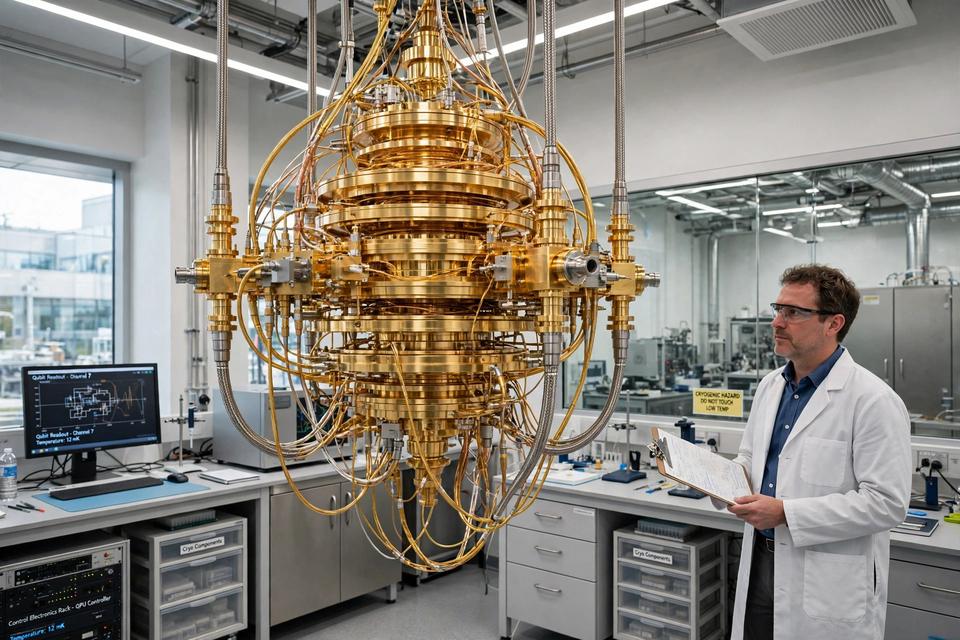
A qubit's quantum state is fragile. Heat, vibration, stray magnetic fields — even measuring it — can cause decoherence. That collapse can corrupt a calculation. That's why quantum processors operate at ultracold temperatures, colder than outer space.
Error correction is also central to making these machines reliable. The idea is to spread information across many more physical qubits than the calculation itself requires, so errors can be detected and corrected before they spread. In 2024, IBM announced an error-correcting code roughly 10 times more efficient than earlier methods. It's a breakthrough. It's also a reminder of how much work remains.
Why governments are already preparing for quantum decryption
Much of today's widely used public-key encryption depends on a mathematical problem being extremely hard to solve: factoring large numbers. In 1994, Peter Shor developed an algorithm showing that a quantum computer could solve that problem efficiently.
Building a quantum computer powerful and reliable enough to perform such attacks is an enormous challenge. But here's where quantum computing stops being a distant laboratory experiment and becomes a practical security question. A sufficiently capable quantum computer could break the public-key encryption that helps secure today's internet.
The US National Institute of Standards and Technology spent eight years running a competition to develop replacements. On August 13, 2024, it finalised the first three post-quantum standards: FIPS 203 (ML-KEM) for general encryption, and FIPS 204 (ML-DSA) and FIPS 205 (SLH-DSA) for digital signatures. These standards are designed to resist attacks from both quantum and classical computers. NIST urges organisations to start migrating now — years before a machine capable of breaking current encryption exists.
The Twikup Take
A quantum computer is not simply a faster computer. It is a different kind of machine. It computes with probabilities, cancels its own wrong answers, and can fail if its environment warms even slightly. The future of computing may not replace your laptop. It may transform what scientists can discover and how the internet protects information. The quantum race isn't just about building a powerful computer. It's about being ready for what that computer could change.
Image: Illustrative image.