
Quick Answer
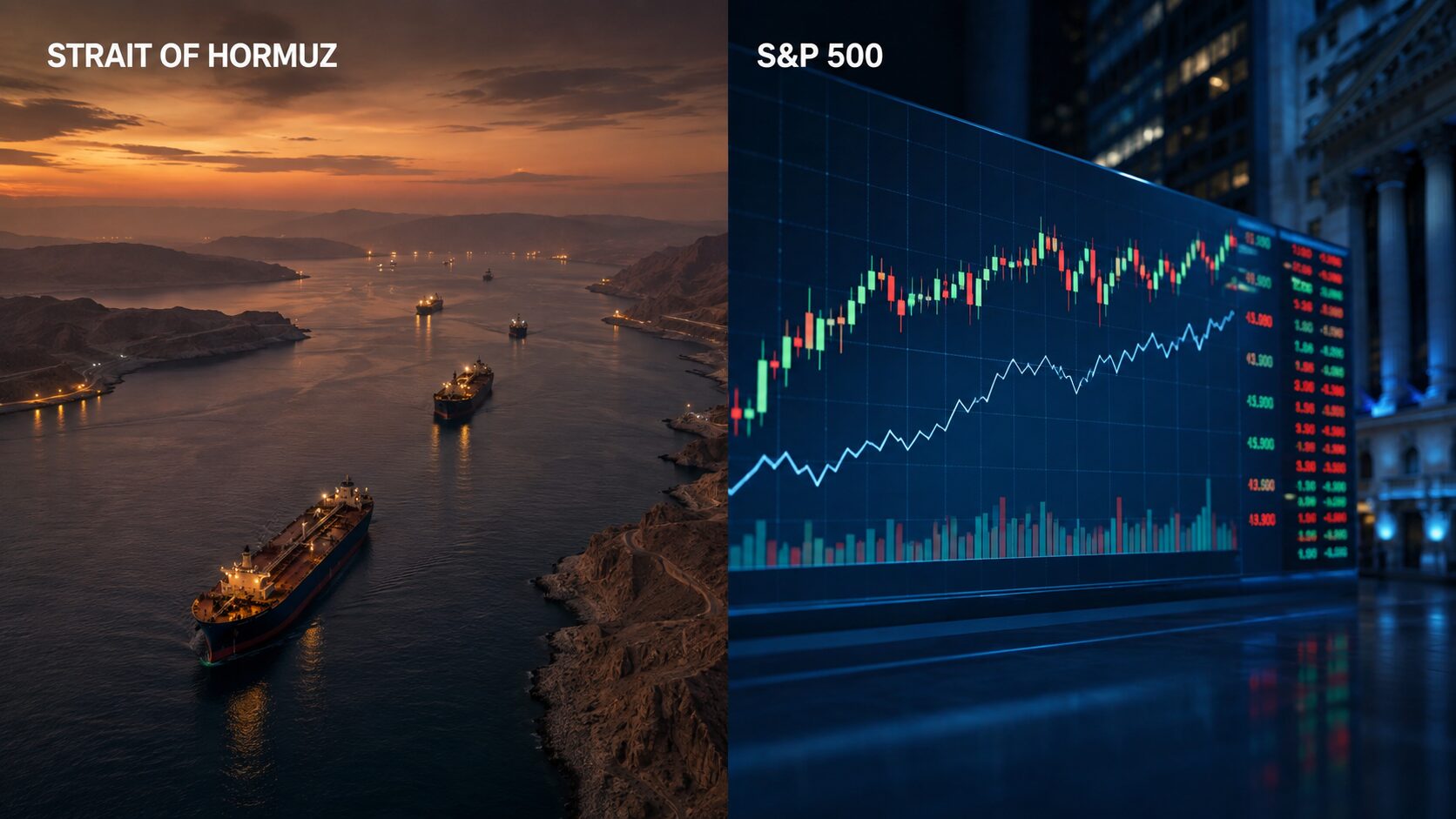
The Strait of Hormuz is affecting financial markets, but its strongest impact on Monday, August 10, 2026, is appearing in oil rather than the broader stock market.
In Monday morning trading, Brent crude rose approximately 1.4% to $84.68 per barrel, while U.S. benchmark crude advanced about 1.4% to $79.30. Investors were questioning how quickly dependable shipping could resume through the critical waterway.
Nevertheless, the S&P 500 was little changed in early trading. Strong corporate earnings, longer-term enthusiasm surrounding artificial intelligence and expectations that the Federal Reserve could delay a potential interest-rate increase were helping offset the energy-market risk.
The market is not ignoring Hormuz. Investors appear to be betting that the disruption will remain manageable. That calculation could change quickly if oil rises sharply, negotiations fail or another attack threatens regional vessels or energy infrastructure.
Key Takeaways
- The S&P 500 was little changed in early trading on August 10.
- Brent crude rose to approximately $84.68, while U.S. benchmark crude reached about $79.30.
- The Dow Jones Industrial Average was down approximately 72 points, while the Nasdaq Composite slipped about 0.1% in the early-trading snapshot.
- Hormuz uncertainty is adding a geopolitical-risk premium to oil prices.
- Strong earnings and support for large technology companies are helping stabilize stocks.
- A weak U.S. employment report raised expectations that the Federal Reserve could postpone a potential rate increase at its next meeting.
- Investors are waiting for U.S. consumer-price data on Wednesday and producer-price data on Thursday.
- Persistently expensive oil could increase transportation, production and consumer costs.
- The stock market’s calm depends partly on investors believing the Hormuz disruption will not intensify.
Wall Street Opened Calmly—but Oil Delivered a Warning
If investors were reacting only to the headlines surrounding the Strait of Hormuz, Monday’s market might have looked very different.
Oil was rising. Negotiations remained uncertain. One of the world’s most important energy routes had not returned to dependable, normal operations. Yet the S&P 500 was little changed in early trading.
The Dow Jones Industrial Average slipped by approximately 72 points, while the Nasdaq Composite declined about 0.1%.
That is not the reaction of a market pricing in an immediate global energy catastrophe. It is the reaction of investors acknowledging a serious risk but concluding, at least for now, that other forces remain strong enough to offset it.
Oil traders and stock investors are effectively viewing the same situation through different windows.
For oil traders, the key question is whether enough crude can move safely and consistently through the region.
For stock investors, the question is broader: Will the disruption become severe enough to damage corporate profits, revive inflation and alter Federal Reserve policy?
So far, Wall Street’s answer appears to be: not yet.
Why the Strait of Hormuz Matters So Much
The Strait of Hormuz is a narrow passage connecting the Persian Gulf with the Gulf of Oman and the Arabian Sea. Its importance is difficult to overstate.
According to the U.S. Energy Information Administration, oil flows through the strait averaged approximately 20 million barrels per day in 2024. That was equivalent to about 20% of global petroleum-liquids consumption.
It is not simply another shipping route. It is an energy bottleneck.
Saudi Arabia and the United Arab Emirates have pipelines capable of bypassing part of the waterway, but those alternatives cannot fully replace its normal capacity.
The EIA estimated in 2025 that approximately 2.6 million barrels per day of unused Saudi and UAE pipeline capacity could potentially bypass the strait during a disruption. That is meaningful, but it represents only a fraction of the oil that normally travels through Hormuz.
A prolonged restriction could therefore reduce available supply, increase tanker and insurance costs and force buyers to compete for oil delivered through alternative routes.
This is why a political statement, an interrupted negotiation or an attack on a vessel can move oil prices before the world loses another physical barrel of supply.
Markets trade expectations. When the perceived probability of disruption rises, oil traders demand a higher price for accepting that risk.
Why Oil Rose on Monday
Investors entered Monday hoping that negotiations involving Iran and Oman could produce a workable arrangement for restoring more dependable passage through the strait.
However, Iran insisted that the United States meet its demands before the waterway reopened. Details surrounding a potential Iran-Oman arrangement also indicated that vessels associated with countries Tehran considers hostile could remain barred.
Those developments weakened expectations of a quick and comprehensive resolution.
Brent crude rose approximately 1.4% to $84.68 per barrel, while U.S. benchmark crude advanced about 1.4% to $79.30.
Those prices remain below the highest levels reached during more severe periods of the Hormuz crisis. This distinction matters.
Oil is signalling significant uncertainty, but Monday morning’s prices were not yet signalling that traders expected the worst possible outcome.
Existing pipelines that bypass the strait can mitigate a portion of the disruption, although they do not provide enough capacity to replace normal Hormuz traffic.
The market is therefore caught between two possible outcomes:
- A negotiated arrangement gradually restores safer and more reliable energy flows.
- Negotiations fail, regional attacks intensify and oil supplies become more vulnerable.
Monday’s price increase reflected the uncomfortable space between those possibilities.
Why the S&P 500 Is Not Falling Sharply
The S&P 500 is being supported by three important counterweights: corporate earnings, large technology companies and interest-rate expectations.
1. Corporate Earnings Remain Strong
Companies ultimately derive their value from profits and expected future cash flows. The latest earnings season has given investors reasons to remain optimistic, with many large companies reporting stronger results than analysts expected.
Berkshire Hathaway, for example, rose on Monday after becoming one of the latest major companies to report better-than-expected profit.
Strong earnings can make the market more resilient. Investors may tolerate geopolitical uncertainty if they believe companies can continue expanding revenue and profits.
That resilience could weaken if expensive energy begins reducing profit margins across transportation, manufacturing, retail and consumer-facing industries.
For now, investors have not seen enough evidence of widespread damage to corporate profits.
2. Large Technology Companies Continue to Support the Index
Longer-term enthusiasm around artificial-intelligence investment has helped support valuations across parts of the technology sector.
Major technology companies continue investing heavily in data centres, cloud infrastructure, semiconductors and artificial-intelligence services. Because the largest technology businesses carry substantial weight in the S&P 500, their performance can influence the direction of the entire index.
This can help explain why geopolitical stress does not always produce an immediate index-wide decline. Strength in a relatively small group of highly valued companies can offset weakness elsewhere.
However, not every large technology stock was rising Monday morning, and AI enthusiasm should not be treated as the sole explanation for the market’s immediate movement.
Technology companies are also sensitive to interest rates, elevated valuations and questions about the eventual returns generated by their enormous AI investments.
The sector’s support for the broader market is powerful, but it is not unlimited.
3. A Weak Employment Report Changed Interest-Rate Expectations
Friday’s weak U.S. employment report increased expectations that the Federal Reserve could hold off on a potential interest-rate increase at its next meeting.
That matters because lower expected interest rates—or a delay in additional increases—generally support stock valuations. This is especially true for growth and technology companies whose expected profits stretch far into the future.
The shift does not necessarily mean the Federal Reserve has finished raising rates. Persistent inflation could still lead policymakers to increase borrowing costs later in the year.
Rising oil prices complicate that decision.
Higher energy costs can affect inflation directly through gasoline and heating expenses and indirectly through transportation, food and business operating costs. Energy inflation can also influence what consumers and companies expect prices to do next.
In other words, Hormuz does not need to close Wall Street to hurt stocks. It could reach the market through a longer chain:
Hormuz disruption → higher oil prices → increased inflation pressure → tighter Federal Reserve policy → pressure on stock valuations
That chain has not fully developed, but investors know it exists.
This Week’s Inflation Reports Could Matter More Than Monday’s Market Move
Investors are now preparing for July’s U.S. consumer- and producer-price reports.
The Consumer Price Index is scheduled for release on Wednesday, August 12, followed by the Producer Price Index on Thursday, August 13.
One morning of higher oil prices will not determine Federal Reserve policy. A sustained increase would be more significant because energy costs can gradually spread throughout the economy.
Higher crude prices can mean:
- More expensive gasoline and air travel
- Increased freight and delivery costs
- Higher manufacturing and packaging expenses
- Pressure on household spending
- Reduced profit margins for companies unable to pass additional costs to customers
A Federal Reserve staff analysis of selected advanced economies estimated that a permanent 10% increase in oil prices would raise energy CPI by approximately 2.3% after two quarters.
Including direct and indirect effects, the study estimated that the increase would raise the headline consumer-price level by almost 0.4% in total. Slower second-round effects passing through food and core prices contributed almost 0.15% at their peak.
The analysis covered a group of advanced economies and should not be interpreted as a precise forecast for the United States or the current Hormuz disruption. However, it illustrates how a sustained oil shock can complicate the inflation outlook.
If this week’s inflation data remain controlled, investors may continue treating Hormuz primarily as an energy-sector problem.
If inflation accelerates while oil remains elevated, it could become a broader stock-market problem.
Which Parts of the Market Could Benefit or Suffer?
An increase in oil prices does not affect every S&P 500 company equally.
Energy producers can benefit when crude prices rise, particularly if higher selling prices exceed increases in operating costs. Before Monday’s opening bell, companies including Marathon Petroleum, Occidental Petroleum and Valero Energy were among the notable gainers.
Defence-related businesses can also attract additional investor attention during periods of geopolitical uncertainty, although the effect varies by company and circumstances.
The pressure is more complicated elsewhere.
Airlines and cruise operators face higher fuel expenses. Delivery and transportation businesses can see costs increase. Manufacturers may pay more for energy and petroleum-based inputs. Retailers can be hurt if households spend more on gasoline and have less money available for other purchases.
In Monday’s premarket trading, cruise operators, hotels and travel-booking companies were among the businesses facing pressure as fuel-cost concerns increased.
Even technology companies are not completely protected. Data centres consume enormous amounts of electricity, and broad energy inflation can eventually affect operating and construction costs.
That is why the index can appear calm while important movement occurs beneath the surface.
What Could Cause the Market to Turn Sharply Lower?
The S&P 500’s current stability depends on the belief that the crisis will remain contained. Several developments could challenge that belief.
Negotiations Collapse
A clear breakdown in diplomacy would reduce the probability of dependable shipping resuming soon and could push the oil-risk premium higher.
Another Vessel or Energy Facility Is Attacked
Physical damage would likely carry more market weight than political statements because it could threaten actual supply and demonstrate that the region’s security situation is deteriorating.
Brent Crude Moves Toward $90 or $100
There is no single oil price that automatically breaks the stock market. However, a rapid move toward $90 or $100 would intensify concerns about inflation, household spending and corporate profit margins.
The speed and persistence of the increase would matter as much as the headline price.
Inflation Comes In Hotter Than Expected
A disappointing inflation report combined with rising oil could force investors to reconsider their expectations for Federal Reserve policy.
Markets could begin pricing in a higher probability of an interest-rate increase or a longer period of restrictive monetary policy.
Technology Shares Lose Momentum
The S&P 500 has substantial exposure to a relatively small number of enormous technology companies. If those shares weaken while energy costs rise, the index would lose one of its most important sources of support.
TwikUp Insight
Monday’s real story is not that the market ignored the Strait of Hormuz. It is that oil and stocks are assigning different probabilities and consequences to the same risk.
Oil traders are charging more for uncertainty surrounding a crucial supply route. Stock investors appear to be betting that strong earnings, support from large technology companies and the possibility of a delayed Federal Reserve rate increase will outweigh that uncertainty.
Both reactions can be rational at the same time.
However, the stock market’s calm should not be mistaken for permanent protection.
If oil remains near current levels or falls as negotiations progress, the S&P 500 may continue looking beyond the crisis. If energy prices surge and remain elevated, Hormuz could move from the commodity pages into inflation reports, corporate earnings and Federal Reserve decisions.
For investors, the most important signal may therefore not be Monday morning’s small movement in the S&P 500. It may be what happens next to oil—and how long it stays there.
Market figures are based on an early-trading or premarket snapshot from Monday, August 10, 2026, and may change during the session.
This article is for informational and educational purposes only. It does not constitute investment, financial, legal or tax advice, or a recommendation to buy or sell any security.
Sources
- Associated Press: U.S. Markets Are Mixed as Oil Prices Take Off
- Associated Press: Wall Street Week Ahead—Inflation and Retail-Sales Updates
- U.S. Energy Information Administration: Strait of Hormuz Remains a Critical Oil Chokepoint
- Federal Reserve: Second-Round Effects of Oil Prices on Inflation
- Federal Reserve: Oil Price Shocks and Inflation in a Global-Economy Model