
Key Takeaways
- The order of returns can materially change a retirement portfolio's outcome when withdrawals are being made.
- In the example, reversing the same five annual returns creates a $109,385 difference after five years.
- Early losses raise the effective withdrawal rate and leave less capital available to recover in a rebound.
Same Returns, Completely Different Result
Let's see what happened.
Both retirees start with $1 million and withdraw $50,000 at the end of each year.
The first retiree experiences:
-20%, -10%, +5%, +15%, +20%
The second gets those exact same returns in reverse:
+20%, +15%, +5%, -10%, -20%
Both have the same simple average annual return: 2%.
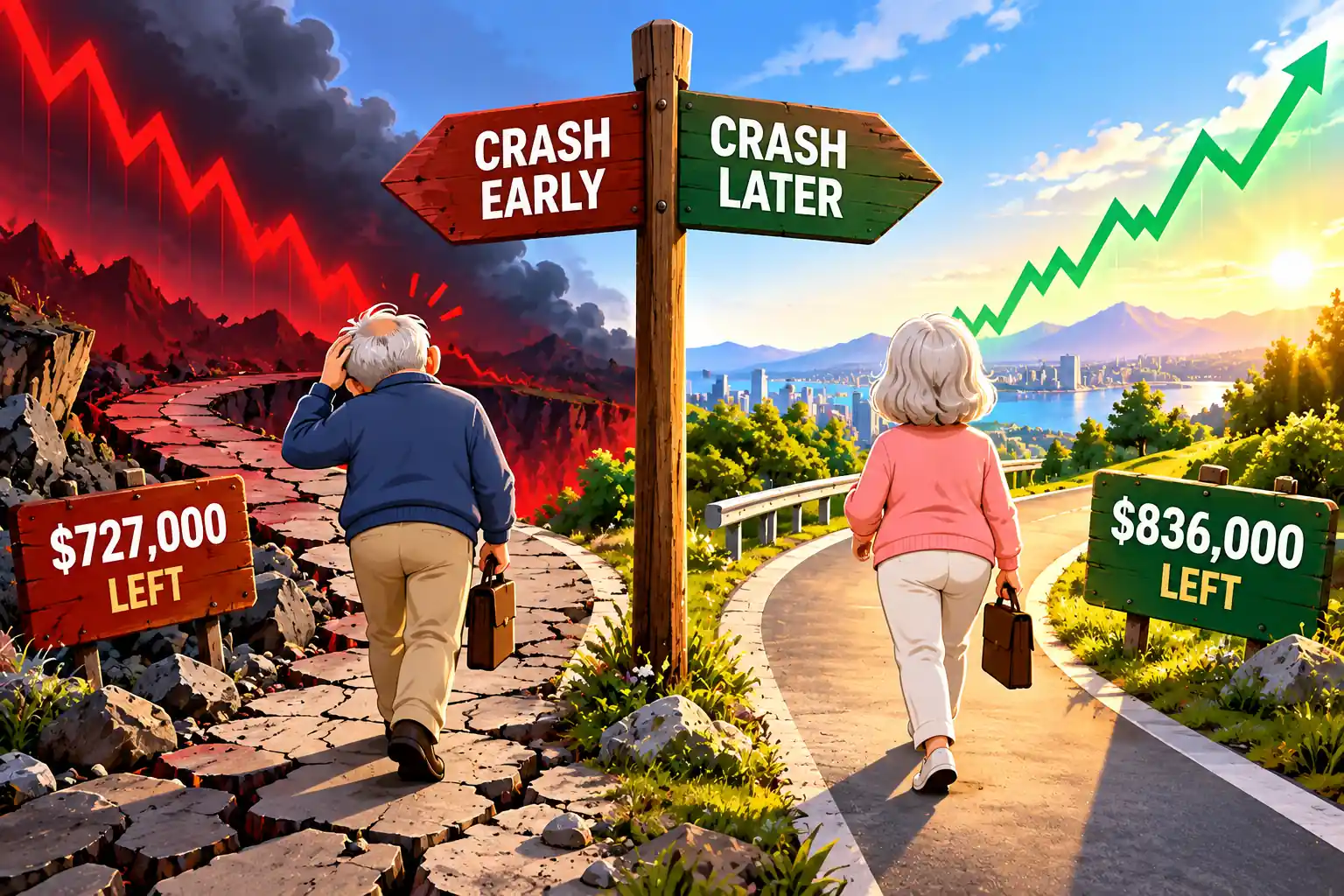
But after five years, the first retiree has approximately $726,625.
The second has approximately $836,010.
That's a $109,385 difference created simply by changing the order of the returns.
This is a simplified hypothetical example that ignores taxes, investment fees and inflation.
Why Does the Early Crash Hurt So Much?
Imagine your $1 million portfolio falls 20% during your first year of retirement.
It is now worth $800,000.
You still need money to live, so you withdraw $50,000. Your portfolio is now down to $750,000.
Then the market begins recovering.
But you're no longer recovering with $1 million invested. You're recovering with $750,000.
Some investments were sold to fund your retirement expenses, and that money is no longer invested to participate in a future rebound.
Reverse the situation and something very different happens.
If strong market years arrive early, your portfolio has an opportunity to grow before withdrawals and future losses take their toll.
That's why a major decline shortly after retirement can be much more damaging than the same decline arriving years later.
Before Retirement, the Math Is Different
Here's where this gets particularly interesting.
Suppose you invest $1 million and don't touch it for five years.
There are no withdrawals.
If you receive the same five investment returns, rearranging their order doesn't change your ending balance.
But start removing $50,000 every year and suddenly the order matters.
Retirement changes the equation because your portfolio now has two jobs at once: generate returns while also paying for your life.
You Don't Need a Giant Market Crash
Sequence risk isn't limited to a historic financial crisis.
Several weak years near the beginning of retirement can also create problems, particularly when you're continuously withdrawing money.
Consider the same $50,000 annual withdrawal.
From a $1 million portfolio, it represents 5%.
If the portfolio falls to $700,000, $50,000 represents about 7.1%.
At $500,000, it represents 10%.
Your spending hasn't changed, but the burden on your remaining investments has become much larger.
That's what makes the combination of falling markets and retirement withdrawals potentially so damaging.
TwikUp Analysis: The Real Risk Isn't Just Losing 20%
The numbers above reveal something that's easy to miss.
The biggest problem isn't simply that the first retiree suffered a 20% market decline. Both retirees eventually experienced that exact same 20% decline.
The difference is what happened to their money before it arrived.
When losses occur early, withdrawals begin removing money from an already smaller portfolio. That leaves less capital available for every recovery that follows.
Our hypothetical example makes the effect surprisingly large.
Both retirees withdraw exactly $250,000 over five years and experience exactly the same five market returns. Yet simply reversing those returns creates a $109,385 gap between their portfolios.
And the size of the withdrawal matters too.
Using the same hypothetical five-year return sequences, but increasing annual withdrawals from $50,000 to $70,000, the early-crash retiree would finish with approximately $611,107, compared with about $764,246 for the retiree who experienced the stronger returns first.
The gap grows to roughly $153,139.
That illustrates an important point: sequence risk isn't only about the market. It is also about how much money has to leave the portfolio while markets are struggling.
For someone approaching retirement, that changes the question.
Instead of planning only around an expected average return, it can be useful to stress-test what happens when several disappointing years arrive first — while withdrawals continue as planned.
That scenario may tell you more about the resilience of a retirement plan than a perfectly smooth average-return projection.
TwikUp calculations are simplified illustrations and do not account for taxes, fees, inflation or individual investment circumstances.
Does This Mean Retirees Should Avoid Stocks?
Not necessarily.
Avoiding market risk entirely creates another challenge. Retirement can potentially last decades, while inflation gradually reduces what each dollar can buy.
The objective isn't necessarily to eliminate investment risk. It's to avoid building a retirement plan that assumes markets will conveniently deliver the same smooth return every year.
Depending on someone's circumstances, that could mean maintaining a diversified portfolio, keeping some money in lower-volatility or liquid assets, using a sustainable withdrawal strategy or having flexibility to reduce discretionary spending during particularly bad market periods.
The appropriate approach depends on factors including retirement income, portfolio size, spending needs, taxes, investment mix and time horizon.
Why an Average Return Can Hide the Real Risk
A retirement projection built around a steady 5%, 6% or 7% annual return can look reassuring.
But real markets don't deliver returns in a neat, predictable order.
You might earn 15% one year and lose 20% another. The long-term average may eventually look reasonable, but that doesn't mean the journey was harmless for someone withdrawing money along the way.
That's why someone approaching retirement shouldn't only ask:
"What average return could my investments earn?"
There's another question worth testing:
"What happens if some of my worst investment years arrive immediately after I retire?"
Two retirees can start with the same $1 million, withdraw the same $50,000 every year and experience exactly the same investment returns — yet finish with dramatically different amounts of money.
Sometimes it's not just how much your investments return that matters.
It's when those returns arrive.