
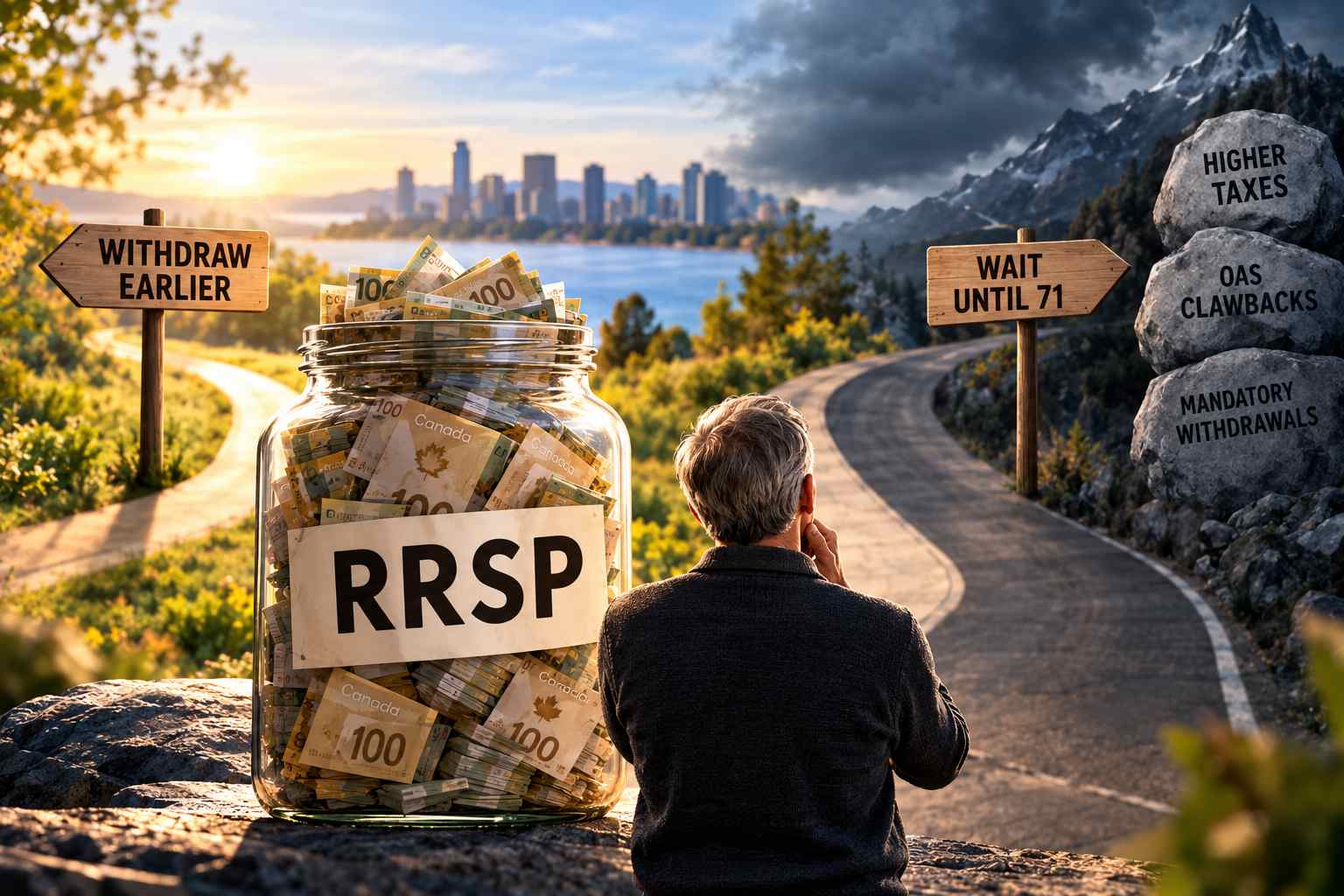
Meet David and His $900,000 RRSP
Imagine David retires at 60 with $900,000 in his RRSP.
His mortgage is paid off, he has some TFSA savings, and he doesn't need much taxable income during the first several years of retirement.
David has two broad choices.
He could leave the $900,000 invested inside his RRSP and withdraw very little.
Or he could deliberately withdraw, say, $30,000 or $40,000 annually during years when his other taxable income is relatively low.
The second option sounds painful because RRSP withdrawals are taxable income.
But consider what could happen if David chooses the first option.
His $900,000 doesn't necessarily stay at $900,000.
If it hypothetically earns an average 5% annually with no withdrawals, it would grow to roughly $1.54 million after 11 years.
David has done exactly what decades of retirement advice told him to do.
And that success may now be creating a surprisingly expensive tax-planning problem.
Age 71 Changes the Game
An RRSP cannot remain an RRSP forever.
By the end of the calendar year in which David turns 71, his RRSP must mature. One common option is converting it into a Registered Retirement Income Fund, or RRIF.
A RRIF requires minimum withdrawals beginning in the year after it is established. The minimum is based on the account's value and an age-related factor.
And now the retirement-income traffic jam can begin.
RRIF income arrives.
CPP may already be coming in.
OAS may be coming in too.
Perhaps David also has an employer pension or taxable investment income.
None of those things is inherently bad.
The problem is that, for tax purposes, several taxable income streams can start arriving at the same time.
David didn't necessarily avoid taxable retirement income during his 60s.
He postponed it — and potentially concentrated more of it into his 70s.
Then There's the OAS Problem
Old Age Security adds another wrinkle.
OAS is income-tested. When a person's net world income exceeds the applicable threshold, the OAS recovery tax begins reducing their benefit.
For the 2026 income year, the recovery-tax threshold is $95,323.
The federal government currently estimates that full OAS recovery occurs at net world income of approximately $155,109 for people aged 65–74 and $161,088 for people 75 and older.
Those upper amounts are estimates and can change.
This creates an unusual situation.
David might have plenty of retirement savings but relatively little taxable income at 61.
Years later, RRIF withdrawals combined with CPP, OAS, pensions and other taxable income could push his income much higher.
An RRSP meltdown strategy attempts to smooth that mountain into a hill.
What If David Started Earlier?
Suppose David begins taking controlled RRSP withdrawals during his 60s.
There is no magic withdrawal amount.
It isn't automatically $30,000, $40,000 or any other number. The appropriate amount depends on his other income, province, deductions and credits, spouse's circumstances, CPP and OAS timing, pensions and longer-term plans.
But the basic concept is straightforward.
David intentionally recognizes some taxable RRSP income during years when his overall taxable income is relatively low.
He could spend the after-tax money.
Or, if he has available TFSA contribution room, he could potentially contribute some of the after-tax proceeds to his TFSA.
Now something interesting has happened.
Money that was sitting in a tax-deferred account has gradually been moved into a tax-free account, although David had to recognize taxable income when withdrawing it from the RRSP.
Future qualifying TFSA withdrawals are generally tax-free. And if David later withdraws money from his TFSA, that amount is added back to his TFSA contribution room at the beginning of the following calendar year.
He's not necessarily blowing through his retirement savings.
He's changing where some of those savings live.
But Don't Start Draining Your RRSP Tomorrow
This is where the strategy needs a giant asterisk.
An RRSP meltdown is not automatically better.
Someone still earning a large salary could create a much bigger current tax bill by withdrawing RRSP money early.
Ordinary RRSP withdrawals also permanently remove that money from the RRSP. Unlike TFSA withdrawals, the amount withdrawn does not automatically create new RRSP contribution room.
And withdrawing earlier means some money loses the benefit of continued tax-deferred compounding inside the RRSP.
There are plenty of other complications too.
CPP timing, OAS timing, pensions, investment returns, provincial tax brackets, spousal RRSP rules, pension-income splitting, available credits, longevity and estate planning can all change the calculation.
Even withholding tax can confuse people.
For ordinary RRSP lump-sum withdrawals outside Quebec, financial institutions generally withhold:
- 10% on withdrawals up to $5,000
- 20% on amounts above $5,000 through $15,000
- 30% on amounts above $15,000
But here's the important part:
That's withholding tax — not necessarily your final tax bill.
The withdrawal is generally included in taxable income, and the actual amount of tax ultimately payable is determined through your income-tax return.
The Bigger Lesson
The goal of retirement planning isn't necessarily to pay the least possible tax this year.
It's worth thinking about taxes across your entire retirement.
For some Canadians, leaving their RRSP invested for as long as possible may work very well.
For others, deliberately recognizing some RRSP income during lower-income retirement years could reduce the size of future RRIF balances, smooth taxable income across retirement and potentially reduce exposure to the OAS recovery tax.
That's what makes the strategy so counterintuitive.
You spend decades being told:
Don't touch the RRSP.
Then retirement arrives, and for some people the smarter question becomes:
Should I actually start taking some of it out before I'm forced to?
Sometimes, withdrawing money before you need it can be part of a broader strategy to manage how much tax you pay later.
This article is for general educational purposes only and isn't individualized tax, financial or investment advice. RRSP and RRIF withdrawal strategies should be evaluated based on expected income, province of residence, government benefits and individual tax circumstances.