
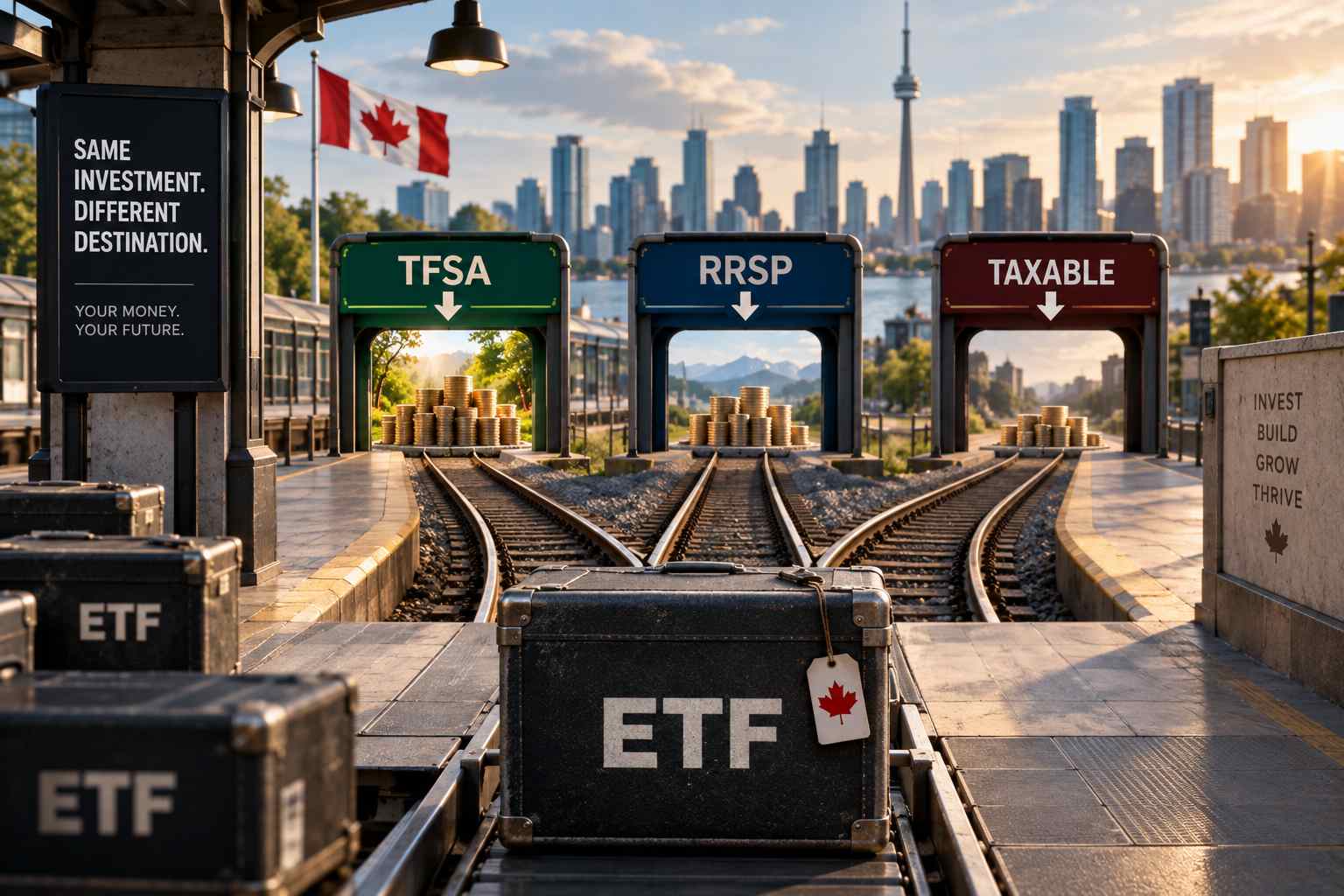
Two Canadians can buy essentially the same investment, earn the same market return — and still end up with different amounts of money.
The reason isn't necessarily better stock picking.
It could simply be where they parked the investment.
Welcome to asset location, one of the less exciting-sounding — but surprisingly important — parts of investing in Canada.
Same ETF, Different Destination
Imagine you have $20,000 to invest in an ETF holding U.S. dividend-paying companies.
Now imagine three versions of you.
Investor A holds it in a TFSA.
Investor B holds it in an RRSP.
Investor C holds it in a regular taxable investment account.
The underlying companies haven't magically changed. But the taxes surrounding the investment can.
That means looking only at an ETF's advertised return doesn't necessarily tell you what ultimately stays in your pocket.
Example #1: The TFSA
The TFSA is Canada's wonderfully named account that mostly does what the name says.
Generally, investment income and capital gains earned inside a TFSA aren't taxed by Canada, and withdrawals are tax-free.
Suppose your $20,000 investment grows to $30,000.
You withdraw the $30,000.
Generally, there is no Canadian tax on that $10,000 gain.
Beautiful.
But there's an international wrinkle.
Foreign withholding taxes can still apply to income from foreign investments. For example, dividends from U.S. stocks can be subject to U.S. withholding tax even when the investment is held inside a TFSA.
And unlike in a taxable account, foreign tax paid on investments inside a TFSA generally can't be used to claim Canada's foreign tax credit.
So "tax-free" doesn't necessarily mean every foreign government has agreed to leave your investment alone.
Example #2: The RRSP
The RRSP plays a different game.
Eligible contributions can reduce taxable income. Investments can compound without annual Canadian tax while they remain inside the plan, but withdrawals are generally taxable income.
Imagine again that $20,000 becomes $30,000.
You don't normally report that $10,000 of growth as taxable income while it accumulates inside the RRSP.
Instead, tax generally arrives when money comes out.
Think of the RRSP less like "tax-free forever" and more like:
CRA: "Enjoy your retirement savings. We'll talk later."
But here's where things get interesting for U.S. investments.
Under the Canada-U.S. tax treaty, certain Canadian retirement arrangements receive special treatment. For example, U.S.-listed ETFs or U.S. stocks held directly inside an RRSP can generally avoid the U.S. withholding tax normally applied to dividends.
But there's an important catch.
If you own a Canadian-listed ETF that itself owns U.S. stocks, putting that ETF inside your RRSP doesn't necessarily eliminate the U.S. withholding tax paid at the fund level.
Same exposure.
Different ETF structure.
Potentially different tax result.
This is where ETF investing suddenly develops paperwork.
Example #3: The Taxable Account
Now put investments in an ordinary non-registered account.
There's no TFSA tax shelter and no RRSP tax deferral.
Investment distributions can create taxable income, while selling an investment for more than its adjusted cost base can create a capital gain.
But taxable accounts aren't automatically the villain.
Eligible Canadian dividends can benefit from the dividend tax credit. Foreign taxes withheld on foreign investment income may also potentially qualify for a foreign tax credit, subject to Canadian tax rules.
Different types of investment income can therefore receive different tax treatment.
That's why simply stuffing every investment into whichever account happens to have room isn't necessarily optimal.
Now Imagine a $100,000 Portfolio
Suppose someone owns:
$40,000 in Canadian equities
$30,000 in U.S. equities
$30,000 in bonds or other interest-producing investments
They also have TFSA, RRSP and taxable-account space.
The advanced question isn't simply:
"Which ETF should I buy?"
It becomes:
"Which investment should live in which account?"
An investor may need to consider taxes on interest, dividends and capital gains; foreign withholding taxes; expected returns; RRSP deductions and future withdrawal taxes; ETF structure; and when the money will eventually be needed.
Suddenly portfolio construction starts looking less like shopping for ETFs and more like assigning seats at a wedding.
Everybody can attend.
You just don't necessarily want everybody sitting at the same table.
There's no universal seating chart, either. The ideal asset location can depend on your income, tax bracket, expected returns, time horizon, available contribution room, ETF structure and future withdrawal plans.
The Bigger Lesson
Diversification determines what you own.
Asset allocation determines how much you own.
Asset location determines where you own it.
Canadian investors can spend enormous amounts of time debating whether an ETF charging 0.20% is better than another charging 0.25%.
Meanwhile, taxes and account location can sometimes matter more than the tiny management-fee difference they're fighting over.
The best-performing ETF on your screen isn't necessarily the investment producing the best after-tax result for you.
Because at the end of the day, your portfolio's headline return isn't what buys groceries, pays the mortgage or funds retirement.
After-tax money does.
This article is for general educational purposes and isn't individualized tax or investment advice.