
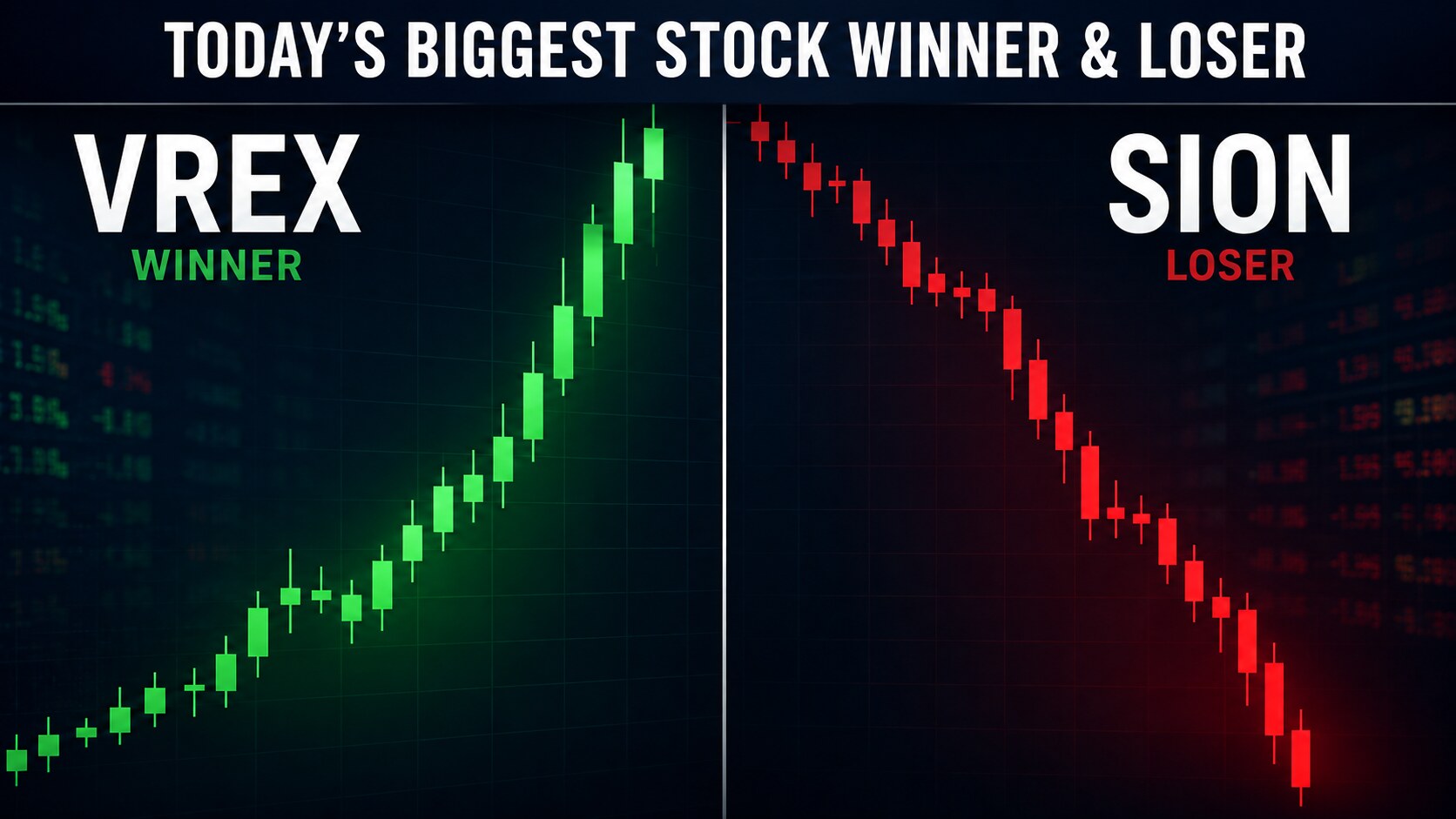
Takeover agreements sent Varex Imaging and MarineMax sharply higher, while disappointing clinical-trial results erased more than 90% of Sionna Therapeutics’ market value.
Several stocks made extraordinary moves Monday, even as the broader U.S. market remained relatively quiet. Varex Imaging and MarineMax surged following all-cash takeover agreements, while Sionna Therapeutics collapsed after an experimental cystic-fibrosis treatment failed to achieve a key clinical objective. Intel also declined after announcing a proposed $15-billion common-stock offering.
Here is what drove some of today’s biggest stock winners and losers.
Varex Imaging jumps 48% on Teledyne takeover
Varex Imaging Corporation (NASDAQ: VREX) climbed approximately 48% after Teledyne Technologies agreed to acquire the company.
Under the definitive agreement, Teledyne will pay $18.90 per Varex share in cash. The transaction has an aggregate value of approximately $1.1 billion, including Varex’s debt and outstanding equity awards.
Varex shares moved close to the proposed purchase price following the announcement.
Varex manufactures X-ray tubes, digital detectors and other imaging components used in medical and industrial equipment. The acquisition would expand Teledyne’s presence in specialized imaging technology, including medical, dental and industrial X-ray applications.
The stock’s gain was slightly smaller than the premium offered because investors generally account for the time required to complete a takeover and the possibility—however small—that regulatory, shareholder or other closing conditions could prevent it from being completed.
Varex also reported its fiscal third-quarter results. Because of the pending acquisition, the company cancelled its scheduled earnings call and withdrew its previously issued financial guidance.
MarineMax surges nearly 46% after $1.5-billion deal
MarineMax (NYSE: HZO) jumped approximately 46% after agreeing to be acquired by Safe Harbor Marinas, a portfolio company of Blackstone Infrastructure.
Safe Harbor will pay $53 per share in cash, giving the transaction an enterprise value of approximately $1.5 billion.
The offer represents a 96% premium to MarineMax’s closing price of $27.03 on January 30, 2026—the final trading day before the public disclosure of an unsolicited proposal to acquire the company. It also represents a 110% premium to MarineMax’s 90-day volume-weighted average price through that date.
MarineMax sells recreational boats and yachts and provides marina, financing, brokerage and superyacht services. Combining it with Safe Harbor would create a broader marine-services business encompassing boat retailing, marinas and superyacht services.
MarineMax’s board unanimously approved the agreement. The companies expect the transaction to close by the end of 2026, subject to shareholder approval, regulatory clearances and other customary closing conditions. The deal is not subject to a financing condition.
MarineMax traded near $51.98 during late-morning trading—below the $53 offer price—reflecting the remaining time and execution risk before the acquisition closes.
Sionna Therapeutics crashes more than 90%
The day’s most dramatic decline belonged to Sionna Therapeutics (NASDAQ: SION), which fell approximately 92% after releasing clinical results from two cystic-fibrosis development programs.
The principal disappointment came from the Phase 2a trial of SION-719. The treatment did not meet its key activity endpoint of reducing sweat chloride when added to Trikafta, an existing standard-of-care treatment.
The trial produced a mean placebo-adjusted sweat-chloride change of negative 1.0 mmol/L, with a p-value of 0.7. Sweat chloride is an important measurement of CFTR protein function in people with cystic fibrosis.
Sionna said potential confounding factors included greater-than-anticipated variability in individual sweat-chloride levels and differences in Trikafta exposure between the SION-719 and placebo treatment periods.
The company will not advance SION-719 as an add-on to the current standard of care. It is continuing to analyze the trial results to determine whether the findings support another development path.
Separately, a Phase 1 trial involving SION-451 in combination with either SION-2222 or SION-109 achieved its safety, tolerability and pharmacokinetic objectives. Sionna identified SION-451 combined with SION-2222 as its preferred dual combination but said it is still evaluating the program’s next steps.
The collapse illustrates the “binary” risk associated with clinical-stage biotechnology stocks. These companies may have little or no product revenue, leaving much of their valuation dependent on a small number of experimental treatments. Positive trial results can create enormous gains, while disappointing data can eliminate most of a company’s value in a single session.
Sionna ended the second quarter with approximately $268.3 million in cash, cash equivalents and marketable securities. The company said it plans to preserve capital while determining its next steps. Sionna’s clinical update
Intel falls after proposed $15-billion stock offering
Intel (NASDAQ: INTC) declined approximately 3.5% after announcing a proposed $15-billion underwritten public offering of common stock.
The chipmaker expects to give the underwriters a 30-day option to purchase as much as $2.25 billion of additional stock at the public offering price, less underwriting discounts.
Intel intends to use the net proceeds for general corporate purposes, potentially including capital expenditures and working capital. The company said the offering would help it pursue emerging opportunities while maintaining a strong balance sheet and its commitment to an investment-grade credit rating.
Selling stock can strengthen a company’s balance sheet and provide money for expansion. However, it also increases the number of outstanding shares, reducing—or diluting—the percentage ownership represented by each existing share. That expected dilution pressured Intel’s stock.
The offering is especially significant because building advanced semiconductor factories requires enormous capital investment. Intel is working to strengthen its manufacturing operations while competing with Taiwan Semiconductor Manufacturing Company and pursuing demand generated by artificial intelligence, advanced packaging and specialized chips. Intel’s stock-offering announcement
The broader market remains calm
These dramatic company-level moves occurred against a subdued market backdrop. During late-morning trading, the S&P 500 was approximately flat, while the Nasdaq Composite and Dow Jones Industrial Average posted modest declines.
Higher oil prices and uncertainty surrounding global crude supplies remained important market concerns. Investors were also awaiting new U.S. inflation data that could influence expectations for the Federal Reserve’s next interest-rate decision.
The contrast was striking: the broader indexes showed limited movement, while takeover offers, clinical results and financing decisions caused individual stocks to gain or lose nearly half—or almost all—of their market value.
The bottom line
Monday’s largest company-level moves came from very different catalysts.
Varex Imaging and MarineMax rose because buyers offered shareholders substantial cash premiums. Their stocks now largely reflect the proposed acquisition prices and investors’ assessment of whether the transactions will close successfully.
Sionna Therapeutics moved in the opposite direction because disappointing Phase 2a data undermined a major part of the investment thesis supporting its valuation. Although the company retains other candidates and approximately $268.3 million in financial resources, investors sharply reduced the value assigned to its development pipeline.
Intel’s decline was less severe but reflected a familiar shareholder concern: dilution from a large proposed stock offering.
The session provides a clear reminder that the biggest daily moves often occur when new information forces investors to reassess a company’s value immediately.
Stock prices and percentage changes are intraday figures recorded at approximately 11:44 a.m. ET on August 10, 2026, and may change before the market closes. This article is for informational purposes only and does not constitute investment advice.