
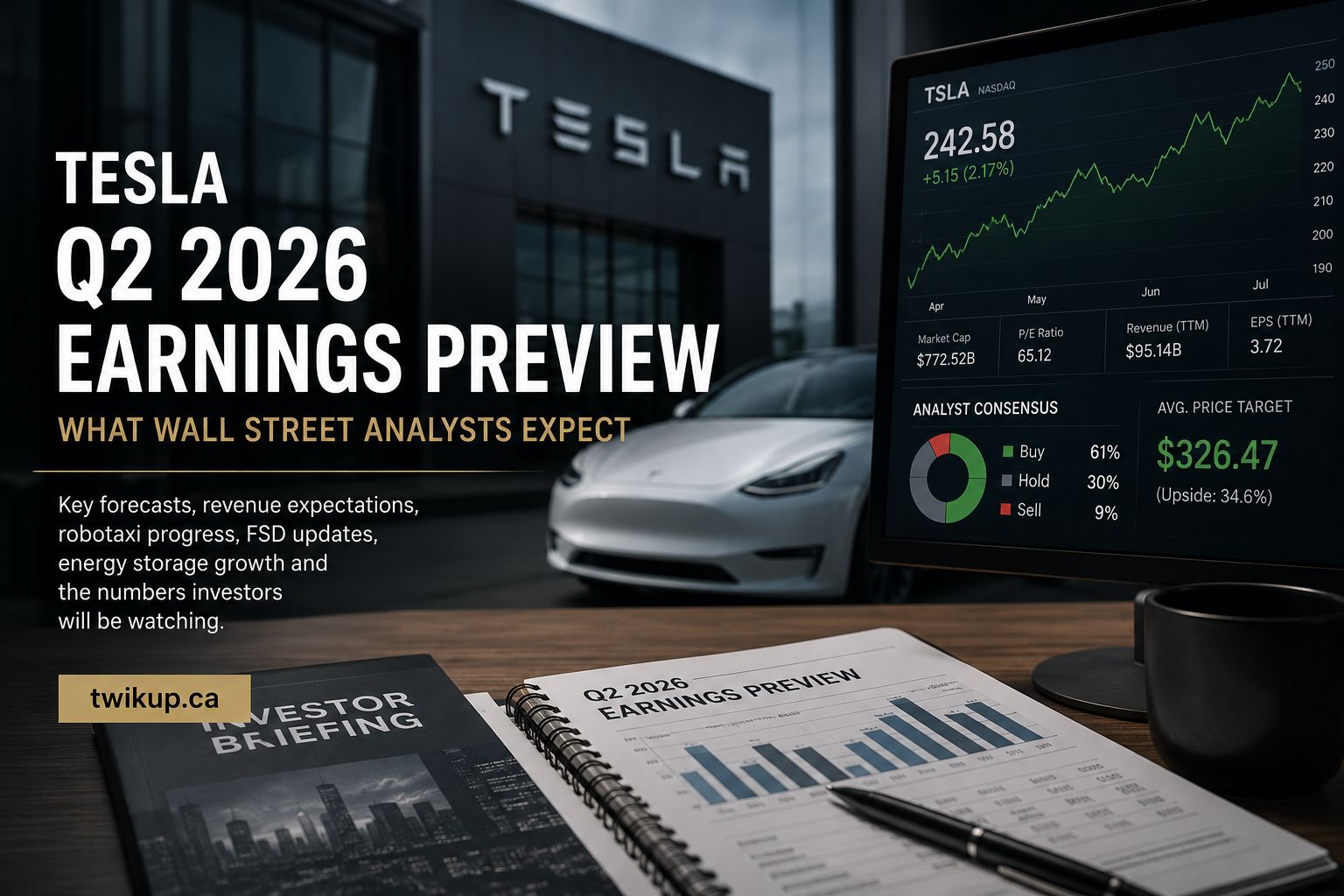
Editorial note: This article was prepared before Tesla released its second-quarter 2026 financial results. Analyst estimates, ratings and price targets can change at any time. Figures below should be read as expectations—not confirmed financial results.
Quick Answer
Wall Street enters Tesla’s second-quarter 2026 earnings report with a mixed but unusually complex set of expectations.
Tesla has already reported 480,126 vehicle deliveries, substantially above the company-compiled analyst consensus of 406,024 deliveries published before the delivery announcement. The company also reported producing 451,758 vehicles and deploying 13.5 GWh of energy-storage products during the quarter. However, Tesla itself cautioned that deliveries and storage deployments are only two measures of performance and should not be treated as reliable predictors of quarterly earnings.
For the full financial report, Tesla’s company-compiled sell-side consensus currently points to approximately:
| Q2 2026 metric | Analyst average |
|---|---|
| Total revenue | $27.58 billion |
| Automotive revenue | $20.05 billion |
| Energy generation and storage revenue | $3.77 billion |
| Services and other revenue | $3.76 billion |
| Gross profit | $5.38 billion |
| Gross margin | 19.5% |
| Operating income | $1.50 billion |
| Operating margin | 5.4% |
| GAAP net income attributable to common shareholders | $1.28 billion |
| GAAP earnings per share | $0.36 |
| Non-GAAP earnings per share | $0.55 |
| Operating cash flow | $3.45 billion |
| Capital expenditures | $6.70 billion |
| Free cash flow | negative $3.25 billion |
These figures are company-compiled estimates from sell-side analysts. They are not Tesla guidance, and Tesla states that it does not endorse the analysts’ information, recommendations or conclusions.
The central question is therefore not simply whether Tesla delivered more vehicles. It is whether those deliveries translated into durable revenue, healthier margins and sufficient cash generation while the company increased spending on artificial intelligence, autonomous vehicles, battery manufacturing and robotics.
TwikUp Insight
Tesla’s earnings report is becoming harder to evaluate through the traditional lens used for an automobile manufacturer.
A conventional automaker is usually judged primarily on vehicle volume, pricing, incentives, production costs, inventory and operating margins. Tesla must still answer all of those questions. But its market narrative increasingly includes several businesses that are either early-stage, capital-intensive or not yet operating at mature commercial scale:
- Full Self-Driving software
- Robotaxi operations
- The purpose-built Cybercab
- Artificial-intelligence infrastructure
- Optimus humanoid robots
- Battery storage and energy services
That creates a valuation tension.
The automotive business generates most of Tesla’s current revenue, while a meaningful part of the market’s long-term enthusiasm appears connected to businesses whose future economics remain uncertain. Reuters reported that investors continue to focus heavily on Tesla’s AI, robotaxi and autonomous-driving ambitions, even after the company posted substantially stronger-than-expected vehicle deliveries.
This is why one quarter can produce two very different interpretations.
One reader may see rising deliveries and conclude that Tesla’s core vehicle business is regaining momentum. Another may focus on operating margin, free cash flow and capital expenditures and ask whether growth is becoming more expensive.
Both interpretations can be reasonable. The financial statements will show which argument received more support during the quarter.
When Will Tesla Report Q2 2026 Earnings?
Tesla is scheduled to publish its second-quarter 2026 financial results after the U.S. market closes on Wednesday, July 22, 2026.
Management is scheduled to hold its earnings webcast and question-and-answer session at:
- 4:30 p.m. Central Time
- 5:30 p.m. Eastern Time
Tesla says a replay should become available approximately two hours after the question-and-answer session concludes.
For investors in Canada, the webcast begins at 5:30 p.m. Eastern Time in Ontario and Quebec.
The Story Before Earnings: Deliveries Were Stronger Than Expected
Before discussing revenue or earnings per share, it is important to understand what Tesla has already disclosed.
Tesla reported the following second-quarter operating results:
| Q2 2026 operating metric | Tesla-reported result |
|---|---|
| Model 3/Y production | 442,936 |
| Other-model production | 8,822 |
| Total vehicle production | 451,758 |
| Model 3/Y deliveries | 467,762 |
| Other-model deliveries | 12,364 |
| Total vehicle deliveries | 480,126 |
| Energy-storage deployments | 13.5 GWh |
Tesla delivered approximately 28,368 more vehicles than it produced during the quarter. That suggests the company reduced some existing inventory rather than relying only on newly manufactured vehicles to support deliveries.
The result was far ahead of expectations.
Tesla’s June 26 company-compiled delivery consensus, based on estimates from 22 sell-side analysts, called for:
- 392,625 Model 3/Y deliveries
- 12,978 other-model deliveries
- 406,024 total deliveries
- 13.8 GWh of energy-storage deployments
Actual vehicle deliveries exceeded that total consensus estimate by more than 74,000 vehicles, although energy-storage deployment came in slightly below the earlier 13.8 GWh consensus.
Reuters also reported a Visible Alpha average estimate of 402,776 vehicles, meaning Tesla’s reported result exceeded multiple widely followed consensus measures.
Why strong deliveries do not automatically guarantee strong earnings
Higher delivery volume can support revenue, but it does not reveal several critical variables:
- The average selling price of each vehicle
- The size and cost of customer incentives
- The mix of higher- and lower-margin models
- Leasing activity
- Regulatory-credit revenue
- Warranty and recall costs
- Manufacturing efficiency
- Foreign-exchange effects
- Inventory-related expenses
- Research-and-development spending
Tesla explicitly warned that delivery and storage figures should not be used alone as an indicator of quarterly financial performance. The company said net income and cash flow also depend on average selling prices, cost of sales, foreign-exchange movements and other factors that will be disclosed with the full results.
That warning is especially important this quarter. A delivery beat can coexist with weaker profitability when volume is supported by lower pricing, subsidized financing, discounts or an unfavourable product mix.
Wall Street’s Q2 2026 Tesla Earnings Expectations
Tesla published its latest company-compiled earnings consensus on July 17, 2026. It includes estimates from 23 sell-side firms for most income-statement measures and 20 to 22 firms for several cash-flow and balance-sheet measures.
Revenue expectations
Analysts expect Tesla to generate an average of $27.58 billion in total revenue, with a median estimate of $27.97 billion.
The expected revenue mix is:
| Revenue category | Q2 2026 average estimate |
|---|---|
| Automotive | $20.05 billion |
| Energy generation and storage | $3.77 billion |
| Services and other | $3.76 billion |
| Total revenue | $27.58 billion |
The automotive operation is still expected to account for nearly three-quarters of quarterly revenue. That makes vehicle pricing and profitability central to the report, even as Tesla’s AI and robotics ambitions receive substantial attention.
Gross-profit and margin expectations
The sell-side average points to:
- $5.38 billion in gross profit
- 19.5% gross margin
- $1.50 billion in operating income
- 5.4% operating margin
The operating margin may be more informative than revenue alone.
A company can grow revenue while producing less operating profit if research spending, manufacturing expansion, employee compensation and other operating costs increase faster than gross profit. Tesla’s consensus operating-expense estimate is approximately $3.87 billion for the quarter.
Earnings-per-share expectations
Tesla’s company-compiled consensus separates earnings into two measures:
| Earnings measure | Q2 2026 average estimate |
|---|---|
| GAAP EPS | $0.36 |
| Non-GAAP EPS | $0.55 |
GAAP earnings follow standardized accounting rules. Tesla’s non-GAAP calculation adjusts for selected items, including stock-based compensation and certain digital-asset effects.
Readers should avoid comparing a reported non-GAAP result with a GAAP estimate—or vice versa. Earnings headlines sometimes appear contradictory because different publications use different definitions.
Cash-flow expectations
Wall Street’s average estimate suggests Tesla may report:
- $3.45 billion of operating cash flow
- Approximately $6.70 billion of capital expenditures
- Approximately negative $3.25 billion of free cash flow
This may become one of the most closely examined parts of the report.
Negative free cash flow is not automatically evidence that a company is deteriorating. It can also occur when a company makes unusually large investments intended to increase future capacity. However, the quality, timing and expected return of those investments matter.
Reuters reported that Tesla expects to spend more than $25 billion on capital expenditures during 2026, nearly three times the prior-year amount, as it expands AI infrastructure, battery production, Cybercab manufacturing and Optimus development.
The earnings call may therefore need to explain not only how much Tesla is spending, but what shareholders should expect that spending to produce.
What Major Analysts Are Saying Before Tesla Earnings
Wall Street is not presenting a single unified view.
Recent analyst actions show a wide range of conclusions, even when analysts are examining the same delivery data and long-term opportunities.
Morgan Stanley: higher target, continued caution
Morgan Stanley was among the firms reported to have raised its Tesla price target following the company’s stronger second-quarter delivery report. However, it maintained a Hold-equivalent rating rather than shifting to a more bullish recommendation.
That distinction matters.
A higher price target does not necessarily mean an analyst believes a stock is attractively priced. It may simply mean that the analyst has increased estimates for revenue, deliveries, future cash flow or the probability assigned to emerging businesses.
Barclays: improved target without a rating upgrade
Barclays also reportedly raised its price target while maintaining a Hold-equivalent view. That positioning suggests recognition of improving operating data without full conviction that the financial outlook or valuation has become sufficiently attractive to justify a more positive recommendation.
Wells Fargo: higher target, Sell rating retained
Wells Fargo reportedly raised its target from $125 to $130 but retained its Sell rating. This illustrates how wide the Tesla debate remains.
An analyst can acknowledge stronger deliveries and still question whether current market expectations adequately reflect execution risks, future spending requirements, competition or the time required to commercialize autonomous-driving and robotics businesses.
Broader analyst consensus remains divided
LSEG data cited by IG showed the following analyst distribution as of July 15, 2026:
| Analyst rating | Number of analysts |
|---|---|
| Strong Buy | 7 |
| Buy | 17 |
| Hold | 24 |
| Sell | 6 |
| Strong Sell | 1 |
The mean 12-month analyst price target was approximately $397.89 at that time.
This distribution is more informative than a single average rating.
It indicates that the largest group of analysts remained in the Hold category, while meaningful groups continued to hold both bullish and bearish opinions. Tesla is therefore not a case in which Wall Street broadly agrees on the company’s likely outcome.
Morningstar: Europe may be an important part of the recovery
Morningstar senior equity analyst Seth Goldstein told Reuters that Europe appeared to be a major driver of Tesla’s recent growth, while U.S. sales remained weaker and China showed smaller growth.
That observation creates an important question for the earnings call: was the European improvement broad and sustainable, or was it influenced by temporary conditions such as incentives, fuel prices, fleet demand or pent-up purchases?
The Most Important Number May Be Automotive Margin
Tesla’s delivery result has already reset expectations for vehicle volume. The remaining question is what Tesla earned on those vehicles.
Automotive profitability is affected by:
- Selling prices
- Financing offers
- Discounts
- Product mix
- Factory utilization
- Battery costs
- Raw-material costs
- Logistics
- Warranty expenses
- Regulatory credits
- Foreign-exchange movements
A high-volume quarter supported by extensive incentives can look impressive in delivery statistics but less impressive in the income statement.
Conversely, stronger factory utilization and lower unit costs can allow higher volume to support profit even if selling prices remain competitive.
What to examine
When Tesla reports, readers should compare:
- Total automotive revenue
- Automotive gross profit
- Automotive gross margin
- Regulatory-credit revenue
- Average revenue per delivered vehicle
- Management’s explanation of incentives and pricing
- Cost per vehicle and factory utilization
Tesla’s overall gross-margin consensus is 19.5%, but the company-compiled table does not provide a separate consensus estimate for automotive gross margin excluding regulatory credits.
That means investors may need to calculate or source additional segment-level figures after the shareholder update is published.
Robotaxi: From Narrative to Operating Evidence
Tesla’s robotaxi effort is likely to receive significant attention during the call.
Reuters reported that Tesla expanded its robotaxi operations after launching a limited commercial service in Austin in June. It also reported that Musk has discussed rapid expansion through 2026 and that Cybercab production is expected to increase later in the year.
The market may now seek evidence beyond launch announcements.
Questions analysts may ask
- How many vehicles are currently operating in the service?
- How many rides have been completed?
- What is the geographic operating area?
- Are safety monitors or remote operators required?
- What is the intervention rate?
- What is the cost per paid mile?
- How quickly can Tesla obtain approval in additional jurisdictions?
- Will expansion rely on existing Tesla models, Cybercab or both?
- When could robotaxi operations materially affect revenue?
- What capital expenditures will be required?
These are operating questions rather than promotional ones.
A robotaxi business cannot be evaluated only by whether a service technically exists. Its long-term economics depend on utilization, insurance, maintenance, cleaning, charging, customer acquisition, regulatory approval and the amount of human oversight required.
Tesla does not need to answer every question in one quarter. But additional measurable disclosure would allow investors to assess progress more precisely.
Full Self-Driving: Adoption, Regulation and Monetization
Full Self-Driving remains connected to both Tesla’s vehicle demand and its autonomous-services strategy.
Reuters reported that Tesla has continued expanding its FSD driver-assistance software in parts of Europe, with broader availability expected by analysts over the coming months.
The earnings call may clarify:
- FSD subscription adoption
- One-time purchase trends
- International regulatory progress
- Deferred-revenue recognition
- Miles driven using supervised FSD
- Safety data
- Hardware requirements
- The relationship between FSD and robotaxi operations
Investors should distinguish between:
- Driver-assistance software used under human supervision
- A commercially deployed driverless service
- A future autonomous network operating at large scale
These represent different technical, regulatory and economic stages.
Optimus: What Would Count as Meaningful Progress?
Optimus is one of Tesla’s most ambitious projects, but it remains difficult to value using conventional financial analysis.
Analysts may be looking for practical evidence such as:
- Number of robots produced
- Number deployed inside Tesla facilities
- Tasks performed
- Hours of productive operation
- Human intervention requirements
- Unit production cost
- Manufacturing timeline
- External customer testing
- Revenue timing
The key distinction is between a successful demonstration and a repeatable commercial product.
A demonstration can prove that a robot is capable of performing a task. A commercial product must perform that task consistently, safely and economically across many operating environments.
Until Tesla provides more financial or production detail, Optimus-related valuation assumptions will continue to vary significantly between analysts.
Energy Storage Could Become Harder to Ignore
Tesla deployed 13.5 GWh of energy-storage products in the second quarter, compared with the earlier company-compiled consensus of 13.8 GWh.
Analysts expect the energy generation and storage segment to produce approximately $3.77 billion in quarterly revenue, according to Tesla’s July 17 earnings-consensus release.
That would make energy a meaningful contributor rather than a minor side business.
Important energy questions
- What was the segment’s gross margin?
- How much revenue came from Megapack versus residential products?
- Is production capacity constrained?
- What is the order backlog?
- How much revenue is recurring?
- How sensitive is demand to regional grid policies?
- Are storage margins becoming more or less predictable?
Strong energy revenue cannot fully offset automotive weakness because the businesses differ greatly in scale. However, sustained growth and attractive margins could reduce Tesla’s dependence on vehicle sales over time.
Capital Expenditures and the Cost of Tesla’s Next Growth Phase
Tesla’s analyst consensus points to approximately $6.70 billion of capital expenditures in Q2 and more than $25 billion for the full year.
That level of spending may become one of the defining issues of the earnings report.
Tesla is attempting to invest simultaneously in:
- Vehicle manufacturing
- Battery production
- AI training infrastructure
- Data centres
- Autonomous-driving development
- Cybercab production
- Optimus
- Energy-storage capacity
Each initiative may have strategic value, but pursuing them together increases financial and operational complexity.
What investors should evaluate
The useful question is not simply whether capital spending is high.
It is whether Tesla can explain:
- Where the money is being allocated
- Which projects are already producing revenue
- Which projects remain experimental
- When major facilities will become operational
- How much additional spending may be required
- Whether expected returns justify the investment
The company-compiled consensus suggests that spending could push free cash flow below zero for the quarter and the full year. Analysts currently expect average 2026 free cash flow of approximately negative $9.85 billion.
That forecast could change materially based on the quarter’s results and updated company commentary.
The Bullish Analyst Case
The bullish case generally rests on the idea that Tesla may be entering a new growth phase rather than remaining dependent on mature electric-vehicle sales.
Supporters may point to:
- Deliveries substantially exceeding expectations
- Improved momentum in Europe
- Growth in energy storage
- Expansion of FSD availability
- The early robotaxi rollout
- Cybercab manufacturing plans
- Potential long-term Optimus applications
- Tesla’s cash and marketable-securities position
- The possibility that large AI investments create new revenue streams
Tesla’s company-compiled consensus estimates approximately $41.0 billion in cash, cash equivalents and marketable securities at the end of Q2, which could provide financial flexibility even during a heavy investment cycle.
Under the bullish interpretation, weak near-term free cash flow may be considered a temporary consequence of investing in high-potential platforms.
However, this remains a thesis rather than a confirmed outcome. The future commercial value of robotaxis, Optimus and other AI initiatives cannot be known from present spending alone.
The Bearish Analyst Case
The bearish case does not necessarily assume that Tesla will stop growing.
Instead, it may argue that the company’s valuation already reflects an unusually successful future and leaves limited room for delays or weaker economics.
Bearish concerns may include:
- Vehicle volume supported by incentives or lower pricing
- Pressure on automotive margins
- Competition in China, Europe and other markets
- Heavy capital expenditures
- Negative free-cash-flow expectations
- Regulatory barriers to autonomous services
- Uncertain robotaxi unit economics
- The long timeline for commercial humanoid robots
- Dependence on several ambitious projects succeeding
- A valuation that may require strong execution across multiple businesses
Recent analyst actions show this tension clearly. Wells Fargo reportedly increased its price target after Tesla’s delivery beat but retained its Sell rating, while Morgan Stanley and Barclays maintained Hold-equivalent positions despite raising their targets.
That suggests stronger quarterly data did not eliminate concerns about valuation or long-term execution.
Why Tesla Could Beat Revenue and Still Disappoint the Market
An earnings beat does not guarantee a favourable market reaction.
Markets respond to the difference between reported results and expectations, but they also react to:
- The quality of the earnings
- Management guidance
- Profitability trends
- Cash flow
- Capital-spending plans
- Previously priced-in optimism
- New information disclosed during the call
Reuters reported that Tesla shares declined after the strong delivery release, even though the delivery total substantially exceeded expectations. Analysts and investors said some optimism had already been reflected in the share price.
That is an important lesson for earnings coverage.
A result can be objectively strong and still fail to exceed the expectations embedded in the market price.
Similarly, a company can miss one headline estimate but receive a more favourable response if management provides stronger margins, lower spending or credible forward guidance.
Why Tesla Could Miss EPS and Still Receive a Constructive Reaction
The reverse is also possible.
Suppose Tesla reports EPS below consensus because it spent more on AI infrastructure, factories or new-product development. The market may view the result less negatively when:
- The spending is clearly explained
- Project timelines remain on track
- Revenue growth is strong
- Core margins stabilize
- Management gives measurable evidence of progress
- Future capital needs appear manageable
This does not mean investors should ignore earnings misses. It means the reason for the miss matters.
An earnings shortfall caused by temporary expansion costs is economically different from one caused by collapsing prices, weak demand or uncontrolled operating expenses.
Tesla’s Earnings Scorecard: What Readers Should Compare
After Tesla reports, the following scorecard can help separate the headline from the underlying performance:
| Metric | Q2 2026 analyst average | What to examine |
|---|---|---|
| Revenue | $27.58B | Volume, pricing and segment mix |
| Automotive revenue | $20.05B | Revenue per delivery |
| Energy revenue | $3.77B | Deployment growth and margins |
| Gross margin | 19.5% | Pricing versus cost efficiency |
| Operating margin | 5.4% | Spending discipline |
| GAAP EPS | $0.36 | Comparable accounting basis |
| Non-GAAP EPS | $0.55 | Adjustments and stock compensation |
| Operating cash flow | $3.45B | Cash generated by operations |
| Capital expenditures | $6.70B | AI, factories and new platforms |
| Free cash flow | -$3.25B | Cost of the investment cycle |
| Cash and investments | $41.00B | Balance-sheet flexibility |
Consensus figures are based on Tesla’s company-compiled analyst estimates published July 17, 2026.
Questions to Watch During Tesla’s Earnings Call
Automotive
- What supported the significant delivery increase?
- How much did incentives affect demand?
- Did average selling prices rise or fall?
- How much inventory was reduced?
- Are European sales improvements sustainable?
- What is happening to demand in the United States and China?
- How are Model Y L orders developing?
- Are factory utilization and unit costs improving?
Margins and cash flow
- What drove the automotive gross margin?
- How much regulatory-credit revenue was recognized?
- Why did capital expenditures rise?
- When could free cash flow improve?
- How much additional AI spending is planned?
- Does Tesla still expect more than $25 billion of 2026 capital expenditures?
Robotaxi and autonomy
- How many robotaxi vehicles are operating?
- How many paid rides have been completed?
- What human supervision is required?
- What is the expansion timeline?
- What approvals remain necessary?
- When could robotaxi revenue become financially meaningful?
FSD
- Is subscription adoption increasing?
- What progress has been made internationally?
- How is Tesla measuring safety and intervention rates?
- Can existing vehicles participate in future autonomous networks?
- Does Tesla still expect licensing opportunities with other manufacturers?
Optimus
- How many Optimus units are operating in Tesla facilities?
- What tasks are they performing?
- When will external customers test the product?
- What is the expected manufacturing cost?
- When could commercial revenue begin?
Energy
- What drove 13.5 GWh of storage deployments?
- What was the energy segment’s gross margin?
- Is Megapack production capacity expanding?
- What does the backlog indicate about future demand?
- How much capital is required to support growth?
How to Read Analyst Price Targets Responsibly
Price targets are often treated as predictions, but they are better understood as the output of a model.
An analyst may estimate:
- Future vehicle deliveries
- Revenue growth
- Margins
- Cash flow
- Capital expenditures
- Valuation multiples
- Autonomous-driving probability
- Robotaxi revenue
- Energy growth
- Robotics revenue
Changing one assumption can materially change the target.
Tesla makes this especially challenging because analysts disagree not only about future numbers but also about which businesses should be included in the valuation.
One analyst may value Tesla primarily as a vehicle and energy manufacturer. Another may assign substantial value to autonomous transportation, software and robotics.
That is one reason published targets can vary so widely.
A price target should therefore not be interpreted as a guarantee, an instruction to trade or proof that a stock is mispriced.
What “Wall Street Consensus” Actually Means
Consensus is an average or median of multiple analyst forecasts.
It does not mean:
- Every analyst agrees
- The forecast is likely to be exact
- Tesla provided the number as guidance
- The company endorses the estimate
- The stock should move in a particular direction
Tesla specifically states that it does not endorse the analyst information, recommendations or conclusions contained in its company-compiled consensus.
Consensus is useful because it creates a reference point. It tells readers roughly what professional analysts expected before the report.
Its limitations became obvious this quarter: the company-compiled delivery consensus was 406,024 vehicles, while Tesla ultimately reported 480,126 deliveries.
Forecasting errors are normal. That is why consensus should be used as a comparison tool rather than a statement of fact.
What Could Matter Most After the Headline Numbers?
The first headlines will probably focus on revenue and EPS.
The longer-term interpretation may depend more on five areas:
1. Margin quality
Did Tesla generate profitable growth, or did pricing and incentives reduce the value of the delivery increase?
2. Cash conversion
Did operating cash flow support capital spending, or did investment needs create a significant funding gap?
3. Capital-allocation clarity
Can management explain how more than $25 billion in expected annual capital spending may create future revenue or efficiency?
4. Measurable autonomy progress
Did Tesla provide operating data for robotaxi or FSD, rather than relying primarily on timelines and aspirations?
5. Energy profitability
Is the energy segment becoming a durable second earnings engine, or is growth still too uneven to offset automotive cyclicality?
Final Take
Tesla enters its second-quarter 2026 earnings report with stronger vehicle momentum than Wall Street expected.
The company delivered 480,126 vehicles, compared with a company-compiled sell-side consensus of 406,024, while energy-storage deployments reached 13.5 GWh.
But the delivery beat does not resolve the central debate.
Wall Street’s latest average estimates call for $27.58 billion in revenue, a 19.5% gross margin, $0.36 in GAAP EPS, $0.55 in non-GAAP EPS and approximately negative $3.25 billion in free cash flow.
Those expectations capture Tesla’s current position: potentially stronger operating momentum combined with an exceptionally expensive investment cycle.
The most useful information may therefore come from the relationship between three numbers:
- How much revenue Tesla generated
- How much profit remained after operating costs
- How much cash remained after capital expenditures
The earnings call could be equally important. Analysts will be listening for measurable progress in robotaxi operations, FSD deployment, Cybercab production, Optimus development and energy storage.
Tesla may be building several potentially important businesses at once. The Q2 report will help show whether its established operations are generating enough profitability and cash to support that ambition.
That is the question behind the quarter—not whether one headline number is simply “good” or “bad.”
Frequently Asked Questions
What does Wall Street expect from Tesla’s Q2 2026 earnings?
Tesla’s company-compiled sell-side consensus calls for average revenue of approximately $27.58 billion, GAAP EPS of $0.36, non-GAAP EPS of $0.55, gross margin of 19.5% and operating margin of 5.4%.
When is Tesla reporting Q2 2026 earnings?
Tesla is scheduled to release its results after market close on Wednesday, July 22, 2026, followed by a webcast at 5:30 p.m. Eastern Time.
How many vehicles did Tesla deliver in Q2 2026?
Tesla reported 480,126 vehicle deliveries and 451,758 vehicles produced during the quarter.
Did Tesla beat delivery expectations?
Yes. Tesla’s company-compiled sell-side delivery consensus was 406,024 vehicles, substantially below the reported result.
Does a delivery beat mean Tesla will beat earnings expectations?
Not necessarily. Tesla says deliveries are only one measure of performance. Revenue, margins and earnings also depend on selling prices, costs, foreign exchange, product mix and other factors.
What are analysts watching most closely?
Major areas include automotive margins, pricing, free cash flow, capital expenditures, robotaxi expansion, FSD adoption, Optimus development and energy-storage profitability.
Are Wall Street analysts bullish on Tesla?
Analyst opinion remains divided. LSEG data cited by IG showed 24 Hold ratings, 24 combined Buy or Strong Buy ratings, and seven combined Sell or Strong Sell ratings as of July 15, 2026.
Is this article recommending Tesla shares?
No. This article summarizes publicly available financial information and analyst expectations. It does not recommend buying, selling or holding Tesla or any other security.
Financial Disclaimer
This article is provided for general informational and educational purposes only. It summarizes publicly available company disclosures, financial data and third-party analyst commentary.
Nothing in this article constitutes investment, financial, legal, accounting or tax advice, or a recommendation, solicitation or offer to buy, sell or hold any security. TwikUp does not know any reader’s financial circumstances, investment objectives, risk tolerance or time horizon.
Analyst estimates, ratings and price targets are opinions and may change without notice. Consensus estimates are forecasts and may differ materially from actual results. Tesla shares may be volatile, particularly around earnings announcements.
Readers should review Tesla’s official investor-relations materials and regulatory filings and consider consulting a qualified, registered financial professional before making investment decisions.
Sources
-
Tesla Investor Relations — Q2 2026 Earnings Consensus Company-compiled financial estimates submitted by sell-side analysts covering Tesla. Tesla states that these forecasts are analyst estimates and are not company guidance. https://ir.tesla.com/press-release/earnings-consensus-second-quarter-2026
-
Tesla Investor Relations — Second Quarter 2026 Production, Deliveries and Deployments Tesla’s official Q2 vehicle-production, delivery and energy-storage deployment announcement, including the earnings release and webcast schedule. https://ir.tesla.com/press-release/tesla-second-quarter-2026-production-deliveries-and-deployments
-
Tesla Investor Relations — Q2 2026 Delivery Consensus Tesla’s company-compiled sell-side delivery estimates published before the company announced its actual Q2 delivery results. https://ir.tesla.com/press-release/delivery-consensus-second-quarter-2026
-
Reuters — Tesla Quarterly Deliveries and Analyst Commentary Reporting on Tesla’s Q2 delivery results, European demand, vehicle pricing, capital expenditures, AI investments, Full Self-Driving and robotaxi expansion. https://www.reuters.com/business/autos-transportation/tesla-posts-stronger-than-expected-q2-deliveries-europe-sales-improve-2026-07-02/
-
Barron’s — Morgan Stanley, Barclays and Wells Fargo Tesla Price-Target Updates Reporting on the firms’ updated Tesla price targets and ratings before the Q2 earnings report. https://www.barrons.com/articles/tesla-stock-price-target-0e4899ed
-
MarketScreener / MT Newswires — Morgan Stanley Tesla Rating and Price Target Reporting that Morgan Stanley raised its Tesla price target to $417 while maintaining an Equal-Weight rating. https://www.marketscreener.com/news/morgan-stanley-adjusts-price-target-on-tesla-to-417-from-415-maintains-equalweight-rating-ce7f5edcde8af022
-
IG — Tesla Q2 2026 Earnings Preview and Analyst Consensus Earnings preview containing analyst-rating distribution and market expectations attributed to LSEG Data & Analytics. https://www.ig.com/en/news-and-trade-ideas/tesla-q2-2026-earnings-preview--can-musk-reignite-growth-amid-sl-260716
-
Tesla Investor Relations — Quarterly Results and Regulatory Documents Tesla’s central investor-relations page for shareholder updates, financial statements, earnings webcasts and SEC filings. https://ir.tesla.com/