
Key Takeaways
- Nvidia shares fell about 5% by early Monday afternoon — down as much as 8.8% at the open — after the board opened an independent investigation following reports that CEO Jensen Hua
- Huang acknowledged in a letter to staff that he had been unfaithful to his wife and said he supports the investigation; the board says it has no reason to believe national security
- The underlying espionage claims come from New York Times and Financial Times reporting, are unproven, and China on Monday called them unsubstantiated.
A Board Investigation, a Personal Admission, and a $250 Billion Question
Nvidia, the most valuable chipmaker of the AI era, spent Monday watching its stock slide for a reason that has nothing to do with chips. The shares opened at $173.04, down from Friday's close of $186.64, touched $170.24 — an 8.8% drop — in early trading, and were still down about 5% near $177 in the early afternoon. Market data services estimated roughly $250 billion of market value was at risk against Friday's close. The chip sector itself was rising on the day — a semiconductor index was up about 4.7% — which made Nvidia's fall stand out as entirely its own story.
The trigger came Sunday. Nvidia's board of directors announced it is "initiating an independent investigation in light of recent reporting that founder and CEO Jensen Huang has been the target of a foreign intelligence effort." A committee of independent directors, assisted by outside independent counsel, will run the inquiry. The board added the sentence investors will hold onto: "While the Board has no reason to believe that either national security or NVIDIA secrets were compromised, the Board's inquiry will examine all available information." It said Huang fully supports the review and that it "has confidence in Jensen and his leadership team."
What Huang Admitted — and What He Did Not
In a letter to employees published the same day, Huang addressed the personal side directly. "I was unfaithful to my wife," he wrote. "My actions hurt her and our children. There is no excuse for what I did." He said he takes full responsibility, supports the investigation and will cooperate fully, and asked for privacy for his family. Nvidia told CNBC separately that Huang is committed to continuing to lead the company as CEO without interruption.
What neither document does is just as important. Neither the board statement nor Huang's letter names any other person, describes any relationship beyond the admission of infidelity, or mentions China. The espionage dimension comes entirely from reporting by The New York Times and the Financial Times: that U.S. intelligence agencies have assessed that an executive at Singapore-based cloud company Megaspeed — named in the reporting as Alice Huang — gathered information for Beijing, that a classified U.S. memo described her as recruited by China's Ministry of State Security, and that the Financial Times described a romantic relationship. None of those claims has been publicly substantiated, the memo has not been released, and no charges have been announced against her or Megaspeed. Singapore's government said on October 31 that it had not investigated the executive over intelligence links, while confirming that investigations into Megaspeed as a company are ongoing; Megaspeed has denied wrongdoing. In Beijing on Monday, Foreign Ministry spokesperson Guo Jiakun dismissed the allegation outright: "The 'Chinese spy' allegation is purely unsubstantiated and directed at smearing China."
Washington Wants a Briefing — and Earnings Come First
Congress is already involved. On November 4, three Republican committee chairs — Brian Mast (Foreign Affairs), John Moolenaar (Select Committee on China) and Rick Crawford (Intelligence) — wrote to Huang requesting a closed-door briefing on November 18, covering his interactions with the Megaspeed executive and Nvidia's security protocols against foreign espionage. That date lands one day after Nvidia reports quarterly earnings on November 17 — meaning investors will hear from Huang about the business before Congress hears from him about the allegations.
Monday's drop also landed on a stock already under pressure: Nvidia fell 9.26% last Thursday, though that move was part of a sector-wide rout in which a semiconductor index fell even further (11.21%). Analysts were notably unmoved on Monday — RBC Capital Markets reiterated its outperform rating and $330 price target, and Goldman Sachs kept its buy — treating the crisis, for now, as a governance and personal scandal layered on top of an unchanged business.
The Twikup Take
Strip away the drama and two facts remain: the world's most important AI company is investigating whether its CEO was targeted by a foreign intelligence service — and its own board says it has no reason to believe anything was compromised. The stock is pricing the uncertainty, not a verdict — and the first real test is whether that distinction survives earnings day on November 17.
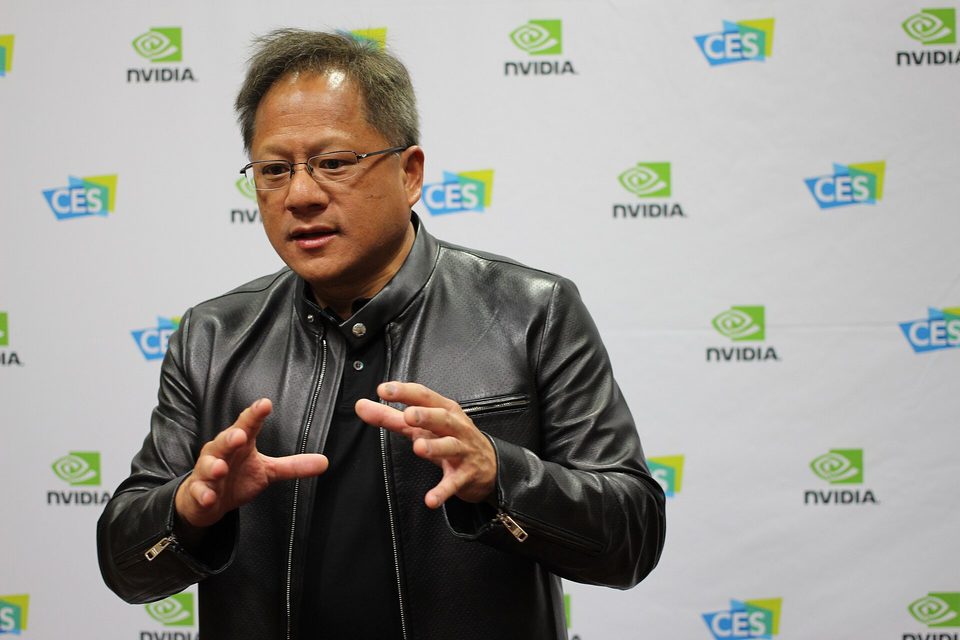
Image: Nvidia CEO Jensen Huang gesturing by Maurizio Pesce, CC BY 2.0.