
Key Takeaways
- In Canada, the federal $10 NSF cap has changed the comparison for customers with personal deposit accounts at federally regulated banks.
- Overdraft protection can cost more than expected when monthly charges, transaction fees and daily interest accumulate.
- A declined payment may create a second expense from the company expecting the money, even when the bank's NSF charge is relatively small.
Overdraft Protection vs NSF Fees: What Is the Difference?
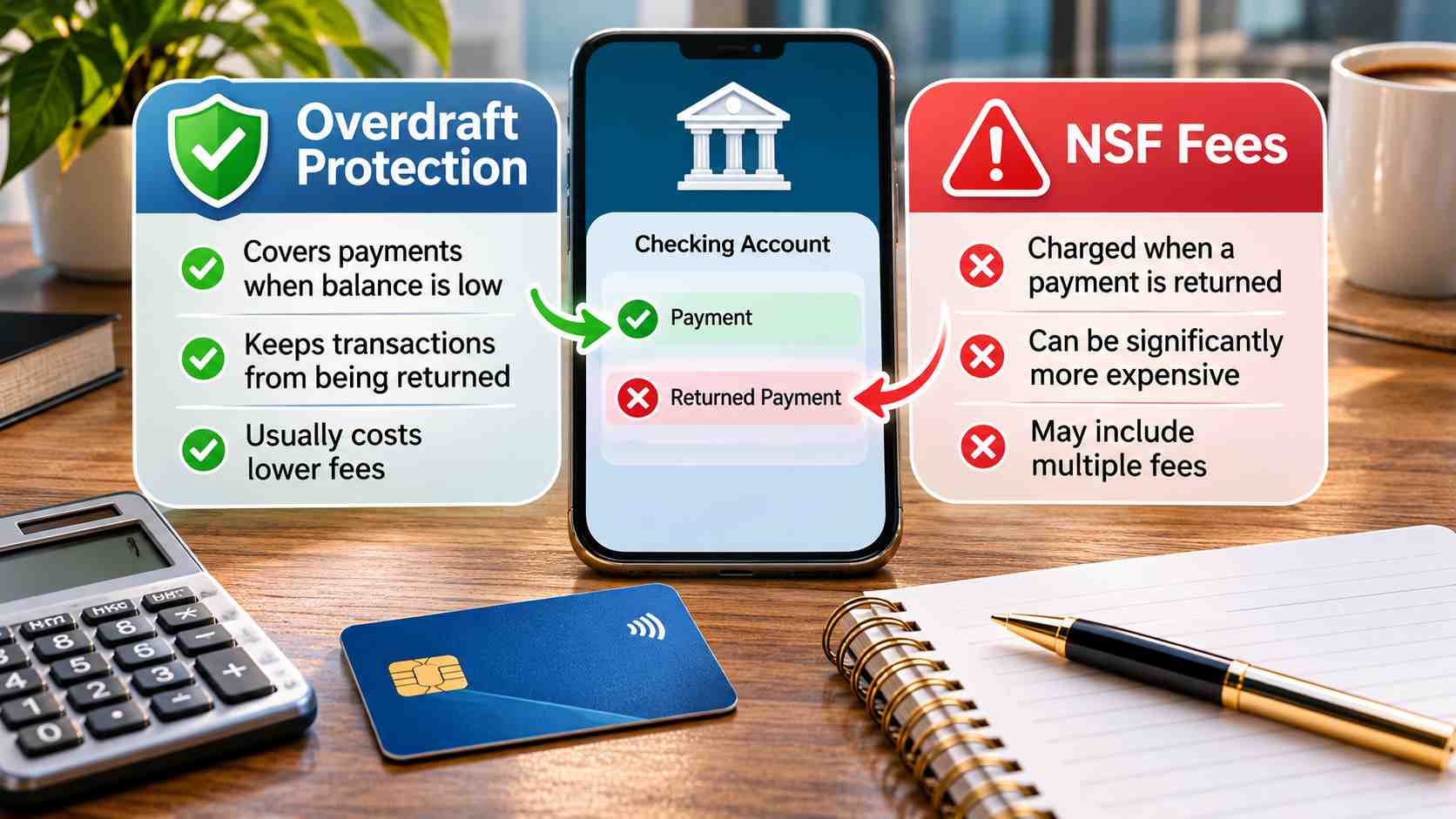
Overdraft protection and non-sufficient funds (NSF) fees apply when your bank account does not have enough available money to cover a transaction. However, they handle the shortfall differently. With overdraft protection, the bank or linked financial product may cover the payment, allowing it to go through. You then repay the amount borrowed, along with any applicable fees and interest.
With an NSF transaction, the bank generally declines or returns the payment because the account cannot cover it. The bank may charge an NSF fee, and the company expecting the payment may impose its own returned-payment charge. Neither option is automatically cheaper. The answer depends on your bank's pricing, how long your account stays overdrawn and whether the failed payment creates another charge.
How Much Does Overdraft Protection Cost?
Canadian banks commonly offer monthly, pay-per-use and linked-account arrangements. A monthly plan may cost around $5, even if you never use it. A pay-per-use arrangement may charge around $5 when an overdraft occurs. Interest is generally added to the amount borrowed, with rates often around 19% to 22% annually.
For example, imagine your account goes $100 below zero for five days. At an illustrative 22% annual interest rate:
Interest = $100 × 22% × 5 ÷ 365 = approximately $0.30.
With a $5 monthly plan, the estimated cost becomes $5.30. With a $5 pay-per-use charge, it is also approximately $5.30 for one qualifying occurrence. Your actual bank terms may differ.
What Happens When You Get an NSF Fee?
An NSF fee is charged when a bank returns a payment because the account lacks sufficient funds. This can affect cheques, pre-authorized debits and other withdrawals.
Canada introduced an important consumer protection on March 12, 2026. Federally regulated banks cannot charge more than $10 for an NSF event on a personal deposit account. They also cannot charge another NSF fee on that account within two business days or charge one when the shortfall is less than $10.
However, the bank's fee is not necessarily the entire cost. A company receiving a returned payment may charge a separate dishonoured-payment fee. That amount depends on the company's agreement and applicable rules.
Canada vs United States: Important Differences
Canada
The federal NSF fee cap applies to personal deposit accounts at federally regulated banks. It does not automatically cover every financial institution or business account. Confirm whether your provider is federally regulated and check your account agreement.
Overdraft protection can be useful when a declined bill payment would trigger additional charges. But remember to include interest and the plan's monthly or transaction fee.
United States
US consumers should check whether they have opted into overdraft coverage for one-time debit card and ATM transactions. Federal rules generally require affirmative consent before banks charge overdraft fees for paying those transactions.
Checks and recurring electronic payments follow different rules. If a payment is returned, an NSF fee or a separate merchant charge may still apply. Bank pricing varies, so do not assume Canadian fee limits apply to US accounts.
Which Option Costs Less? A Practical Comparison
Consider a Canadian customer whose account is short by $100 for five days. Assume a $5 monthly overdraft plan, a 22% annual interest rate and a $10 NSF fee. Also assume the payment recipient charges a hypothetical $25 returned-payment fee.
| Cost | Overdraft protection | Payment returned |
|---|---|---|
| Bank fee | $5 monthly | $10 NSF |
| Interest | About $0.30 | $0 |
| Recipient fee | $0 assumed | $25 assumed |
| Total | About $5.30 | $35 |
This illustration shows why overdraft protection may be cheaper when a declined payment triggers another charge. It is not a universal result: if the recipient charges nothing and your bank's overdraft plan has a high monthly fee, allowing a payment to be declined may cost less.
How to Choose the Better Option
Start by reviewing your recent bank statements. Count how often your balance falls below zero and calculate the fees you actually paid.
If shortfalls are rare, a pay-per-use plan or a linked savings account may be more economical than paying a monthly fee. If they happen regularly, compare the monthly plan with the combined cost of individual overdraft charges.
Also check whether your bank charges interest immediately, whether multiple transactions can trigger multiple fees and whether the service covers the payments you need. Set low-balance alerts and keep a small cash buffer where possible.
TwikUp's Perspective
The cheapest option is usually the one you rarely need. Overdraft protection can act as a useful safety net, but it should not become a substitute for a workable monthly budget.
A useful way to judge the decision is to compare the cost of protection with the cost of a failed payment over several months, not just one incident. This same principle applies to other financial protection decisions. For example, understanding the difference between term life and whole life insurance and which policy makes more financial sense can help households choose coverage that fits their actual needs without committing more money than necessary.
If your account regularly runs short, the more important task may be changing bill dates, building a cash reserve or reviewing recurring expenses. Bank fees are easier to manage when you understand the full chain of charges before a payment fails. A little preparation can prevent a small timing problem from becoming a much larger expense.
Disclaimer
This article is for general educational purposes and does not constitute financial or banking advice. Fees, overdraft eligibility, interest rates and consumer protections vary by institution, account type and jurisdiction. Check your bank's current fee schedule and account agreement before making a decision.