
Key Takeaways
- Stock-based compensation deserves attention because issuing shares carries an economic cost even when the expense does not immediately consume cash.
- Repeated restructuring and integration expenses can reveal a permanent feature of a company's operating model rather than an isolated event.
- A useful earnings analysis should examine what remains after taxes, working capital requirements, interest payments and necessary capital expenditure.
Adjusted EBITDA: The Profit Number Behind the Headline
A company announces record adjusted EBITDA, investors celebrate and analysts discuss improving profitability. But open its financial statements and the picture may look different.
Adjusted EBITDA is a non-GAAP financial measure that modifies earnings before interest, taxes, depreciation and amortization by excluding additional expenses selected by management. It can help investors understand operating performance, but its definition varies between companies.
The real challenge is understanding which costs disappear during those adjustments.
What Do Companies Commonly Remove?
Several adjustments appear frequently in earnings presentations:
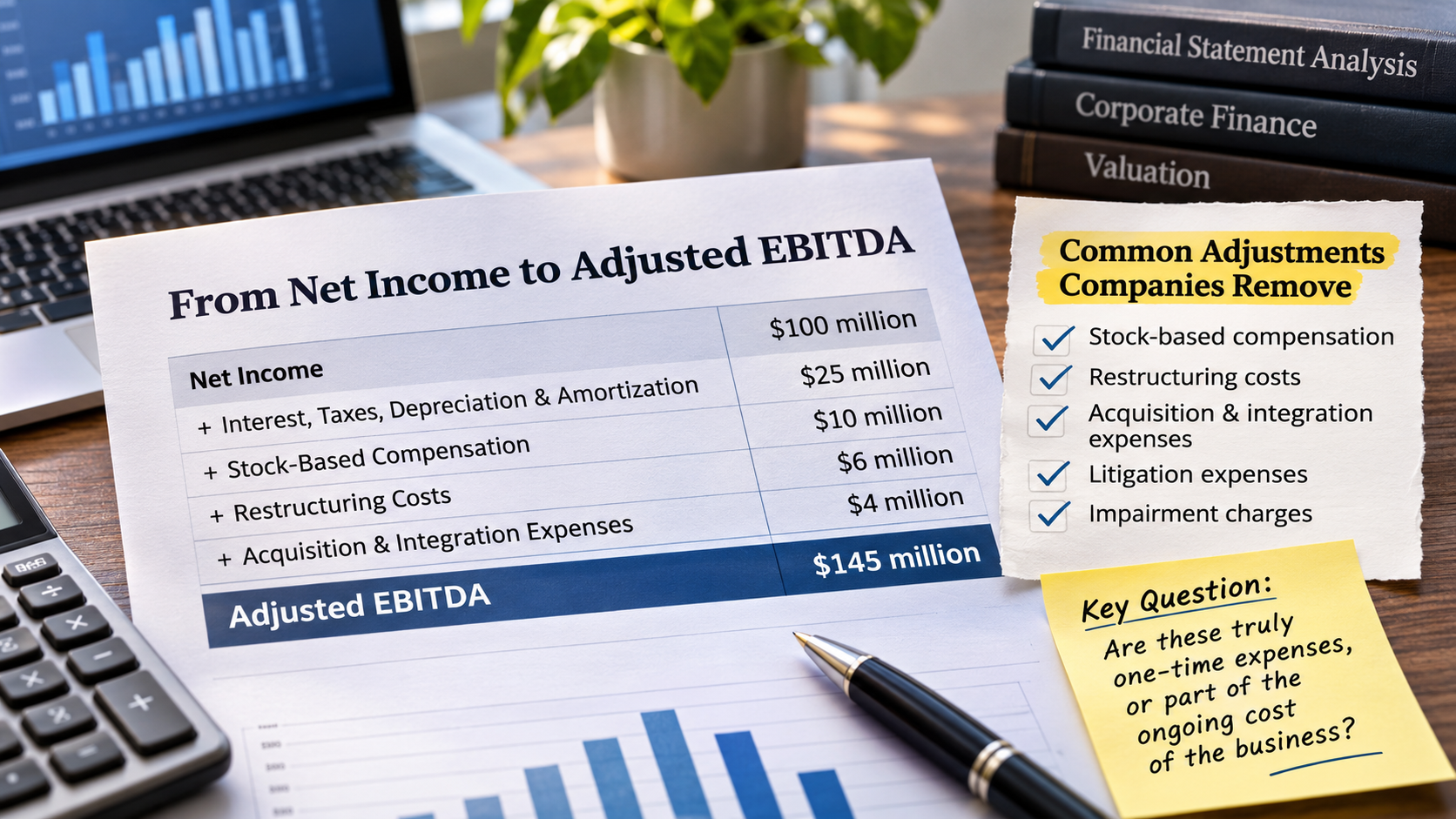
- Stock-based compensation: Companies often exclude employee share awards because they are non-cash expenses. However, issuing shares can dilute existing shareholders.
- Restructuring costs: Severance payments, office closures and operational reorganizations may be excluded. Repeated restructuring deserves closer examination.
- Acquisition and integration expenses: Deal fees and integration costs may be removed, even when acquisitions form a regular part of the company's growth strategy.
- Litigation expenses: Certain settlements may be presented as exceptional, although legal disputes can become recurring business costs.
- Impairment charges: Write-downs are often excluded, but they can reveal that previous investments failed to deliver expected value.
None of these adjustments is automatically inappropriate. Their economic significance and recurrence matter.
When Do Adjustments Become Misleading?
The SEC warns that excluding normal operating expenses that recur, even at irregular intervals, can make a non-GAAP performance measure misleading. It also highlights inconsistent treatment of similar expenses and the selective exclusion of losses without comparable gains.
Companies presenting non-GAAP measures must provide the most directly comparable GAAP measure and an appropriate reconciliation under applicable SEC requirements.
A Simple Example: The Profitability Gap
Imagine a fictional company reporting $100 million in net income.
It adds back $25 million in interest, taxes, depreciation and amortization, then removes another $20 million in stock-based compensation, restructuring and acquisition expenses.
Its adjusted EBITDA reaches $145 million.
That is 45% higher than net income, but the difference does not represent additional cash available to shareholders. Investors must investigate every adjustment before accepting the headline figure.
TwikUp's Perspective: Follow the Cash, Not Just the Add-Backs
Start with the reconciliation between adjusted EBITDA and net income. Then examine operating cash flow, working capital, taxes, interest payments and capital expenditure.
A company that repeatedly excludes the same categories deserves particular scrutiny. The important question is whether those expenses genuinely sit outside normal operations or are simply part of the cost of running the business.
Adjusted EBITDA can provide useful context. It should never replace the financial statements that explain what the business actually earns and spends.
Disclaimer
This article is for educational and informational purposes only. It does not constitute investment, financial or trading advice. Non-GAAP financial measures involve management-defined adjustments and may not be comparable across companies. Investors should review official financial statements and conduct independent research before making investment decisions.