
Key Takeaways
- RV and boat storage serves owners who lack suitable parking space at home or face local restrictions.
- Covered and enclosed parking can attract different customers and rental rates, but requires additional capital.
- Local demand, permitted land use and realistic occupancy assumptions matter more than the number of parking spaces alone.
Could RV and Boat Storage Become an Attractive Property Investment in Canada?
A recreational vehicle might spend several weeks travelling across Canada, but it can remain parked for months during the off-season. Boats face a similar challenge when boating weather ends. For owners without enough driveway or yard space, dedicated storage becomes a practical requirement.
This creates an opportunity for investors considering RV storage investment in Canada. Instead of constructing apartments or conventional commercial buildings, investors can develop or acquire land designed to accommodate recreational vehicles, boats, trailers and other large equipment.
However, the opportunity depends on more than vehicle ownership. A property must attract enough paying customers, comply with local land-use rules and generate sufficient income to cover its operating and financing costs.
Why Could Demand for RV and Boat Storage Grow?
RV ownership provides one indication of the potential customer base. RVDA of Canada estimated that approximately 2.1 million Canadian households owned an RV in 2022, representing around 14% of households. Its economic impact research also estimated approximately $400.3 million in RV storage expenditure during that year.
These figures demonstrate that storage is already an established part of RV ownership. They should not, however, be treated as current annual revenue available to a new facility.
Housing patterns can create another source of demand. Residents of condominiums, townhouses and smaller residential properties may not have enough room to park a large motorhome, travel trailer or boat. Some municipalities also restrict recreational vehicle parking in certain residential areas.
For example, Montréal has specific rules governing recreational vehicle and trailer storage on private residential property, including seasonal restrictions for certain front-yard spaces.
Investors should examine these local restrictions carefully. A facility near residential neighbourhoods, marinas, recreational routes or RV dealerships may have a useful customer base, but its actual demand must be established through local research.
What Type of Storage Facility Should Investors Develop?
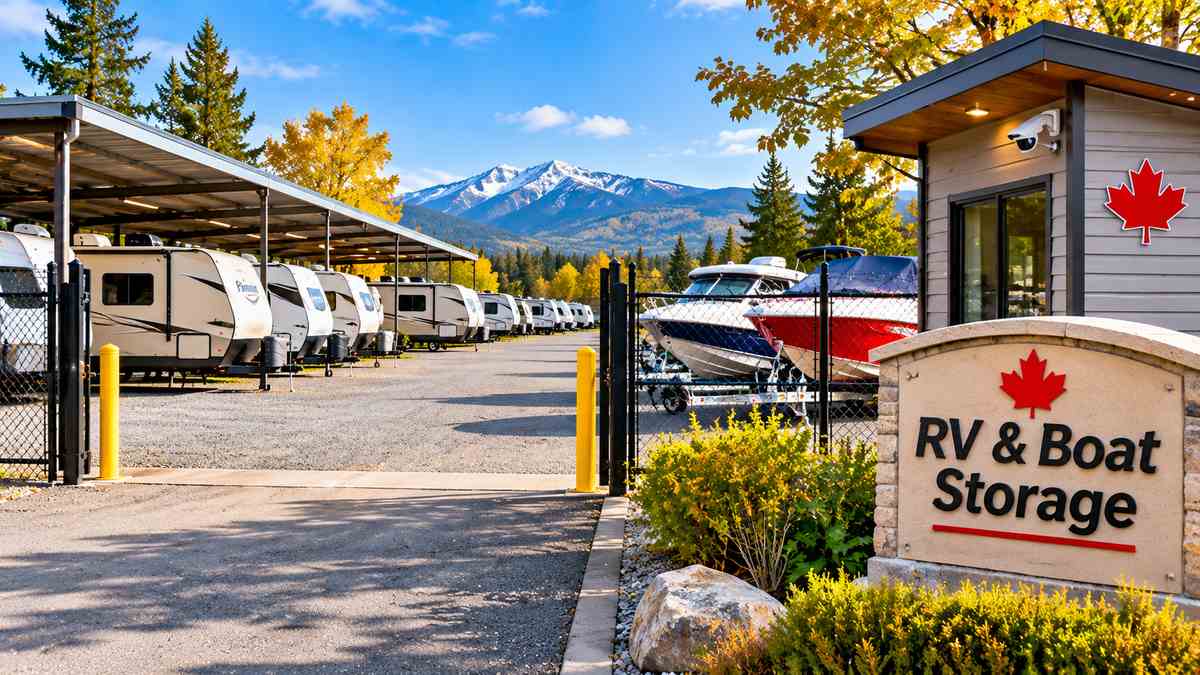
Outdoor RV and boat storage generally offers a lower-complexity starting point than constructing a fully enclosed storage building. Customers park their vehicles in designated spaces within a secured property.
Covered storage adds a roof or canopy, providing additional protection from weather and sunlight. Enclosed storage offers more protection and privacy, but construction and maintenance costs are usually higher.
The right format depends on local customer preferences and competing facilities. A market with harsh winter conditions may have customers interested in protected storage, while another location may have stronger demand for affordable uncovered parking.
A practical facility should provide wide access lanes, sufficient turning space, durable ground surfaces, drainage, lighting, perimeter fencing and controlled entry. Vehicle dimensions also matter. A site that cannot accommodate larger motorhomes or boats may exclude an important customer segment.
How Much Income Can an RV Storage Property Generate?
Rental income depends on the number of usable spaces, monthly rates and occupancy. Consider a hypothetical facility with 100 outdoor parking spaces.
If each space rents for $150 per month and average occupancy reaches 85%, the calculation would be:
100 spaces × 85% occupancy × $150 × 12 months = $153,000 annual gross rental revenue.
This is an illustrative calculation, not a verified Canadian market rental rate or guaranteed income.
The owner must still deduct property taxes, insurance, maintenance, security, administration, utilities, financing expenses and other operating costs. Seasonal vacancies can also affect annual revenue.
Additional income may come from covered parking, larger vehicle spaces or optional services, provided local regulations and insurance arrangements permit them.
Which Canadian Locations Deserve Attention?
There is no reliable basis for declaring one province the most profitable RV storage market without comparing local supply, demand and property costs.
Ontario and Quebec have large populations and established recreational boating activity. British Columbia offers access to coastal and inland recreation, while Alberta has a substantial road-travel and outdoor recreation market.
These are research starting points, not investment rankings.
Investors should study areas near marinas, lakes, RV dealerships, major highways and communities where residential parking is limited. They should also identify existing storage operators and compare their available spaces, pricing and customer reviews.
What Risks Should Investors Consider?
Zoning is one of the first challenges. A parcel classified for industrial or commercial use is not automatically approved for outdoor vehicle storage. Municipal rules may address screening, setbacks, lighting, drainage, access and permitted outdoor storage activities.
Other risks include land acquisition costs, security incidents, vehicle damage claims, winter maintenance, insurance premiums and competition from existing facilities.
Investors should also consider the seasonal nature of demand. A property may attract strong bookings before summer but experience slower enquiries during colder months. Annual contracts, advance bookings and a balanced customer mix can help reduce this exposure.
Before purchasing land, obtain written confirmation of permitted uses and commission a local feasibility assessment.
TwikUp's Perspective
RV and boat storage is an interesting niche because it connects property investment with an existing recreational ownership market. Yet the business should not be judged by the number of vehicles in a province or the size of the available land parcel.
Investors comparing this opportunity with industrial outdoor storage or traditional self-storage should assess each property's operating model separately. A lower-cost outdoor facility may be attractive, but only when its occupancy, rental pricing and land costs support a sustainable business.
Disclaimer
This article is for general educational and informational purposes only. It does not constitute financial, legal, tax or investment advice. Property costs, rental rates, zoning requirements and investment returns vary by location. Investors should conduct independent due diligence and consult qualified local professionals before making investment decisions.