
Key Takeaways
- Industrial outdoor storage provides space for trucks, trailers, containers, construction equipment and contractor materials, creating a specialised commercial property investment category.
- Canadian investor interest is emerging, with Colliers reporting a 12% preference for IOS and truck terminals in its 2027 survey.
- Zoning approval, highway access, drainage, security and tenant demand are critical factors when evaluating industrial yard investments.
Why Is Industrial Outdoor Storage Attracting Investor Attention in Canada?
Not every industrial property needs a massive warehouse to generate rental income. Some businesses simply need secure outdoor space where trucks can park, containers can be stored and construction equipment can remain between projects. This is where industrial outdoor storage (IOS) enters the picture.
Canada's logistics, construction, transportation and infrastructure businesses depend on accessible industrial land. As these industries operate across busy commercial corridors, properly located storage yards can become valuable properties for businesses that need space without paying for a large enclosed facility.
Investor interest is also becoming more visible. Colliers' 2027 Global Investor Outlook survey found that industrial outdoor storage and truck terminals represented 12% of Canadian investors' stated industrial and logistics preferences. This does not mean IOS dominates the market, but it shows that investors are beginning to recognise the asset category.
What Types of Industrial Outdoor Storage Properties Can Investors Buy?
IOS is not limited to empty land surrounded by a fence. Different properties serve different commercial purposes.
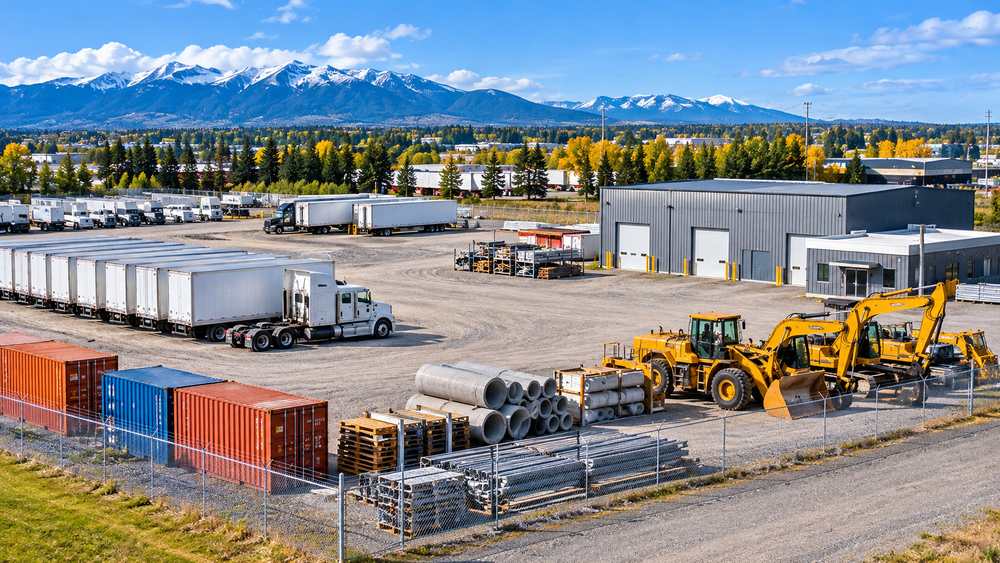
Truck and trailer yards provide parking space for transportation companies and fleet operators. Container yards support logistics businesses that need temporary space for shipping containers. Contractor yards accommodate construction materials, tools and heavy machinery, while equipment storage properties serve rental companies and infrastructure contractors.
Some sites also include small offices, maintenance buildings or covered storage areas. These additional facilities can support tenant operations, but the outdoor land remains the main component of the property's value.
Which Canadian Markets Could Offer Investment Opportunities?
Investors should begin with established industrial and transportation corridors rather than selecting a city based on population alone.
Toronto and the Greater Toronto Area offer access to major distribution networks, population centres and intermodal facilities. However, land acquisition costs, competition and local zoning restrictions can make suitable sites difficult to secure.
Hamilton may deserve attention because of its industrial base, transportation connections and proximity to the wider GTA. Calgary and Edmonton also offer opportunities to investigate around logistics, construction, energy and equipment-related businesses.
Montreal provides access to major freight and distribution networks, while Vancouver's industrial land constraints make suitable locations particularly important to evaluate.
CBRE reported 10.3 million square feet of national industrial net absorption in Q3 2026, while industrial availability declined to 5.2%. These figures provide broader market context, not proof that outdoor storage rents are rising at the same pace.
How Can Industrial Yard Properties Generate Rental Income?
IOS properties can earn income through leases based on land area, individual parking spaces, or a combination of outdoor and indoor facilities.
Consider an illustrative investment in a three-acre industrial yard. If an operator leases the entire property for $12,000 per acre monthly, the gross monthly rental income would be $36,000, or $432,000 annually.
This is only a hypothetical example, not a verified Canadian market rental rate. Actual income depends on location, permitted uses, site quality, lease structure and tenant demand.
Investors must deduct property taxes, insurance, repairs, security, maintenance, financing and vacancy costs before calculating net operating income.
What Risks Should Investors Check Before Buying an Outdoor Storage Property?
Zoning is one of the most important issues. A property being used for truck parking today does not automatically mean that the activity is legally permitted or that a new owner can continue operating it.
Investors should confirm permitted uses with the municipality and review site-plan approvals, environmental restrictions, access requirements and any applicable operating conditions.
Physical inspections are equally important. Poor drainage, contaminated soil, inadequate paving, weak fencing and limited vehicle access can create expensive problems. Investors should also assess lighting, security, stormwater management and the distance from residential neighbourhoods.
Tenant concentration presents another risk. A yard leased to one transportation company may experience a sudden income disruption if that tenant relocates or reduces operations.
Can Outdoor Storage Become a Stronger Property Investment in 2027?
Industrial outdoor storage offers an alternative to conventional warehouse ownership, particularly for investors who understand land-based commercial operations. Its appeal comes from practical business requirements rather than attractive buildings or residential-style amenities.
However, a large vacant parcel is not automatically an investment opportunity. The strongest properties are likely to combine legal outdoor-storage permissions, reliable road access, suitable infrastructure and demand from established commercial tenants.
TwikUp's Perspective
TwikUp believes investors should evaluate industrial outdoor storage through practical factors such as permitted land use, tenant demand, site accessibility and realistic operating costs rather than relying on market excitement alone. Investors exploring other forms of Canadian property investment can also read our guide, Canada Mortgage Investment Corporations 2027: Are MICs Worth Considering for Investors?, which explains how mortgage investment corporations generate income, the risks attached to private mortgage lending and what investors should examine before committing capital. Both investment approaches offer different ways to participate in Canada's real estate market, but neither should be evaluated without understanding its underlying risks.
Disclaimer This article is intended for informational and educational purposes only. Industrial outdoor storage investments involve zoning, environmental, financial, tenant and market risks. Readers should obtain independent legal, financial, environmental and real estate advice before making investment decisions.