
Key Takeaways
- Canada's greenhouse industry is expanding, creating potential demand for specialised agricultural buildings and supporting infrastructure.
- Ontario, British Columbia and Quebec are important markets to examine because of their established greenhouse production clusters.
- Investors must evaluate construction costs, energy requirements, water access, tenant strength and agricultural permissions before purchasing or developing a greenhouse property.
Can Agricultural Greenhouse Investment Become a Property Opportunity in Canada?
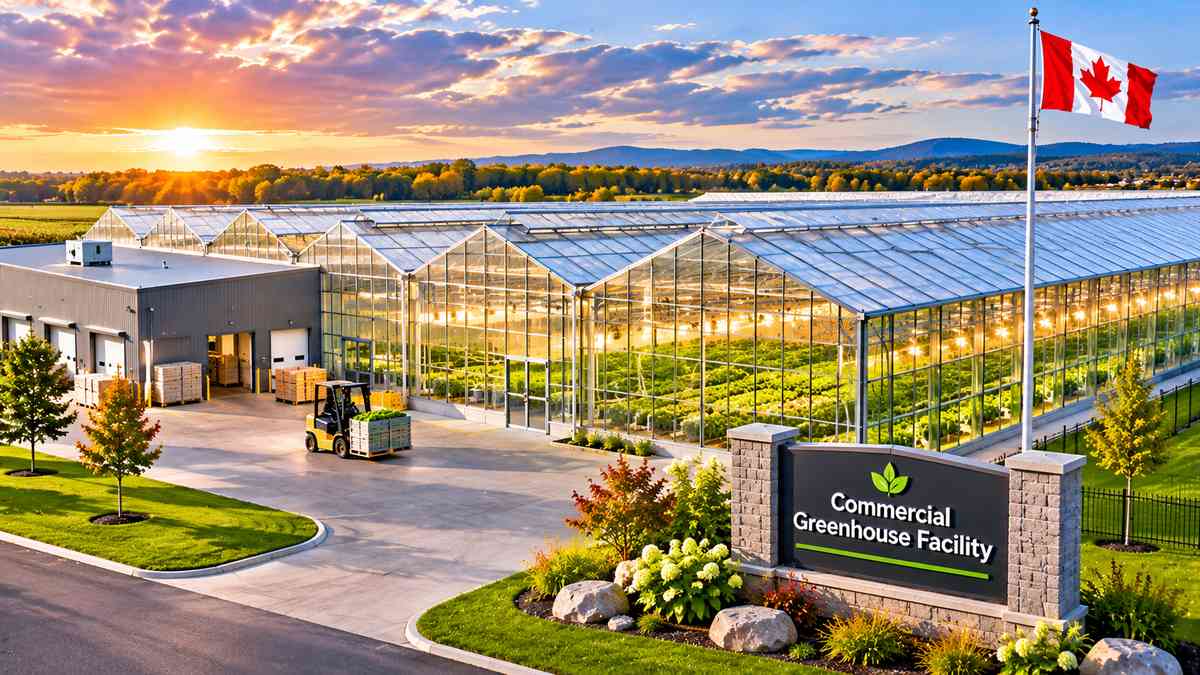
A greenhouse is more than a glass or plastic structure filled with growing plants. A commercial operation may include climate-control systems, irrigation networks, heating equipment, packing areas, storage buildings and specialised electrical infrastructure.
That makes agricultural greenhouse investment in Canada an interesting property niche. Investors can explore owning greenhouse facilities, leasing agricultural buildings to professional growers or developing land for controlled-environment farming.
The opportunity is supported by an established Canadian industry. However, greenhouse property is not a conventional rental asset. Its value depends heavily on agricultural demand, infrastructure quality, operating costs and the financial strength of the tenant.
Why Is Canada's Greenhouse Industry Attracting Attention?
Statistics Canada's 2025 figures show that Canada's total greenhouse area increased by 1.4% to 35.9 million square metres. Ontario accounted for 64.9% of this area, followed by British Columbia at 17.4% and Quebec at 10.4%.
The vegetable sector also demonstrates substantial commercial activity. Agriculture and Agri-Food Canada reported 974 commercial greenhouse vegetable operations in 2024, producing 866,484 metric tonnes of vegetables.
These figures show that greenhouse agriculture is an established business rather than a small experimental market. For property investors, the important question is whether growing producers will need additional facilities, upgraded buildings or suitable locations.
Which Provinces Offer Greenhouse Property Opportunities?
Ontario deserves attention because it has the largest concentration of greenhouse production. Southern Ontario benefits from proximity to major population centres, distribution networks and established agricultural businesses.
British Columbia's Fraser Valley is another important greenhouse cluster. Its established production base and access to regional markets make it worth examining.
Quebec also has a meaningful greenhouse sector, particularly around the Montréal region. Investors should investigate local land costs, utility availability, agricultural policies and access to buyers before selecting a property.
These provinces are research priorities, not a ranking of investment returns. A smaller facility in a suitable location may offer a better opportunity than a large greenhouse in an expensive or poorly connected area.
How Can Investors Earn Income From Greenhouse Property?
There are several possible approaches.
Lease an existing greenhouse: Investors purchase a functioning facility and lease it to an established agricultural operator. Income depends on the lease structure, facility condition and tenant's financial position.
Develop and lease a new facility: An investor develops a greenhouse with suitable utilities, irrigation, heating and supporting infrastructure, then secures a tenant. This approach requires more upfront capital and careful pre-development planning.
Acquire agricultural land: Investors purchase land with potential for greenhouse development, subject to agricultural land-use rules, planning approvals and infrastructure availability.
Lease supporting buildings: Packing facilities, cold rooms, equipment storage and distribution buildings may provide additional opportunities alongside greenhouse operations.
What Costs Can Affect Greenhouse Property Returns?
Greenhouse facilities can require substantial investment in construction, glazing, structural systems, heating, ventilation, irrigation, lighting and automation.
Energy is particularly important. Heating requirements can vary significantly by province, season, greenhouse design and crop type. Electricity and fuel expenses can influence whether an agricultural tenant can operate profitably.
Water access, drainage, wastewater management, road access and proximity to labour and distribution facilities also affect property suitability.
Consider a hypothetical greenhouse property leased for $25,000 per month. Its annual gross rental income would be $300,000 before expenses. This is an illustrative calculation, not a verified Canadian market rental rate or investment return.
Property taxes, insurance, maintenance, financing, capital repairs and vacancy periods must still be considered.
Can Government Funding Support Greenhouse Development?
Agriculture and Agri-Food Canada's Controlled Environment Agriculture Growth Pathway Program is a relevant development to examine.
The programme provides a $750 million funding envelope over seven years, including a technology adoption stream supporting eligible upgrades and construction of controlled-environment agriculture facilities.
Its published intake period runs from October 30 to December 23, 2026. Investors and agricultural operators should review eligibility requirements carefully. Funding is not automatic, and property investors should not include an unapproved grant in their financial projections.
What Risks Should Investors Consider?
A greenhouse is a specialised property, which can make tenant replacement more difficult than for an ordinary warehouse.
An incoming operator may need different growing systems, crop layouts, equipment or climate controls. An older facility may require expensive upgrades before it can be used efficiently.
Investors should also examine water availability, environmental approvals, drainage, energy supply, building condition and agricultural land restrictions.
In Ontario, greenhouse operators may require approvals for water taking and wastewater or stormwater discharge, depending on their activities. Local building and municipal requirements also need to be checked before construction or renovation.
TwikUp's Perspective
Agricultural greenhouse property deserves attention because it combines land ownership with specialised infrastructure that supports year-round food production. But investors should not confuse growth in greenhouse sales with guaranteed growth in property values or rental income.
TwikUp believes the stronger opportunity lies in facilities that meet real agricultural operating needs, have reliable utilities and can attract financially capable tenants. Comparing greenhouse property with food processing real estate investment and cold storage investment can help investors understand how specialised agricultural infrastructure fits into the wider commercial property market.
The best investment is not necessarily the largest greenhouse. It is the property whose location, infrastructure, tenant demand and total development cost create a sustainable long-term business case.
Disclaimer
This article is for general educational and informational purposes only. It does not constitute financial, legal, tax or investment advice. Greenhouse construction costs, rental income, agricultural permissions, funding eligibility and operating requirements vary by province and property. Investors should conduct independent due diligence and consult qualified agricultural, legal, engineering and financial professionals before making investment decisions.