
Key Takeaways
- Modular factories create a specialised industrial property opportunity beyond conventional warehouses and distribution centres.
- Ontario, British Columbia and Quebec offer established prefabrication industry clusters worth examining.
- Manufacturing capacity, tenant financial strength and long-term contracts matter more than projected market growth alone.
Could modular construction factories become a Canadian real estate opportunity?
Modular construction facility investment in Canada could attract attention in 2027 as housing agencies, developers and manufacturers look for faster ways to deliver buildings. The opportunity is not simply to own another warehouse. It is to control a specialised industrial property designed to produce wall panels, structural assemblies or complete building modules.
A factory benefits from demand only when manufacturers have reliable contracts, suitable equipment, trained workers and access to customers. Investors should assess the property and operating business separately.
What makes a modular construction facility different?
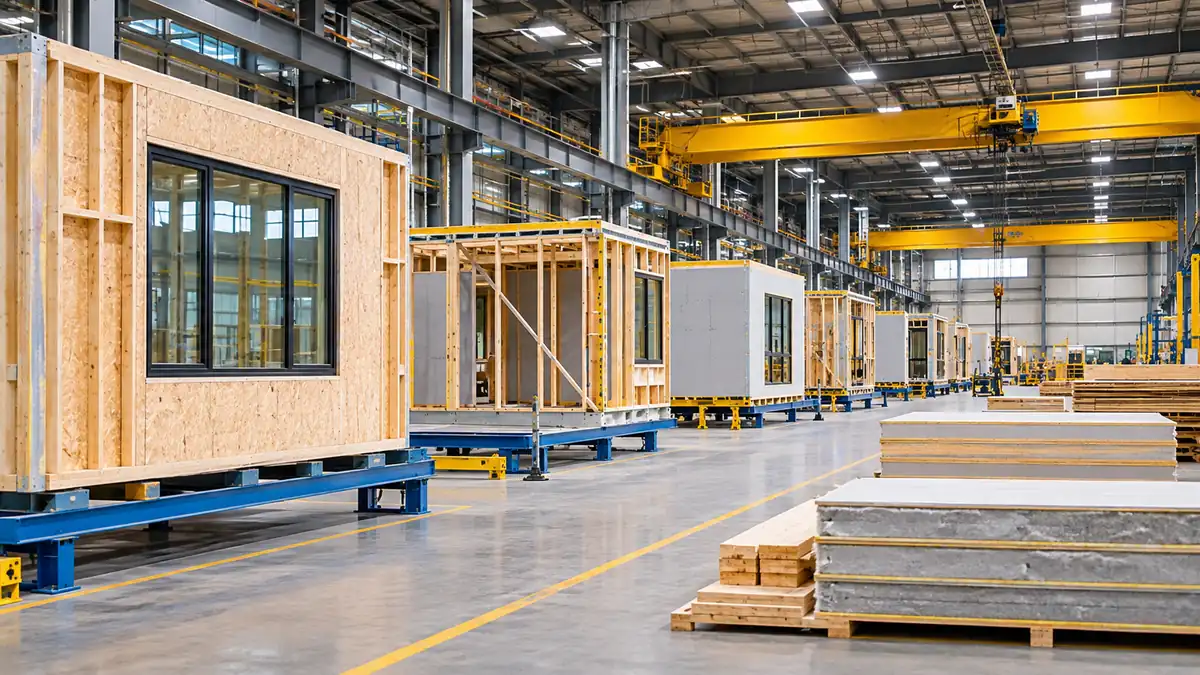
A modular facility manufactures building components or complete sections before they are transported to a construction site. Operations may include cutting, framing, welding, insulation, electrical installation, finishing, storage and loading.
Unlike a standard warehouse, a suitable site may require high clear heights, reinforced floors, overhead cranes, substantial electrical capacity, large loading doors, outdoor staging space and truck access.
Why could demand grow in 2027?
A 2025 study supported by Natural Resources Canada identified 830 prefab companies operating from 1,028 locations across Canada. Ontario had the largest number, followed by British Columbia and Quebec. Facilities produce products ranging from wall and floor panels to structural assemblies and volumetric modules.
The Modular Building Institute’s 2026 report estimates Canada's permanent modular construction market at about $5.5 billion, with annual growth of roughly 5% projected through 2029. Other reports use different definitions and estimates, so these figures are industry indicators, not guaranteed revenue growth.
Policy is another demand signal. In May 2026, CMHC expanded mortgage insurance options for prefabricated and modular homes, including multi-unit projects using modular construction. Build Canada Homes has also identified factory-built housing as part of its plan to industrialise homebuilding.
Which locations could attract facility investment?
Ontario combines an established prefab company base with access to major housing and institutional markets. In August 2026, Invest Ontario announced a $15 million SEKISUI Canada Modular Solutions manufacturing hub in Burlington, citing skilled labour, transport infrastructure and proximity to customers.
British Columbia and Quebec also have established prefabrication activity. Prairie investors may assess housing demand, industrial projects, forestry inputs and transport corridors.
What should investors examine before buying?
Start with the operator, not the building's advertised potential. Check signed orders, repeat customers, production schedules and the tenant's financial position. A modern factory without a dependable order book can become an expensive specialised vacancy.
Review zoning, permitted industrial uses, building permits, fire protection, environmental condition, power supply, floor loading, ceiling height and truck access. Confirm that the site can accommodate the intended production process and outdoor storage.
Model fit-out costs, equipment financing, insurance, maintenance, property taxes and the risk that another tenant may require costly alterations. A pre-leased development may reduce leasing uncertainty if the tenant is financially credible.
What risks could limit returns?
The central risk is confusing industry growth with guaranteed factory occupancy. Recent industry analysis has highlighted unused manufacturing capacity and inconsistent project pipelines. Without steady public procurement or private orders, facilities may operate below break-even levels.
Other challenges include high upfront costs, skilled-labour shortages, supply-chain delays, transport expenses and different building-code requirements across provinces. Factory-built components must comply with applicable local codes. CSA A277 certification is an important route for demonstrating factory-built building compliance, while site work and installation remain subject to local requirements.
Tax incentives need care. Budget 2026 lists certain modular-housing machinery and equipment as potentially eligible under the Productivity Mega Deduction. It does not mean the factory building itself automatically qualifies. Legislation and CRA determinations govern eligibility.
TwikUp's Perspective
Modular construction facilities could become a specialised segment of Canada's industrial property market, but the strongest opportunity may be in adaptable buildings secured by experienced operators and credible multi-year contracts. This investment approach also connects with other specialised property categories, including veterinary real estate investment in Canada, where tenant requirements, purpose-built infrastructure and long-term leasing potential influence property values. For 2027, investors should prioritise logistics access, tenant strength and proven production capability over speculative projects built around optimistic housing forecasts.
Disclaimer
This article is intended for general educational and informational purposes. Modular construction facility investments involve commercial property, manufacturing, financing, regulatory and operational risks. Market projections are not guarantees of future performance. Government incentives and tax eligibility depend on applicable legislation and individual circumstances. Investors should consult qualified real estate, legal, tax and financial professionals before making investment decisions.