
Key Takeaways
- Interchange is paid by the merchant's bank to the cardholder's bank on every credit card sale; Visa and Mastercard set the rates but don't keep the fee.
- Canadian consumer interchange runs roughly 0.92% to 2.53% depending on card tier and channel, and premium rewards cards cost merchants the most.
- Since October 19, 2024, eligible small businesses get a 0.95% weighted-average in-store rate under federal agreements with Visa and Mastercard.
Every tap of your card quietly moves money you've never seen
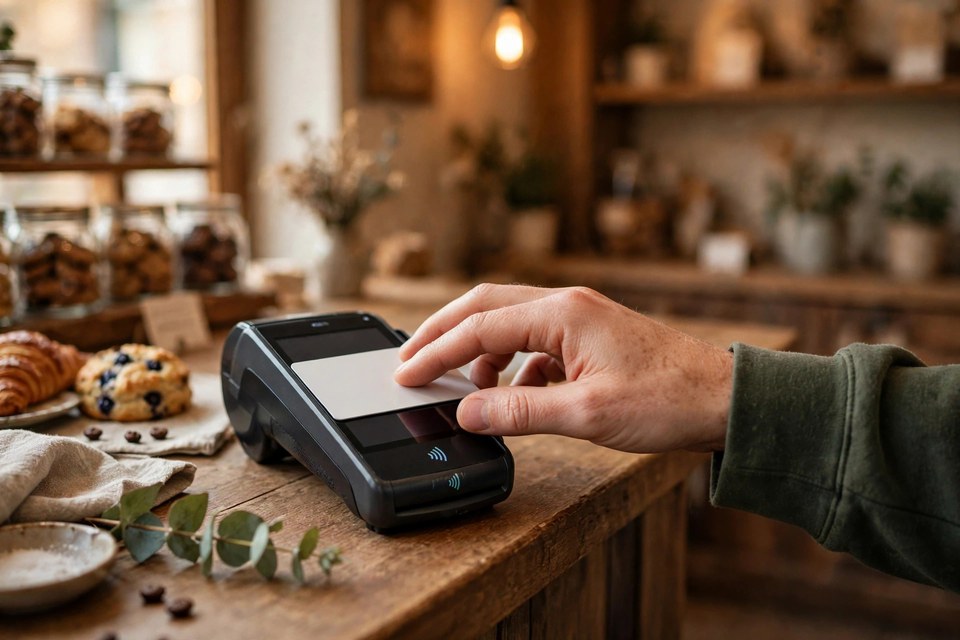
When you tap a credit card for a $100 purchase, the store does not receive $100. A slice — typically somewhere between about $0.92 and $2.53 of it, depending on the card — is diverted along the way, and the largest part of that slice is a fee most Canadians have never heard of: interchange.
What interchange actually is
Interchange is a bank-to-bank fee. When a purchase settles, the merchant's bank (the acquirer) pays a percentage of the sale to your bank (the issuer). Visa and Mastercard set the rates and publish them, but the networks themselves don't keep the fee — it flows to the issuer, where it funds, among other things, the reward points and cashback on your card.
Merchants never pay interchange directly. They pay their acquirer a merchant discount rate — a bundle of interchange, network fees and the acquirer's own markup. Interchange is by far the biggest ingredient, accounting for roughly 70% to 90% of a merchant's total card-acceptance cost.
What the rates look like in Canada
Rates vary by card tier, by channel, and by merchant size — and premium cards cost merchants the most:
- Visa consumer cards: in-store rates run from 1.25% for basic cards to 2.08% for Infinite Privilege; online, from 1.40% to 2.40%, with standard transactions up to 2.45%. Small merchants in Visa's program pay as little as 0.70% in-store.
- Mastercard consumer cards (rates effective April 1, 2026): in-store chip transactions run from 0.92% for Core cards to 1.95% for World Legend; online commerce from 1.67% to 2.23%; standard transactions up to 2.53%. Small-business rates start at 0.70%.
That spread explains a quiet tension at every checkout: the rewards card you love most is, dollar for dollar, the most expensive card for the store to accept — and merchants recover those costs the only way they can, in shelf prices paid by everyone, including people paying cash.
The small-business deal
Ottawa has twice leaned on the networks to cut these rates. Under voluntary commitments, the average effective interchange rate fell to 1.40% in 2020. Then, in agreements that took effect October 19, 2024, Visa and Mastercard committed to an annual weighted-average rate of 0.95% on in-store domestic consumer transactions for eligible small businesses — those with annual Visa volume under $300,000 or Mastercard volume under $175,000 — and a smaller cut online. Finance Canada estimated the reductions at up to 27% for some merchants, worth about $1 billion over five years, covering more than 90% of card-accepting businesses — with cardholders' reward points explicitly protected.
Canada's Code of Conduct for the credit and debit card industry adds transparency on top: the networks must post all standard interchange rates publicly, and merchants must get at least 90 days' notice of fee increases or new fees, with the right to cancel their contracts without penalty.
Interchange is the engine of the rewards economy: merchants fund it, issuers collect it, and cardholders redeem a share of it back as points. Whether that makes it a fair trade or a hidden tax on prices depends on which side of the till you stand on — but now, at least, you know where the slice of your $100 goes.
The Twikup Take
The genius of interchange is its invisibility: a two-percent toll on modern commerce that no consumer ever sees itemized and few merchants can refuse. Canada's approach — squeeze the rate for small businesses, protect the points, publish everything — is a compromise that keeps all three sides mildly dissatisfied, which in payments policy usually means it's roughly working.
Your rewards aren't free — they're just hidden in the price of everything you buy.
Image: Illustrative image.