
Key Takeaways
- A low-cost Canadian bank account can provide essential services for $4 or less per month without requiring a minimum balance.
- Some charges depend on account usage, so the cheapest advertised plan may not be the least expensive option for your habits.
- Federal rules introduced in March 2026 significantly reduced NSF fees at federally regulated banks, but other costs from returned payments may remain.
Why Do Bank Account Fees Deserve Your Attention?
A bank account may look inexpensive when you open it, but the monthly maintenance charge is only one part of its total cost. Transaction limits, ATM withdrawals, overdraft services and optional features can add more expenses over time.
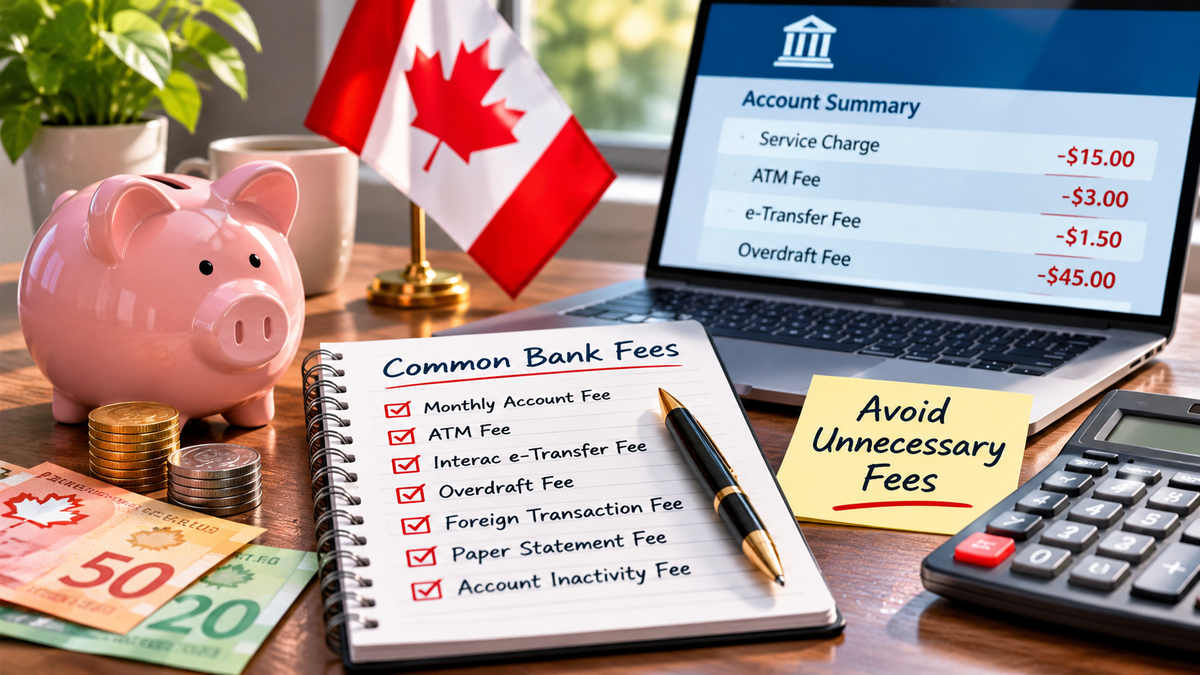
The Financial Consumer Agency of Canada (FCAC) examined common banking charges in its October 2026 review. Its findings highlight how several small fees can combine into a noticeable annual expense. Here are seven charges worth checking on your latest bank statement.
1. Monthly Account Maintenance Fees
Many Canadian banks charge a monthly fee for maintaining a chequing account. The amount depends on the account package and the services included. FCAC's October 2026 review found that standard chequing accounts at Canada's Big Six banks commonly charged between $11.95 and $17.95 per month. Premium accounts could cost considerably more.
Some banks waive the monthly charge if you maintain a required minimum balance. However, keeping several thousand dollars in a chequing account just to avoid a fee may not be the best use of your savings.
What you can do: Check whether a lower-cost account provides the transactions and services you actually use. Canada offers low-cost accounts with monthly fees of $4 or less.
2. Extra Transaction Fees
Your account may include a fixed number of debit transactions each month. Once you exceed that limit, the bank can charge an additional amount for each eligible transaction.
For example, an account may include 18 transactions. If you make 25 transactions, seven may fall outside the monthly allowance, depending on the account's rules.
Frequent debit purchases, bill payments and transfers can make a limited-transaction account more expensive than expected.
What you can do: Review your monthly activity and compare it with your account's transaction allowance. If you regularly exceed the limit, consider an account with unlimited transactions or a higher allowance.
3. Out-of-Network ATM Fees
Using an ATM outside your bank's network can result in more than one charge. Your own bank may apply an out-of-network withdrawal fee, while the ATM operator may impose a separate surcharge.
The total cost depends on the account package, ATM owner and withdrawal location. For someone who regularly withdraws cash, even a modest charge can become an unnecessary recurring expense.
What you can do: Use your bank's ATM network where possible. Before confirming a withdrawal, read the fee message displayed on the machine. If you frequently need cash, compare accounts that include more convenient ATM access.
4. Overdraft Protection Fees and Interest
Overdraft protection allows certain payments to go through even when your account balance is insufficient. It can prevent a declined payment, but the service is not necessarily free.
Depending on the arrangement, your bank may charge a monthly fee or a pay-per-use fee. Interest may also apply to the amount borrowed.
FCAC explains that some institutions charge a monthly overdraft fee even when the customer does not use the service during that month.
What you can do: Check whether you actually need overdraft protection. If you rarely use it, ask whether a pay-per-use option or cancellation would cost less. Also compare the total cost of overdraft protection with the consequences of a returned payment.
For a detailed comparison, read Overdraft Protection vs NSF Fees: Which Banking Option Saves You More Money?.
5. Non-Sufficient Funds (NSF) Fees
An NSF fee may apply when a payment is returned because your account does not have enough money and overdraft protection does not cover it.
Canada introduced an important change in March 2026. Federally regulated banks must now limit NSF fees on personal deposit accounts to $10. They cannot apply another NSF fee to the same account within two business days or charge one when the shortfall is less than $10.
However, a returned payment can still create another expense. A landlord, utility provider or lender may charge a separate dishonoured-payment fee under the applicable agreement and rules.
What you can do: Set low-balance alerts, keep track of automatic withdrawals and leave enough money in your account before scheduled payments. If you believe an NSF fee was applied incorrectly, contact your bank.
6. Foreign-Currency Conversion Fees
Buying something in another currency or withdrawing cash while travelling can involve currency conversion costs. A bank may apply a conversion markup when changing Canadian dollars into another currency. Cross-border debit transactions may also involve separate fees, depending on the account and transaction.
These charges can be easy to overlook because the original purchase amount may appear in a foreign currency before the final Canadian-dollar amount is posted.
What you can do: Review your bank's foreign-currency and international debit fee schedule before travelling. Compare the total cost of different payment methods and check the exchange rate and conversion charges before confirming a transaction.
7. Paper Statements and Optional Service Fees
Some banking services carry separate charges even when your regular account package appears affordable. These may include paper statement delivery, replacement cards, cheque orders, special account documents or other optional services.
Not every bank charges for these features, and some account packages include them without an additional fee. Low-cost and no-cost accounts under the federal commitment must include free digital monthly statements and certain other basic services.
What you can do: Check which services your account already includes. Switch to digital statements if they meet your needs, and ask about the cost before ordering cheques or requesting additional banking services.
How Much Could You Save by Reviewing Your Bank Fees?
Consider an illustrative account that charges $15 per month. Its annual maintenance cost is:
$15 × 12 = $180.
If the customer also pays $3 for two out-of-network ATM withdrawals each month, that adds:
$3 × 2 × 12 = $72.
The combined annual cost becomes $252, before any other service charges.
Moving to a suitable account with no monthly fee and fewer ATM charges could reduce that expense. Actual savings depend on the replacement account's features, eligibility and usage conditions.
TwikUp's Perspective
Managing bank account fees becomes even more important when your regular income changes. If you receive a severance payment after losing your job, understanding how much you will actually keep after tax can help you plan your expenses and manage your savings.
Read our guide on Severance Pay Tax in Canada: How Much Will You Keep After Tax? to understand the tax treatment of severance payments and estimate your take-home amount.
Disclaimer
This article is for general educational purposes and is not personalized financial advice. Bank fees, account features, eligibility requirements and service charges vary by institution and account type. Confirm current terms directly with your financial institution before changing accounts.