
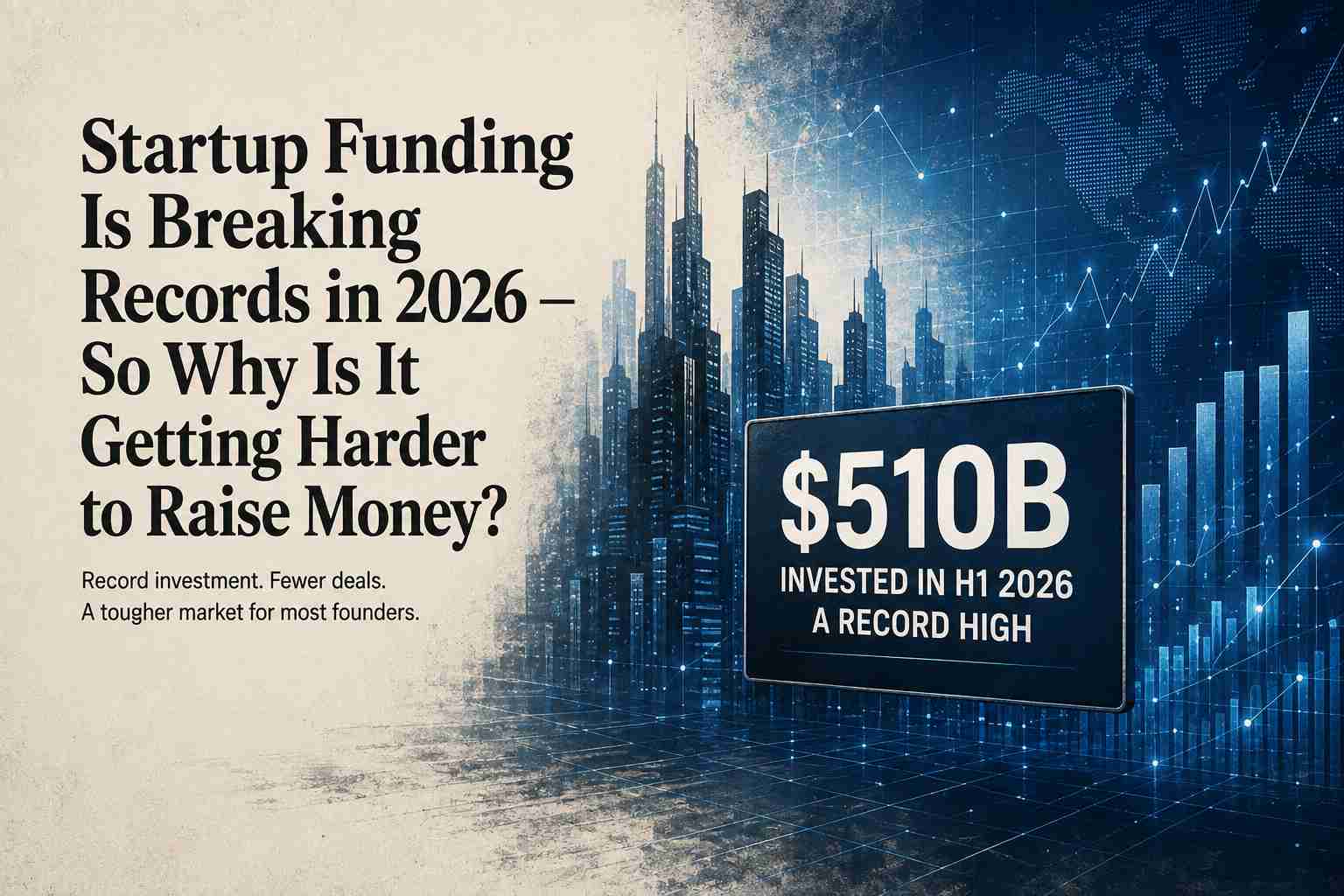
Global startup investment reached approximately $510 billion in the first half of 2026, according to Crunchbase, surpassing the roughly $440 billion invested during all of 2025.
But the headline number hides an extraordinary concentration of capital. OpenAI and Anthropic alone accounted for $217 billion, or 43% of all global startup funding in the first half of 2026, according to Crunchbase.
CB Insights reported another sign of the divide: global venture funding exceeded $200 billion for a second consecutive quarter in Q2 2026, while deal count fell to its lowest level in more than a decade. Just 263 mega-rounds captured 81% of all funding during the quarter.
For founders looking toward the rest of 2026 and into 2027, that creates an important distinction:
There is more capital in the startup market, but much of it is flowing into a relatively small number of enormous deals.
Quick Answer
Startup investment is breaking records in 2026, but the boom is highly concentrated.
AI companies—and particularly a handful of exceptionally large private companies—are absorbing an extraordinary share of global venture capital. At the same time, investment is spreading into robotics, AI infrastructure, energy, biotech and other technologies that could support the next phase of the AI economy.
That does not mean the average startup is experiencing an easy fundraising market.
Instead, record funding is coexisting with fewer deals and massive mega-round concentration.
For founders heading toward 2027, the question may therefore be less about whether venture capital exists and more about what a company must prove to earn a share of it.
$510 billion changes the headline — not necessarily the founder experience
At first glance, 2026 looks extraordinary.
Crunchbase estimates that global startup investment reached approximately $510 billion during the first six months of the year, setting a record for a half-year period.
KPMG recorded the enormous acceleration at the beginning of the year as well. Its Venture Pulse report put global VC investment at $330.9 billion across 8,464 deals in Q1 2026, compared with $128.6 billion across 10,097 deals in Q4 2025.
Ten funding rounds of $2 billion or more contributed more than $206 billion to the Q1 total, according to KPMG.
That helps explain why record investment does not necessarily mean capital has become broadly easier to access.
The concentration becomes even clearer when looking at Crunchbase's first-half numbers.
OpenAI and Anthropic accounted for $217 billion—43% of all global startup funding during H1 2026.
In other words, nearly $0.43 of every $1 invested globally during the first half went to just two companies.
CB Insights found a similar pattern in Q2: 263 mega-rounds captured 81% of global venture funding, even as overall deal count dropped to its lowest level in more than a decade.
That produces an unusual venture market:
Record amounts of money can be invested while many startups still compete for a much smaller portion of the total capital pool.
AI is consuming an extraordinary share of venture capital
The concentration is particularly visible in artificial intelligence.
The NVCA's 2026 Yearbook, which examines the 2025 U.S. venture market, says AI-related companies represented 65.4% of U.S. venture deal value in 2025, up sharply from 50.9% in 2024.
The momentum continued into 2026.
North American startups raised approximately $392 billion in the first half of 2026, according to Crunchbase.
The concentration was even more dramatic early in the year. Crunchbase reported that more than 87% of North American startup investment in Q1 went to companies in AI-related categories.
That makes the current venture boom difficult to separate from the AI investment cycle.
But AI investment is also beginning to stretch beyond models and software applications.
Capital is flowing into some of the technologies required to build, power and deploy AI at scale—including robotics, computing infrastructure and energy systems.
The next investment battle may be over the infrastructure behind AI
Artificial intelligence requires considerably more than models and applications.
It requires chips, data centres, electricity, cooling, networking, manufacturing capacity and increasingly sophisticated physical systems.
That is helping broaden investor interest toward what might be described as the physical layer of AI.
Robotics startups raised approximately $16.3 billion across 492 deals in Q1 2026, according to PitchBook data reported by Business Insider.
KPMG's Q1 Venture Pulse also highlighted areas including autonomous vehicles, robotics, energy management, biotech, defence technology and AI-related infrastructure as notable areas of investment activity.
The result is a widening definition of an “AI investment.”
The companies benefiting from the AI boom may not all build chatbots or foundation models. Some could build the infrastructure, machines, energy systems and specialized technologies required to make AI work at enormous scale.
Five areas investors are watching heading toward 2027
Based on 2026 funding patterns and investor commentary, five areas appear especially important heading toward 2027.
AI and AI infrastructure remain at the centre of venture investment. The opportunity increasingly extends beyond consumer-facing AI applications into computing, data infrastructure and technologies supporting the broader AI ecosystem.
Robotics and physical AI are attracting substantial capital as investors look for ways to bring increasingly capable AI systems into factories, warehouses, laboratories, transportation and other physical environments.
Energy and power technology could become increasingly important because the expansion of AI infrastructure and data centres requires enormous amounts of electricity, grid capacity and supporting infrastructure.
Healthcare and biotech continue to attract significant investment, including businesses applying AI to drug discovery, scientific research and specialized industry problems.
And cybersecurity remains comparatively resilient. Crunchbase reported that cybersecurity and privacy startups raised approximately $10.6 billion during the first half of 2026, with funding remaining at historically high levels.
These categories will not automatically produce winners. But they illustrate where some of the biggest technological and infrastructure problems—and therefore potential investment opportunities—are emerging.
What does this mean for an ordinary startup?
Imagine two founders entering the fundraising market.
One says:
“We have an AI startup and the market is growing quickly.”
The other can demonstrate paying customers, increasing usage, improving economics, proprietary technology or data, and a credible explanation of how additional capital could turn those advantages into substantially larger revenue.
The second story gives investors considerably more to evaluate.
In a market where enormous funding totals are being driven by relatively few companies, simply belonging to a fashionable category may not be enough.
KPMG's venture analysis points to continued investor discipline, with attention on businesses demonstrating traction, operational efficiency and clearer paths toward eventual liquidity.
For founders, that makes the quality of the underlying business increasingly important.
A company may need to demonstrate not only that it operates in an attractive market, but also why customers need its product, why competitors cannot easily replicate it and why additional investment can produce significantly greater value.
Record funding does not mean easy funding
This distinction may be the most important lesson from the 2026 venture market.
A founder looking only at the global funding total might conclude that venture capital is booming.
Technically, it is.
But consider the numbers together:
Global startup investment reached approximately $510 billion in H1 2026.
Just OpenAI and Anthropic captured $217 billion of that total.
CB Insights says 81% of Q2 funding went into mega-rounds.
And global venture deal count fell to its lowest level in more than a decade during Q2.
Those figures describe something different from a broad-based startup funding boom.
They describe a market capable of making extraordinarily large bets on a relatively small number of companies.
The 2027 question is not simply whether the AI boom continues
Trying to predict exactly how much venture capital will be invested in 2027 would require assumptions that cannot yet be verified.
A more useful question is what happens if today's pattern continues.
If enormous rounds keep pushing total funding higher while deal counts remain subdued, founders could enter 2027 facing a venture market with plenty of money but a high threshold for accessing it.
That would be different from a traditional venture boom in which rising capital broadly lifts funding opportunities across the startup ecosystem.
Instead, the market could increasingly resemble a competition to identify a relatively small number of companies capable of becoming dominant platforms, infrastructure providers or category leaders.
For founders outside those mega-rounds, the implication is important.
The record amount of money in venture capital does not eliminate the need to demonstrate traction, defensibility, strong economics and a credible path to scale.
It may make those qualities even more important.
Key Takeaways
- Global startup investment reached approximately $510 billion in H1 2026, according to Crunchbase.
- OpenAI and Anthropic alone accounted for $217 billion, or 43% of global H1 startup funding, highlighting how concentrated the boom has become.
- North American startups raised approximately $392 billion during the first half of 2026.
- CB Insights says Q2 venture deal count fell to its lowest level in more than a decade, even as funding remained above $200 billion.
- Just 263 mega-rounds captured 81% of Q2 global venture funding.
- AI remains the dominant investment theme, while capital is also flowing into robotics, infrastructure, energy, biotech and cybersecurity.
- Record global funding should not be interpreted as evidence that raising capital has become broadly easier.
- Heading toward 2027, traction, defensibility, capital efficiency and the ability to scale could become increasingly important alongside the sector in which a startup operates.
TwikUp Insight
The biggest startup story of 2026 may not be the record amount of money being invested.
It may be how concentrated that money has become.
When two companies can absorb 43% of global startup funding during a six-month period, the headline total stops telling the full story of what most founders experience.
That is the contradiction at the centre of the 2026 venture market.
There is no obvious shortage of capital. Investors are demonstrating that they are willing to deploy extraordinary amounts of money when they believe they have found a potential winner.
But fewer deals and enormous mega-round concentration suggest that access to that capital is far from evenly distributed.
For entrepreneurs looking toward 2027, the lesson is not that venture capital has disappeared.
It is that record funding and easy funding are two very different things.