
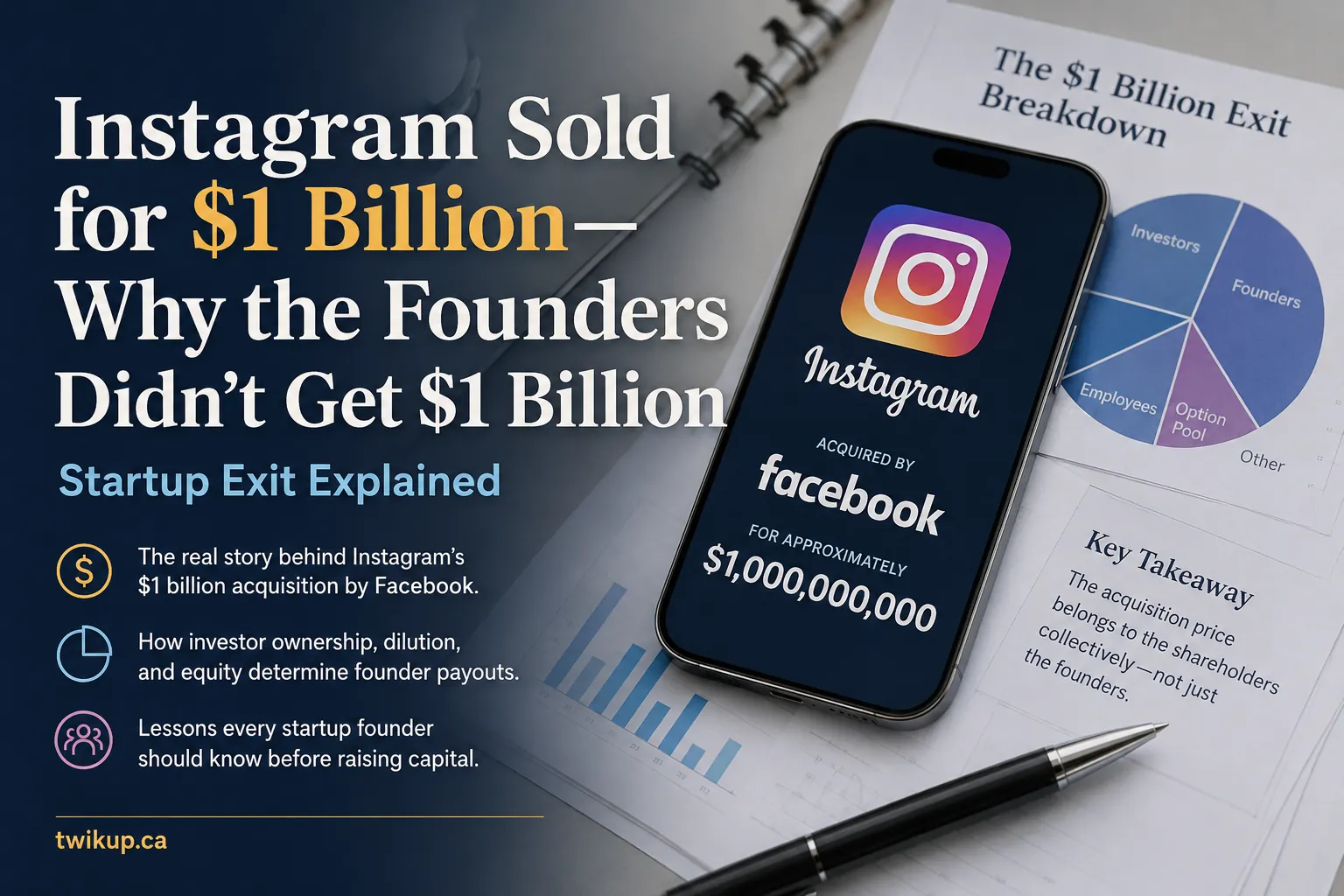
Instagram Sold for $1 Billion—Why the Founders Didn't Get $1 Billion
In April 2012, the technology world was stunned.
Facebook announced it would acquire Instagram for approximately $1 billion.
At first glance, it sounded simple.
A small photo-sharing app with only 13 employees had just become a billion-dollar company.
News headlines around the world celebrated the acquisition.
Many readers walked away believing one thing:
Instagram's founders became instant billionaires overnight.
But that's not what actually happened.
The $1 billion acquisition price belonged to the company—not to a single person.
Like almost every venture-backed startup, Instagram had multiple shareholders.
Those shareholders included:
- Founders
- Venture capital investors
- Early employees
- Advisors
- Option holders
Every one of them owned a piece of Instagram.
When Facebook bought the company, the money wasn't deposited into Kevin Systrom's personal bank account.
Instead, it was divided according to ownership.
This is one of the biggest misconceptions about startup exits.
The acquisition price is only the beginning.
The ownership structure determines who actually gets paid.
If you haven't already, read our complete guide:
Related Reading
How Startup Exits Work: IPOs, Acquisitions, and Founder Payouts (2026 Founder Guide)
That article explains liquidation preferences, acquisitions, IPOs, founder payouts, and cap tables in detail.
This article builds on those concepts using one of the most famous startup acquisitions in history.
💡 TwikUp Insight
The headline acquisition price belongs to the shareholders collectively—not to the founder alone.
Every funding round, employee option grant, and investment changes how exit proceeds are ultimately distributed.
Why Instagram's Acquisition Changed Silicon Valley
Today Instagram is one of the world's largest social media platforms.
But in 2012, things looked very different.
Instagram had:
- Around 30 million registered users
- No significant revenue
- Just 13 employees
- Extraordinary engagement
- Explosive user growth
The company wasn't purchased because it was generating billions in profit.
Facebook saw something much more valuable:
Attention.
Instagram had become the fastest-growing mobile social platform in history.
At a time when Facebook was still transitioning from desktop to mobile, Instagram represented both an opportunity and a competitive threat.
Instead of building a rival product from scratch, Facebook decided to acquire Instagram.
The acquisition would become one of the most successful technology purchases ever made.
The Birth of Instagram
Instagram officially launched in October 2010.
The founders were:
- Kevin Systrom
- Mike Krieger
Originally, the product was very different.
Kevin Systrom had been working on an app called Burbn, which combined location sharing, check-ins, gaming features, and photo uploads.
The product tried to do too many things.
Users mainly cared about one feature:
Uploading photos.
Rather than adding more features, Systrom and Krieger made a bold decision.
They removed almost everything.
The team rebuilt the application around one simple experience:
Take a photo.
Apply a filter.
Share it instantly.
That relentless focus transformed Instagram into one of the fastest-growing consumer apps ever created.
Growth That Shocked Silicon Valley
Instagram's growth was unlike almost anything investors had seen.
Within:
24 Hours
Over 25,000 users joined.
Two Months
The platform reached 1 million users.
One Year
Instagram had surpassed 10 million users.
Early 2012
More than 30 million users.
Millions of photos were uploaded every day.
Even more impressive:
Instagram achieved this growth with an incredibly small team.
At the time of acquisition, only about 13 employees were running one of the fastest-growing social platforms in the world.
This extraordinary efficiency attracted investors and potential acquirers alike.
Why Investors Loved Instagram
Instagram wasn't simply growing.
It demonstrated nearly every characteristic venture capitalists look for.
Massive User Growth
User adoption was accelerating without expensive marketing campaigns.
Strong Product-Market Fit
People weren't just downloading Instagram.
They were using it every day.
Engagement levels were exceptionally high.
Network Effects
Every new user made Instagram more valuable.
Friends invited friends.
Creators attracted audiences.
More content attracted more users.
The platform became increasingly difficult for competitors to replicate.
Mobile-First Strategy
In 2010 and 2011, many technology companies still prioritized desktop experiences.
Instagram focused entirely on smartphones.
That decision proved visionary.
Simple Product
Instead of solving dozens of problems, Instagram solved one problem exceptionally well.
Users could capture beautiful photos and share them instantly.
The simplicity became one of its greatest competitive advantages.
Facebook Wasn't the Only Company Paying Attention
By early 2012, Instagram had become impossible to ignore.
Technology companies understood that mobile photography and social sharing represented the future.
Instagram wasn't simply another startup.
It had become one of the fastest-growing consumer applications in history.
Reports suggested multiple companies were interested in partnerships or acquisitions.
Facebook moved quickly.
On April 9, 2012, Mark Zuckerberg announced Facebook's agreement to acquire Instagram.
The transaction was valued at approximately:
$1 Billion
The deal consisted of:
- Cash
- Facebook shares
It immediately became one of the largest startup acquisitions ever completed for a company with so few employees.
The announcement dominated technology headlines around the world.
For many readers, one assumption quickly emerged.
Instagram's founders just became billionaires.
That assumption was understandable.
But it wasn't accurate.
In the next section, we'll examine Instagram's ownership structure, how venture capital influenced the cap table, and why the $1 billion headline never translated into a $1 billion founder payout.
The $1 Billion Was Never Meant for One Person
One of the biggest misconceptions about startup acquisitions is that the founder receives the entire purchase price.
That almost never happens.
When Facebook acquired Instagram for approximately $1 billion, it wasn't buying Kevin Systrom's personal company.
It was buying Instagram, Inc.
Every shareholder owned a percentage of that company.
When the acquisition closed, the proceeds were distributed according to ownership—not according to who appeared in the headlines.
This is exactly how most startup acquisitions work today.
Who Owned Instagram Before the Acquisition?
Like most venture-backed startups, Instagram had multiple shareholders.
These included:
- Kevin Systrom (Co-founder)
- Mike Krieger (Co-founder)
- Venture Capital Investors
- Early Employees
- Advisors
- Option Holders
Although the exact ownership percentages were never publicly disclosed in full, several regulatory filings, investor reports, and industry analyses provide a reasonable picture of how ownership was distributed.
A simplified illustration looked something like this.
| Shareholder | Approximate Ownership |
|---|---|
| Kevin Systrom | Significant Founder Stake |
| Mike Krieger | Significant Founder Stake |
| Benchmark Capital | Major VC Investor |
| Other Investors | Minority Stakes |
| Employee Option Pool | Equity Grants |
Important: These figures are illustrative because the complete cap table has never been made public. The exact ownership percentages remain private.
The Role of Venture Capital
Instagram wasn't entirely self-funded.
Like thousands of startups before and after it, Instagram raised venture capital to accelerate growth.
One of the most important investors was Benchmark Capital.
Benchmark invested approximately $7 million during Instagram's Series A funding round.
At the time, Instagram was still a young company with enormous potential but very little revenue.
The investment allowed the founders to:
- Hire engineers
- Scale infrastructure
- Improve the product
- Support explosive user growth
- Continue expanding without relying on immediate profitability
Without venture capital, Instagram's growth might have been much slower.
But raising investment also meant giving away ownership.
This is one of the most important trade-offs every startup founder faces.
Funding Creates Dilution
Every time founders raise investment, they usually exchange equity for capital.
That means founders own a smaller percentage of the company after each financing round.
For example:
Suppose a founder initially owns:
100%
They raise investment and sell:
20%
Ownership becomes:
Founder: 80%
Investor: 20%
Raise another round?
Founder ownership decreases again.
Raise multiple rounds?
Founder ownership continues to shrink.
This process is known as dilution.
It is completely normal.
In fact, nearly every successful venture-backed startup experiences dilution.
The key question is not:
"Did I get diluted?"
The better question is:
"Did the value of my ownership increase faster than my percentage decreased?"
A Smaller Piece of a Bigger Company
Many first-time founders fear dilution.
But dilution is not automatically bad.
Imagine these two scenarios.
Scenario A
Own 100% of a company worth:
$2 million
Your ownership value:
$2 million
Scenario B
Own 30% of a company worth:
$1 billion
Your ownership value:
$300 million
Although your ownership percentage is smaller, your financial outcome is dramatically better.
Instagram is one of the best examples of this principle.
The founders owned less than 100% after raising venture capital—but the company's value grew exponentially.
💡 TwikUp Insight
Great founders focus less on owning 100% of a small business and more on building a much larger company where a smaller ownership stake is worth significantly more.
Why Benchmark's Investment Became Legendary
Benchmark Capital invested roughly $7 million in Instagram.
Just two years later, Facebook acquired the company for approximately $1 billion.
The investment generated one of the most celebrated venture capital returns in Silicon Valley.
For Benchmark, Instagram became a textbook example of why venture capital works.
VC firms know that many investments will fail.
But a single extraordinary success can return an entire investment fund many times over.
Instagram became one of those rare success stories.
What Did Kevin Systrom Actually Receive?
This is the question most people ask.
The honest answer is:
Nobody outside the company knows the exact figure.
Instagram never publicly released its full capitalization table.
However, because Kevin Systrom retained a substantial ownership stake, industry analysts estimate that he personally received hundreds of millions of dollars, not $1 billion.
That distinction matters.
The acquisition price belonged to all shareholders collectively.
Kevin Systrom received his portion based on the percentage of Instagram he still owned after funding rounds and employee equity grants.
The same principle applied to:
- Mike Krieger
- Benchmark Capital
- Employees with stock options
- Other investors
Every shareholder received proceeds based on ownership.
Employee Equity Also Created Wealth
One often-overlooked aspect of the Instagram acquisition is its impact on employees.
Although Instagram employed only around 13 people, many of those employees had received stock options.
When Facebook completed the acquisition, eligible employees benefited from those equity awards.
For startup employees, equity can become one of the most valuable parts of total compensation.
This is why many engineers, designers, and early hires choose startups over larger companies.
While startup salaries may initially be lower, equity provides the opportunity to participate in future success.
Of course, equity is never guaranteed to become valuable.
Most startups never achieve billion-dollar exits.
But Instagram demonstrates what can happen when a startup succeeds.
The Acquisition Wasn't Entirely Cash
Another common misconception is that Facebook transferred $1 billion in cash.
It didn't.
The acquisition consisted of:
- Cash
- Facebook stock
Receiving stock rather than only cash meant shareholders continued participating in Facebook's future growth.
As Facebook's market value increased over the following years, the value of many shareholders' holdings increased as well.
This is common in large technology acquisitions.
Buyers often use their own shares to finance part of the purchase price.
Why Facebook Paid So Much
At the time of acquisition, many critics argued Facebook had dramatically overpaid.
After all:
- Instagram had almost no revenue.
- The company had only 13 employees.
- It was barely two years old.
But Facebook wasn't buying current revenue.
It was buying future potential.
Instagram already possessed:
- Extraordinary engagement
- Massive mobile growth
- Strong network effects
- A globally recognizable product
- Exceptional user retention
Facebook recognized something many others underestimated:
Attention would become one of the world's most valuable digital assets.
History proved that decision remarkably successful.
Today, Instagram generates tens of billions of dollars in annual advertising revenue and has more than two billion monthly active users.
Viewed through that lens, Facebook's $1 billion acquisition is widely regarded as one of the greatest technology investments ever made.
The Real Lesson for Startup Founders
The Instagram story isn't really about a billion-dollar acquisition.
It's about understanding ownership.
Many founders obsess over valuation.
Far fewer understand:
- Cap tables
- Investor ownership
- Employee option pools
- Dilution
- Exit proceeds
Those factors determine how much founders ultimately receive—not the headline acquisition price.
Instagram illustrates this perfectly.
The company sold for approximately $1 billion.
But the proceeds were shared among everyone who helped build and finance the business.
In the final part of this case study, we'll explore the biggest lessons founders should take from Instagram's acquisition, common myths about startup exits, and how you can avoid costly mistakes when raising capital.
7 Lessons Every Startup Founder Can Learn from Instagram's $1 Billion Exit
Instagram's acquisition wasn't just a landmark technology deal.
It became one of the greatest startup case studies ever because it demonstrates how product focus, venture capital, ownership, and timing work together to create extraordinary outcomes.
Here are the biggest lessons founders can apply today.
1. Great Products Solve One Problem Exceptionally Well
Instagram didn't start as Instagram.
Kevin Systrom's original app, Burbn, included check-ins, gaming, messaging, location sharing, and photo uploads.
It tried to do everything.
Users only cared about one feature:
Sharing photos.
Instead of adding even more features, the founders made a difficult decision.
They removed almost everything.
That focus transformed Instagram into one of the fastest-growing consumer apps in history.
Founder Takeaway
Don't build ten average features.
Build one exceptional product that people genuinely love using.
2. User Growth Can Be More Valuable Than Early Revenue
At the time Facebook acquired Instagram:
- Revenue was minimal.
- The team consisted of only about 13 employees.
- The company had not built a mature advertising business.
Yet Facebook still agreed to pay approximately $1 billion.
Why?
Because Instagram had something far more valuable:
- Explosive user growth
- Exceptional engagement
- Strong network effects
- Massive long-term potential
Technology companies often acquire future opportunity—not current revenue.
3. Venture Capital Doesn't Take Your Company—It Helps Build It
Some founders fear dilution so much that they avoid raising outside capital.
Instagram demonstrates why thoughtful fundraising can accelerate success.
Benchmark Capital invested approximately $7 million when Instagram was still a young company.
That funding helped the founders:
- Hire world-class talent
- Improve infrastructure
- Scale rapidly
- Support millions of new users
Without investment, Instagram may never have reached the scale that attracted Facebook.
The lesson isn't to avoid dilution.
The lesson is to raise capital responsibly.
4. Ownership Percentage Isn't Everything
Many first-time founders ask:
"How can I keep 100% ownership?"
A better question is:
"How can I maximize the value of the ownership I keep?"
Owning:
- 100% of a $2 million company
is often far less valuable than owning:
- 25% of a $1 billion company.
Instagram is a textbook example.
The founders owned less than 100%.
Yet their remaining ownership became extraordinarily valuable because the company itself became far more valuable.
5. Employees Help Build Billion-Dollar Companies Too
Instagram employed only around 13 people at the time of acquisition.
Many of those early employees received stock options.
As the company grew, those options became meaningful financial assets.
This is why startup equity matters.
When employees contribute to creating long-term value, equity allows them to participate in that success.
For founders, employee equity is not simply an expense.
It's a tool for attracting exceptional talent.
6. Headlines Never Tell the Whole Story
Most news articles simply reported:
Facebook buys Instagram for $1 billion.
That statement was true.
But it left out an important detail.
The acquisition price belonged to all shareholders collectively.
The proceeds were distributed among:
- Founders
- Venture capital investors
- Employees
- Advisors
- Other shareholders
No single person received the full acquisition price.
This misunderstanding still exists today whenever a major startup is acquired.
7. Every Funding Decision Shapes Your Exit
Many founders think about fundraising and exits as separate events.
They are not.
Every financing round changes:
- Ownership
- Dilution
- Investor rights
- Employee equity
- Future payouts
By the time a company is acquired, years of financing decisions have already determined how the proceeds will be distributed.
This is why founders should understand venture capital before signing their first term sheet.
💡 TwikUp Insight
A successful startup exit isn't won in the final acquisition meeting.
It's built over years through smart fundraising, disciplined ownership decisions, thoughtful hiring, and a clear understanding of how equity works.
Common Myths About Startup Acquisitions
Instagram's story has created several myths that continue to confuse entrepreneurs.
Let's separate fact from fiction.
| Myth | Reality |
|---|---|
| The founder gets the entire acquisition price. | The proceeds are distributed among all shareholders according to ownership. |
| A higher valuation guarantees a larger founder payout. | Investor rights, dilution, liquidation preferences, taxes, and ownership all influence final payouts. |
| Venture capital takes away founder wealth. | Responsible fundraising often helps founders build significantly more valuable companies. |
| Employees don't benefit from acquisitions. | Early employees with equity may receive substantial payouts during successful exits. |
| Revenue is the only thing buyers care about. | Strategic buyers often value growth, engagement, technology, talent, and market position alongside revenue. |
How This Applies to Your Startup
Whether you're building:
- A SaaS platform
- An AI company
- A FinTech startup
- A HealthTech business
- A marketplace
- A mobile application
the principles remain the same.
Before raising capital, understand:
- Your cap table
- Investor rights
- Equity dilution
- Employee option pools
- Future fundraising strategy
Every percentage point of ownership can have a significant impact when your company eventually reaches a liquidity event.
Thinking about exits early doesn't mean planning to sell tomorrow.
It means making informed decisions today.
Final Thoughts
Instagram's $1 billion acquisition is one of the most famous startup exits in history.
But the real lesson isn't the billion-dollar headline.
It's understanding how startup ownership works.
Kevin Systrom and Mike Krieger created one of the fastest-growing mobile products ever built.
Benchmark Capital helped finance that growth.
Employees contributed through years of hard work.
When Facebook acquired Instagram, everyone who owned equity shared in the success according to the company's ownership structure.
That is how startup exits work.
For founders, the goal isn't simply to build a valuable company.
The goal is to understand how ownership, fundraising, and equity shape the value you ultimately receive when success arrives.
Key Takeaways
- Instagram's $1 billion acquisition price was shared among founders, investors, employees, and other shareholders.
- Venture capital funding accelerated Instagram's growth but also diluted founder ownership.
- Employee stock options allowed early team members to participate in the acquisition.
- Strong user growth and product-market fit can be more valuable than early revenue.
- Every fundraising round influences future founder payouts.
- Understanding cap tables and ownership is just as important as building a great product.
- The best founders think about exit mechanics long before acquisition discussions begin.
Continue Learning About Startup Exits
Want to understand exactly how acquisitions, IPOs, liquidation preferences, founder payouts, and employee equity work?
Read our complete guide:
How Startup Exits Work: IPOs, Acquisitions, and Founder Payouts (2026 Founder Guide)
It explains the complete mechanics behind startup exits, including investor rights, cap tables, dilution, IPOs, acquisitions, and founder payout calculations.
Sources & Helpful References
Meta Investor Relations
SEC Filings
Benchmark Capital
Kevin Systrom Interviews
https://www.startupschool.org/
Y Combinator Startup Library
https://www.ycombinator.com/library
CB Insights – Venture Research
https://www.cbinsights.com/research/
Business Development Bank of Canada (BDC)
https://www.bdc.ca/en/articles-tools
About TwikUp
At TwikUp, we simplify complex topics into practical guides for founders, investors, homebuyers, professionals, and newcomers to Canada.
Follow TwikUp for expert insights on:
- 🚀 Startup Investing & Venture Capital
- 📈 Personal Finance
- 🏡 Canadian Real Estate
- 🏦 Mortgages
- 🍁 Canadian Immigration
Our goal is to help readers make smarter financial and business decisions through well-researched, easy-to-understand content.