
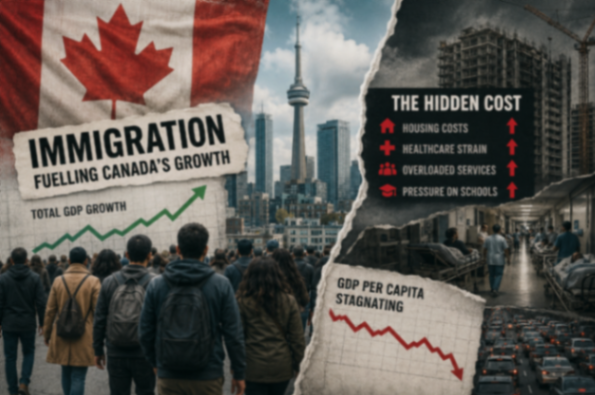
Immigration has helped Canada avoid a demographic cliff and expand its economy, but recent population growth has also exposed some of the country's biggest structural weaknesses. The result is a debate that is less about whether immigration is necessary and more about whether Canada can keep pace with the demands that come with it.
Why Canada's Economy Grew While Many Canadians Felt Left Behind
Immigration has been one of the strongest contributors to Canada's overall economic expansion.
Every new resident adds demand for housing, food, transportation, services, and consumer goods. More workers and consumers naturally increase economic activity, helping Canada maintain some of the strongest total GDP growth rates among G7 nations.
Yet a growing economy does not automatically translate into rising living standards.
While total economic output expanded, real GDP per capita declined repeatedly in recent years and remained close to levels seen several years earlier. This created a growing disconnect between national economic performance and the financial reality experienced by many households.
For many Canadians, the economy appeared to be growing on paper while affordability challenges continued to worsen.
The Retirement Wave That Makes Immigration Difficult to Replace
Canada faces a long-term demographic challenge that existed well before recent immigration debates emerged.
An aging population and low birth rates mean millions of workers are expected to leave the workforce over the coming years.
Key demographic pressures include:
- Millions of Canadians are expected to retire by 2030.
- Newcomers account for nearly all labour force growth.
- Immigrants play critical roles in healthcare, construction, and technology.
- Healthcare systems increasingly depend on internationally trained workers.
The healthcare sector provides one of the clearest examples of this dependence.
Newcomers represent a significant share of physicians, nurses, and other healthcare professionals, helping maintain services as demand rises from an aging population.
Without continued immigration, labour shortages across multiple sectors could become substantially more severe.
When Labour Growth Becomes a Productivity Challenge
While immigration helps fill vacancies, it can also create unintended economic consequences.
A growing supply of readily available labour may reduce incentives for businesses to invest in automation, technology, and productivity-enhancing equipment.
This creates what some economists describe as a productivity trap.
Instead of increasing efficiency through innovation, businesses may rely on expanding headcounts to meet demand. Over time, this can weaken productivity growth, which is one of the most important drivers of long-term wage increases and economic prosperity.
The challenge is not immigration itself but ensuring newcomers are integrated into higher-value jobs that strengthen productivity rather than simply increasing labour supply.
Housing, Hospitals, and Schools Reached a Breaking Point
The most visible impact of rapid population growth has been felt in physical infrastructure.
Housing construction struggled to keep pace with population increases, particularly during periods when more than one million people were added in a single year.
The result was a widening gap between housing demand and available supply.
Major pressure points included:
- Rising rents across many cities.
- Increased home prices.
- Longer wait times for healthcare services.
- Overcrowded hospitals and clinics.
- Growing strain on public school systems.
- Delays in various social services.
These pressures highlighted a broader policy challenge: population growth can occur much faster than infrastructure expansion.
When growth significantly outpaces construction and service capacity, quality-of-life concerns become increasingly difficult to ignore.
Why Immigration Policy Is Shifting Toward Capacity Limits
Recent policy discussions have increasingly focused on matching immigration levels with infrastructure readiness.
The central question is no longer whether Canada needs immigration. Most economic and demographic indicators suggest it does.
Instead, policymakers are examining whether housing construction, healthcare expansion, and labour market integration can keep pace with newcomer arrivals.
This concern has contributed to decisions to reduce temporary and permanent resident targets after years of rapid growth.
The objective is to better align population increases with Canada's ability to absorb and support them.
| Immigration Benefits | Key Challenges |
|---|---|
| Expands total economic output | Does not guarantee higher individual wealth |
| Supports labour force growth | GDP per capita can stagnate |
| Helps offset retirements | Housing demand can outpace supply |
| Strengthens healthcare staffing | Public services face added pressure |
| Supports key industries | Productivity growth may weaken |
FAQ: Brief Insights on Canadian Immigration
Is immigration necessary for Canada's economy?
Yes. Immigration helps replace retiring workers, supports labour force growth, and fills critical shortages in sectors such as healthcare and construction.
Why do some Canadians feel worse off despite economic growth?
Because total GDP and individual prosperity are different measures. An economy can grow overall while GDP per capita and affordability conditions remain under pressure.
How does immigration affect housing?
Rapid population growth increases housing demand. When home construction fails to keep pace, rents and property prices tend to rise.
Why are policymakers reducing immigration targets?
The focus has shifted toward aligning population growth with available housing, healthcare capacity, and public infrastructure.