
Key Takeaways
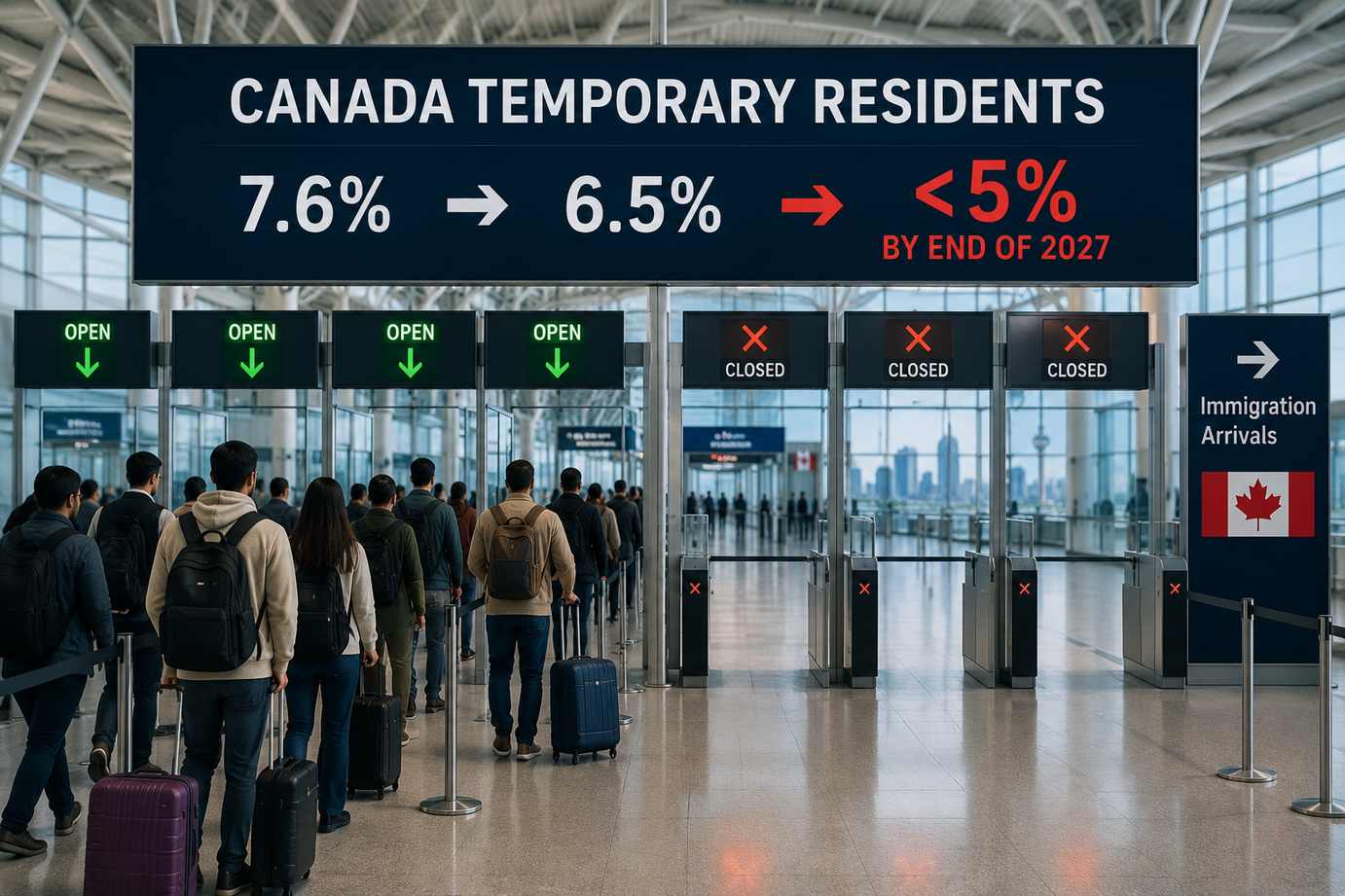
- Canada aims to reduce its temporary population to less than 5% of the total population by the end of 2027.
- The 2026 plan targets 385,000 new temporary resident arrivals: 155,000 students and 230,000 workers.
- Ottawa has not announced a temporary-resident percentage target beyond the current below-5% objective.
Canada's immigration system is moving through one of its biggest shifts in years.
After a period of rapid population growth driven partly by international students and temporary workers, the federal government is now deliberately trying to reduce Canada's temporary population.
The official objective is clear: bring Canada's temporary population to less than 5% of the country's total population by the end of 2027.
And the latest numbers suggest the shift is already well underway.
New international student arrivals have fallen dramatically. Temporary worker arrivals are down. Ottawa has lowered its targets for future temporary resident arrivals and tightened several programs that previously helped drive temporary immigration.
But 2027 may not be the end of the story.
The federal government is now preparing Canada's 2027–2029 Immigration Levels Plan, which is expected this fall.
That raises an important question:
Once Canada gets temporary residents below 5%, what happens next?
For international students, foreign workers, employers and people hoping to transition from temporary status to permanent residence, the answer could shape Canada's immigration system for years.
Canada's Immigration Story Has Changed Remarkably Quickly
Imagine arriving in Canada as an international student only a few years ago.
The system around you looked very different.
Canadian colleges and universities were recruiting heavily overseas. Employers were looking internationally for workers. Post-graduation work opportunities gave many students a chance to gain Canadian experience.
For some temporary residents, permanent residence seemed like the natural next chapter.
Then Canada's immigration conversation changed.
Housing affordability became a much larger political and economic concern. Canada's population expanded rapidly. Questions intensified over whether housing construction, health care, infrastructure and other public services could keep pace.
Federal immigration policy subsequently began shifting from rapid expansion toward lower and more controlled temporary immigration levels.
That change is now visible in the numbers.
IRCC briefing material says Canada's non-permanent resident population has declined from a peak of approximately 7.6% of the total population to about 6.5%.
The government's current destination is below 5% by the end of 2027.
And one of the main ways Ottawa is trying to get there is by reducing the flow of new temporary residents entering the country.
Canada Is Targeting 385,000 New Temporary Resident Arrivals in 2026
Canada's 2026–2028 Immigration Levels Plan establishes targets for new temporary resident arrivals.
| Year | Target for new temporary resident arrivals |
|---|---|
| 2026 | 385,000 |
| 2027 | 370,000 |
| 2028 | 370,000 |
The 2026 target is divided into:
155,000 new student arrivals
and
230,000 new worker arrivals.
For both 2027 and 2028, the student target is 150,000 annually, while the worker target is 220,000.
But there's an extremely important detail hidden behind those numbers.
These are targets for new arrivals.
They do not mean Canada will have only 385,000 temporary residents in 2026.
Canada already has a much larger population of people holding temporary status.
Meanwhile, people are constantly moving through the system.
Some temporary residents leave Canada.
Some extend or change their status.
Some transition to permanent residence.
And new students and workers continue arriving.
That is why reducing Canada's total temporary population is more complicated than simply reducing the number of permits issued during a particular year.
International Student Arrivals Have Already Fallen Dramatically
Perhaps the clearest evidence of Canada's immigration reset can be found in the international student numbers.
According to IRCC's latest data, covering January through June 2026, Canada recorded approximately:
22,405 new study permit holder arrivals
and
98,125 new work permit holder arrivals.
Now compare the student numbers with previous full years.
2024: 292,885 new student arrivals
2025: 115,005 new student arrivals
January–June 2026: 22,405 new student arrivals
Between 2024 and 2025 alone, new student arrivals declined by approximately 61%.
Worker arrivals also fell substantially.
2024: 393,205 new worker arrivals
2025: 208,625 new worker arrivals
January–June 2026: 98,125 new worker arrivals
That represents an approximately 47% decline between 2024 and 2025.
IRCC cautions that these figures are approximate, and its methodology excludes certain groups, including permit extensions, asylum claimants and some seasonal or short-duration workers.
Even with that qualification, the direction is unmistakable.
Canada isn't merely planning to reduce temporary immigration sometime in the future.
The intake pipeline has already changed.
How Did Canada Get Here?
There wasn't one immigration announcement that suddenly changed everything.
Instead, Ottawa introduced a series of policy changes affecting different parts of the temporary immigration system.
Canada introduced an annual cap on international student study permits in 2024 and subsequently announced further reductions.
The government also strengthened requirements within the International Student Program.
Changes were made to the Post-Graduation Work Permit Program, including language requirements and, for certain non-degree programs, field-of-study requirements linked to occupations facing longer-term labour shortages.
Eligibility for open work permits available to some spouses of international students and temporary foreign workers was also restricted.
The Temporary Foreign Worker Program changed as well.
Among other measures, Ottawa placed limits on low-wage hiring and stopped processing certain low-wage Labour Market Impact Assessment applications in census metropolitan areas where unemployment reaches the applicable threshold.
Taken together, these policies have created a considerably different temporary immigration environment from the one Canada had only a few years ago.
Why Does the 5% Target Matter So Much?
The government's commitment to bring Canada's temporary population below 5% by the end of 2027 may sound like just another percentage.
It isn't.
At 5%, temporary residents would represent roughly one out of every 20 people in Canada.
IRCC says the non-permanent resident share had previously reached approximately 7.6%.
Moving from that peak to below 5% therefore requires a substantial change in Canada's temporary population relative to the overall population.
But here's where the next immigration debate becomes interesting.
The government has established where it wants the temporary population to be by the end of 2027.
It has not yet announced what percentage it believes should represent Canada's longer-term normal after that point.
There is currently no announced federal target below the existing less-than-5% commitment.
That makes Canada's next Immigration Levels Plan particularly important.
Ottawa Is Already Preparing the Next Immigration Plan
Canada's current immigration reset doesn't end with the 2026–2028 plan.
IRCC held public consultations from May 12 through June 30, 2026 as it prepares Canada's 2027–2029 Immigration Levels Plan.
The federal government says immigration planning needs to balance several competing priorities.
Canada wants immigration to help fill labour shortages and strengthen important sectors of the economy.
It also wants to support family reunification, meet humanitarian commitments and increase Francophone immigration outside Quebec.
At the same time, Ottawa says overall immigration levels need to be better aligned with the capacity of Canada's housing, infrastructure and public services.
Those goals don't always point in exactly the same direction.
The new Immigration Levels Plan is expected to be tabled in fall 2026.
And one of the most important things to watch will be what Ottawa says about temporary immigration after 2027.
There's Another Side to Canada's Immigration Equation
Reducing temporary immigration isn't simply a matter of issuing fewer study permits.
Canada continues to rely on temporary foreign workers in industries and communities facing labour shortages.
That creates a difficult balancing act.
Reduce temporary immigration too slowly, and pressures involving housing, infrastructure and services could remain elevated.
Reduce it too aggressively, and some employers and communities could struggle to fill jobs.
The government's current Immigration Levels Plan attempts to navigate that tension.
Workers make up the majority of planned temporary resident arrivals under the 2026–2028 plan.
Ottawa says its targets are designed to meet labour-market needs while prioritizing Canada's existing workforce.
But perhaps the most interesting part of Canada's strategy involves people who are already here.
Canada Is Moving Some Temporary Workers Toward Permanent Residence
Canada's immigration reset isn't simply about reducing the number of temporary residents.
The government is also trying to retain certain workers who are already contributing to Canadian communities.
Ottawa has launched a one-time In-Canada Workers Initiative intended to accelerate the transition of up to 33,000 workers to permanent residence during 2026 and 2027.
IRCC says the initiative is initially focusing on eligible workers who have already applied for permanent residence through established regional programs and occupation-driven pathways and who have been living in smaller Canadian communities for at least two years.
The government is aiming to transition at least 20,000 workers in 2026, with the remainder expected in 2027.
That reveals an important part of Canada's evolving immigration strategy.
It's not simply:
"Temporary residents out."
It's closer to:
reduce new temporary arrivals while selectively retaining people Canada considers important to particular communities and labour-market needs.
That distinction could become increasingly important.
What Could This Mean for International Students?
For prospective international students, Canada's new direction means the system is becoming considerably more selective.
The era of rapidly expanding international student volumes is no longer Canada's policy direction.
Lower arrival targets, tighter PGWP requirements and restrictions affecting some accompanying spouses have changed the calculation for people considering Canada as a study destination.
That doesn't mean studying in Canada has stopped being valuable.
Canadian universities and colleges continue to attract international students, and Ottawa has specifically emphasized attracting certain highly skilled students and researchers.
But one distinction needs to be clearer than ever:
A Canadian education and Canadian permanent residence are not the same thing.
Studying in Canada should not automatically be interpreted as a guaranteed pathway to permanent residence.
Immigration eligibility depends on the programs and requirements available when someone applies.
What About Temporary Foreign Workers?
For workers, the picture is more complicated.
Canada continues to need foreign labour in certain sectors and regions.
But Ottawa is simultaneously reducing overall worker arrival targets and emphasizing employment opportunities for Canada's existing workforce.
That means factors such as occupation, skill level, wage, industry, location and immigration program may become increasingly important in determining where temporary foreign labour continues to play a significant role.
Someone working in an occupation facing a serious labour shortage in a smaller Canadian community may encounter a very different immigration environment from someone entering a sector where domestic labour is readily available.
Canada isn't closing temporary worker programs.
It is becoming more selective about where temporary immigration is used.
What About People Already in Canada?
This may be the most important part of the story.
Reducing Canada's temporary-resident share does not mean millions of people suddenly disappear from population statistics.
Think of Canada's temporary population like water in a bathtub.
New temporary residents entering Canada are the faucet.
People leaving temporary status are the drain.
Ottawa can turn down the faucet by admitting fewer new students and workers.
But the water level also depends on what happens at the other end.
Temporary residents may leave Canada.
Some may transition to permanent residence.
Others may extend or change their legal status.
At the same time, new temporary residents continue arriving.
That is why Canada can dramatically reduce new arrivals without seeing the total temporary-resident population decline by exactly the same percentage immediately.
The government's below-5% objective depends on both sides of that equation.
What Happens After Canada Reaches 5%?
This may become one of the biggest Canadian immigration questions of 2027.
The government has told Canadians where it wants the temporary population to go:
below 5%.
But that target has a deadline attached to it — the end of 2027.
What happens afterward hasn't yet been established through a new publicly announced percentage target.
Ottawa could decide that keeping the temporary population around that level provides the right balance.
It could allow the share to fluctuate depending on economic conditions.
Or future Immigration Levels Plans could pursue additional reductions.
Those are possibilities — not announced government policy.
That's precisely why the upcoming 2027–2029 Immigration Levels Plan matters.
TwikUp Insight
The most important Canadian immigration number over the next year may not be another Express Entry CRS score.
It could be 5%.
Canada's immigration system has already changed significantly.
New student arrivals fell from approximately 292,885 in 2024 to 115,005 in 2025.
New worker arrivals fell from approximately 393,205 to 208,625 over the same period.
During the first six months of 2026, Canada recorded only 22,405 new study permit holder arrivals and 98,125 new work permit holder arrivals under IRCC's methodology.
Meanwhile, Ottawa is targeting just 385,000 total new temporary resident arrivals in 2026, followed by 370,000 in 2027 and 2028.
And the government's broader objective remains unchanged:
reduce Canada's temporary population to less than 5% of the total population by the end of 2027.
What we don't know yet is what Ottawa wants the system to look like afterward.
That distinction matters.
There is currently no announced federal target saying Canada's temporary population will fall to 4%, 3% or any other specific percentage after 2027.
The next major clue should arrive when Ottawa tables Canada's 2027–2029 Immigration Levels Plan this fall.
Until then, Canadians don't need speculation to see that an immigration reset is happening.
The numbers already show it.
International student arrivals have fallen sharply.
Temporary worker arrivals have declined.
Future arrival targets have been reduced.
Some immigration pathways have become more selective.
And at the same time, Canada is creating targeted opportunities to transition certain workers already contributing to Canadian communities into permanent residents.
The question is no longer whether Canada's temporary immigration system is changing.
It already has.
The bigger question is what Canada decides the new normal should look like after 2027.
Sources
- Immigration, Refugees and Citizenship Canada — Supplementary Information for the 2026–2028 Immigration Levels Plan
- Immigration, Refugees and Citizenship Canada — Understanding Student and Temporary Worker Numbers in Canada
- Immigration, Refugees and Citizenship Canada — Temporary Resident Targets, March 23, 2026