
Key Takeaways
- Using a rubber-hand illusion and millisecond brain imaging, researchers mapped the feeling of body ownership to a sequence lasting about a tenth of a second.
- The key integration step happened roughly 116 to 156 milliseconds after touch, in right premotor and parietal cortex and the cerebellum.
- The brain began preparing the ownership response before the touch even arrived — one parietal region peaked 76 milliseconds early.
How fast does your brain claim a hand as its own?
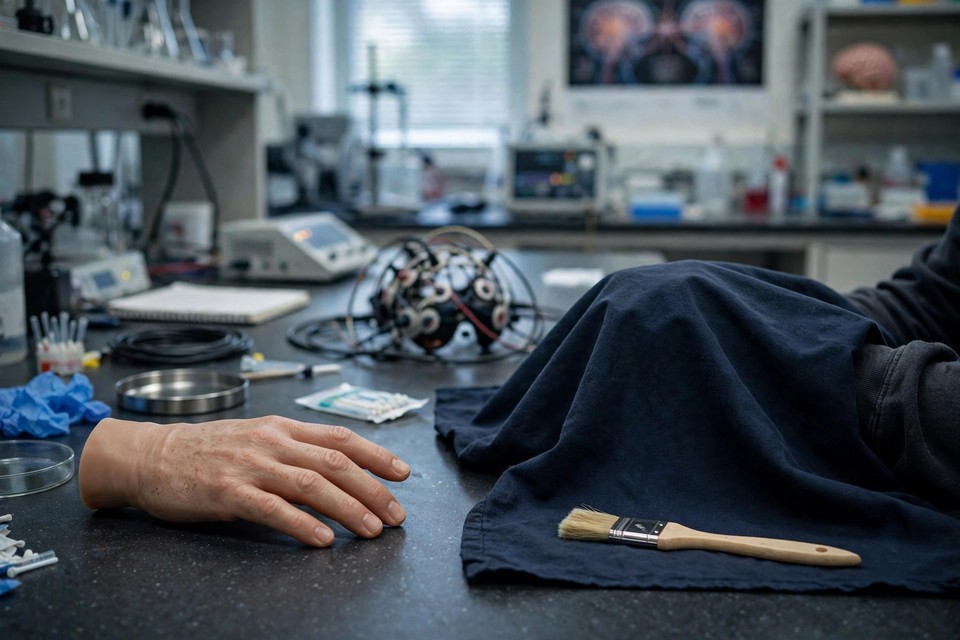
Put a realistic rubber hand in front of someone, hide their real hand, and brush both at the same time — within minutes, most people feel the fake hand is theirs. It is psychology's most famous illusion, and it reveals something real: the feeling that your body belongs to you is something your brain actively builds.
Researchers at Sweden's Karolinska Institutet put volunteers in an MEG scanner — a machine that reads the brain's magnetic fields millisecond by millisecond — while robotic arms delivered precisely timed brush strokes to a fake left hand and the volunteer's hidden real one.
Forty-five healthy adults took part; the brain findings rest on the 30 participants who actually experienced the illusion.
A tenth of a second, in three acts
The ownership signal unfolded in a timed sequence:
Before touch: the brain set the stage early. A region in the right posterior parietal cortex peaked 76 milliseconds before the brush arrived, with the cerebellum active about 44 milliseconds early — the brain was anticipating the touch, not just reacting to it.
Integration, ~116 to 156 milliseconds after touch: right premotor cortex, right posterior parietal cortex and the front of the cerebellum combined sight and touch into the feeling of ownership. The parietal peak came at 132 milliseconds.
Late phase, from ~184 milliseconds: the insula, on both sides, joined in, followed by the left premotor cortex.
The researchers note the right-hemisphere-first pattern may help explain why people who suffer right-brain strokes so often lose the feeling that their left hand belongs to them.
The Twikup Take
"I know it's my hand" feels instant and obvious — it is neither. It is a construction project your brain finishes in about a tenth of a second, starting before the touch even lands. Knowing the exact timetable matters for prosthetics and stroke rehabilitation, where rebuilding that feeling is the whole job.
Image: Illustrative image.