
Key Takeaways
- Webb's mid-infrared mapping of individual dust clumps in Cassiopeia A shows the star's inner shells merged shortly before it exploded — possibly just hours before core collapse.
- Two regions inside the remnant are dominated by silica and carbon dust, while the "Green Monster" is rich in magnesium silicates shed before the explosion.
- The results, published November 23 in The Astrophysical Journal Letters, give astronomers a new way to read an exploded star's internal structure from its dust.
The star's insides churned — possibly hours before it blew apart
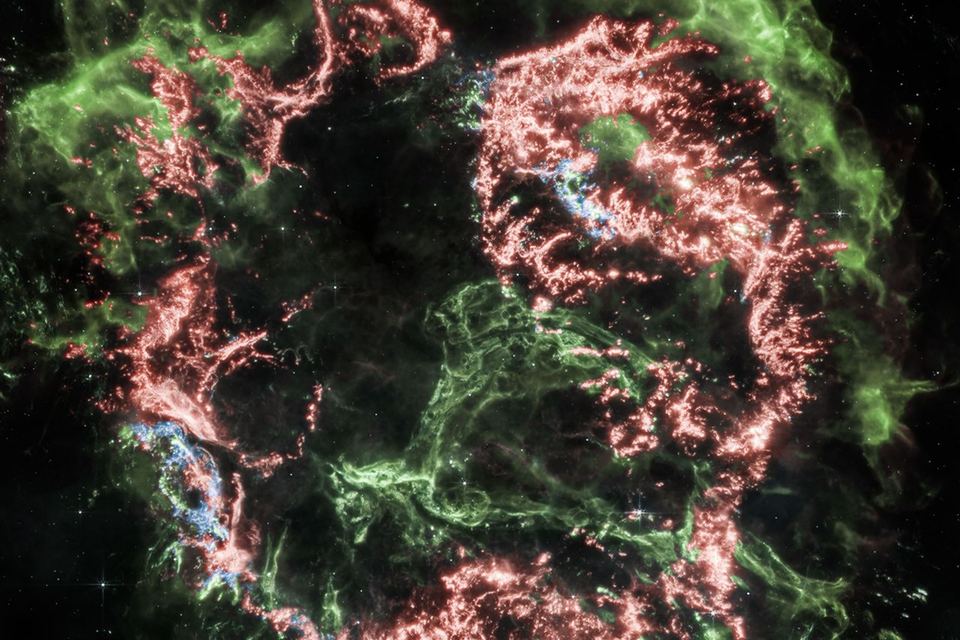
A star's final hours are impossible to watch directly. But NASA's James Webb Space Telescope has now read them in dust. In findings published November 23 in The Astrophysical Journal Letters, Webb mapped the chemistry of individual, solar-system-sized dust clumps across the Cassiopeia A supernova remnant — and the pattern points to a "shell merger" inside the star shortly before it exploded.
Inside a massive star, elements burn in layered shells. "Material within these shells churns and circulates, which can cause the shells to merge shortly before the supernova explosion," said lead author Tea Temim of Columbia University. NASA says the merger may have been underway just hours before the star's core collapsed.
Three regions, three different stories
Two regions Webb studied sit in the remnant's reverse-shocked zone: one's debris is mostly silica dust, the other's dominated by carbon — exactly the mixed chemistry a shell merger would leave behind. The third, the filament structure nicknamed the "Green Monster," is rich in complex magnesium silicates and came from material the star shed before exploding, not from the blast itself.
The dust map, about 24 light-years across in a remnant 11,090 light-years away, builds on earlier target-finding by the retired Spitzer telescope and X-ray data from Chandra and XRISM.
Why dust chemistry matters
"With Webb, the vast improvement in being able to resolve at the individual clump level helps us do more sophisticated dust chemistry," said co-author Dan Milisavljevic of Purdue University. "It's telling us about what was happening, we think, in the hours leading up to core collapse." Because a star's internal structure decides which elements its explosion scatters into the galaxy, reading that structure from the wreckage explains how future stars and planets get their ingredients.
The Twikup Take
Astronomers usually reconstruct an explosion from its aftermath centuries later. Webb has turned Cassiopeia A's dust into something closer to a flight recorder — evidence that a star can rearrange its own insides in its final hours, changing what the explosion delivers to the universe.
Image: Dust in Cassiopeia A (MIRI image), showing the hot dust of the supernova remnant Cassiopeia A. Credit: NASA. (https://science.nasa.gov/asset/webb/dust-in-cassiopeia-a-miri-image/)