
Key Takeaways
- All seven DragonCam cameras are installed and tested on NASA's Dragonfly rotorcraft.
- The cameras must work at Titan temperatures of minus 290 degrees Fahrenheit.
- Dragonfly launches in July 2028 and reaches Titan in late 2034.
A flying laboratory gets its eyes
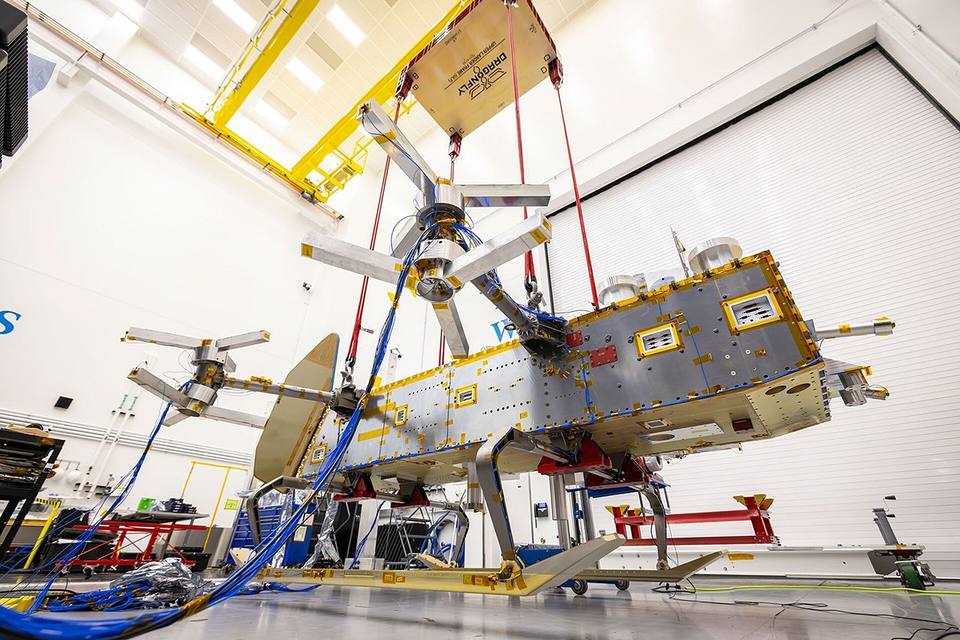
The car-sized rotorcraft NASA is sending to Saturn's moon Titan can now see. All seven cameras of the DragonCam suite have been installed, tested and integrated into the Dragonfly lander at the Johns Hopkins Applied Physics Laboratory in Laurel, Maryland, NASA announced Tuesday.
DragonCam, built by Malin Space Science Systems, is the first major science instrument package to arrive for the mission. The cameras sit in insulated housings behind protective windows — they have to work at Titan surface temperatures of minus 290 degrees Fahrenheit.
Seven cameras, four jobs
Two forward-mounted cameras — a wide-angle camera with a 90-degree field of view and a medium-angle camera overlapping it at higher resolution — will give stereoscopic views of the terrain ahead, for science and for flying. Two side-mounted wide-angle cameras will build panoramas. Two downward-facing cameras will check landing sites for safety around the drill and seismometer.
The seventh is a high-resolution microscopic imager that will examine millimetre-sized sand grains collected at the drill site. An LED array built at APL, spanning infrared to ultraviolet light, may even reveal organic molecules that fluoresce during Titan's night, which lasts about eight Earth days. Two separate navigation cameras were installed over the summer, bringing the craft's total to nine.
Next stops: more instruments, then a 2028 launch
Dragonfly's other instruments — a gamma-ray and neutron spectrometer, a geophysics and meteorology package, a mass spectrometer and the drill itself — will be delivered and integrated over the next several months. The mission, led by principal investigator Elizabeth Turtle, is scheduled to launch in July 2028 and reach Titan in late 2034, where it will fly between sites to study the moon's chemistry and habitability.
The Twikup Take
Dragonfly is still six years from Titan, but this is the moment it stops being a frame and starts being a spacecraft — its first science payload is in, tested, and already taking pictures of the clean room it will leave behind.
Image: NASA.