
Key Takeaways
- Geomagnetic storms are rated G1 to G5 by the Kp index; a G5 can collapse power grids, push pipeline currents into the hundreds of amps, and knock out HF radio for one to two days —
- A flare's radiation reaches Earth in about 8 minutes, but the damaging plasma cloud (a CME) takes 1 to 3 days — which is the warning window forecasters work with.
- Canada is among the most exposed countries on Earth:in March 1989 a storm collapsed the Hydro-Québec grid in about 90 seconds, leaving over 6 million people in the dark for 9 hours
Two things leave the Sun — and they travel at very different speeds
A solar flare is a flash of radiation, classified A, B, C, M or X, each letter ten times stronger than the last. Its light reaches Earth in about 8 minutes, so radio effects begin essentially when the flare is seen. The strongest flare ever measured with modern instruments, in 2003, saturated its sensors at X28.
The real threat is what often follows: a coronal mass ejection, a gigantic cloud of electrified gas. A CME takes 1 to 3 days to cross to Earth — and that gap is the entire basis of space-weather forecasting. Once the cloud passes the ACE satellite, parked 1.5 million kilometres sunward of Earth, forecasters get a final 30 to 90 minutes of warning.
The G-scale: from pretty lights to grid collapse
NOAA rates geomagnetic storms by the Kp index:
- G1 (Kp 5): weak grid fluctuations, aurora at high latitudes — about 1,700 per solar cycle.
- G2 (Kp 6): voltage alarms in northern power systems; long storms can damage transformers; aurora as far south as New York.
- G3 (Kp 7): voltage corrections, false alarms on grid protection devices, patchy satellite navigation and HF radio; aurora to Illinois and Oregon.
- G4 (Kp 8): possible widespread voltage problems, some grid protection systems tripping key assets by mistake, satellite navigation degraded for hours; aurora to Alabama.
- G5 (Kp 9): some grid systems may suffer complete collapse or blackouts, transformers can be damaged, pipeline currents can reach hundreds of amps, HF radio can be impossible for one to two days, and aurora can reach Florida. G5s average only about four per 11-year cycle.
Canada's proof: Québec, March 13, 1989
Canada sits close to the north magnetic pole and under the auroral zone, among the most storm-exposed places on Earth — and it has the scar tissue to prove it. A CME that left the Sun on March 10, 1989 reached Earth on March 12. The next morning, storm-induced currents tripped Hydro-Québec's protective devices in cascade: the entire 21,000 MW grid collapsed in about 90 seconds, and over six million people lost power for nine hours.
Satellites are Canadian victims too: on January 20, 1994, a space-weather disturbance knocked out Anik E1 and E2, the country's main communications satellites, cutting cable TV, media transmission and northern telephone service.
The historical ceiling — and the modern benchmark
The largest geomagnetic storm ever recorded is still the Carrington Event of 1859: aurora far beyond its usual range, telegraph operators shocked, wires sparking fires, and some telegraphs sending messages while unplugged. The modern benchmark came in May 2024, when at least eight Earth-directed CMEs produced the first G5 storm since 2003 — aurora reported down to 26 degrees magnetic latitude and so many satellites manoeuvring at once that NASA called it one of the largest satellite migrations in history. The Sun runs on a roughly 11-year activity cycle, and storms cluster around its maximum.
How Canada watches
The Canadian Space Weather Forecast Centre, part of Natural Resources Canada's Geomagnetic Laboratory, monitors the Sun-to-Earth chain and the ground magnetic field through a national magnetometer network, issuing the forecasts and alerts that let power utilities harden their operations before a storm lands. Induced currents are the common thread — in power lines, pipelines (where they quietly corrode protective systems), and the ionosphere that GPS and Arctic radio depend on.
The Twikup Take
A G5 storm is a rare, forecastable natural disaster with a 1-to-3-day fuse. Québec 1989 is not ancient history — it is the design case every northern grid operator plans against, and May 2024 showed the modern version arrives with satellites, GPS and pipelines all in the blast radius. The science of warning works; the open question is always whether the hardware is ready.
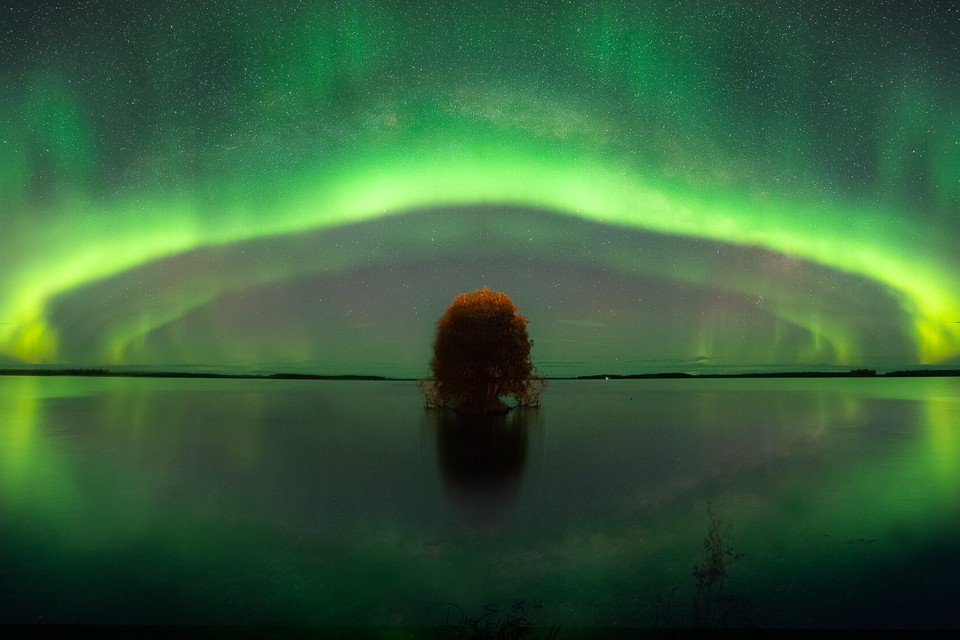
Image: Aurora reflection by Dre Erwin Photography, CC BY-SA 4.0. (https://commons.wikimedia.org/wiki/File:Aurora_Hunting_in_Saskatchewan.jpg, https://creativecommons.org/licenses/by-sa/4.0)
Sources
- NOAA Space Weather Prediction Center — NOAA Space Weather Scales
- Natural Resources Canada — Learning about space weather (Canadian Space Weather Forecast Centre)
- Natural Resources Canada — Chronology of effects: geomagnetic disturbances on power systems
- NASA — How NASA Tracked the Most Intense Solar Storm in Decades (May 2024)
- NOAA — Five historically huge solar events