
Key Takeaways
- Multi-sport buildings can accommodate different operators, potentially reducing dependence on one recreational activity.
- Existing industrial and retail properties may offer conversion opportunities, but zoning and building approvals can change project economics.
- Tenant financial strength, specialised maintenance and replacement costs matter as much as headline rental income.
Could Indoor Sports Facilities Become an Investment Opportunity in Canada?
An indoor sports facility is more than a place to play. It is a specialised commercial property that can accommodate sports clubs, training academies, recreational operators and organised leagues. For investors, the opportunity lies in owning a suitable building and leasing it to businesses that need dedicated indoor space throughout the year.
Canada's recreation sector provides an encouraging demand signal. Statistics Canada reported that fitness and recreational sports centres generated $6.1 billion in operating revenue in 2025, an increase of 9.4% from 2024. However, this figure represents industry revenue, not property rental income. Investors still need to assess whether a particular operator can afford a long-term lease.
Why Could Indoor Sports Properties Attract Tenants?
Weather is an important factor in Canada's recreation market. Outdoor activities face seasonal limitations, while indoor venues can support scheduled training, competitions and recreational bookings throughout the year. Potential tenants include basketball academies, volleyball clubs, pickleball operators, indoor soccer businesses, gymnastics schools, swimming instructors and fitness companies.
Pickleball offers one example of changing demand. Pickleball Canada's 2026 survey estimated approximately 1.8 million Canadian participants, up 14% from its 2025 estimate. The survey also identified a shortage of facilities as a participation barrier for some respondents. This creates a reason to investigate suitable venues, although it does not guarantee that every new facility will attract enough paying customers.
Which Types of Indoor Sports Buildings Can Investors Consider?
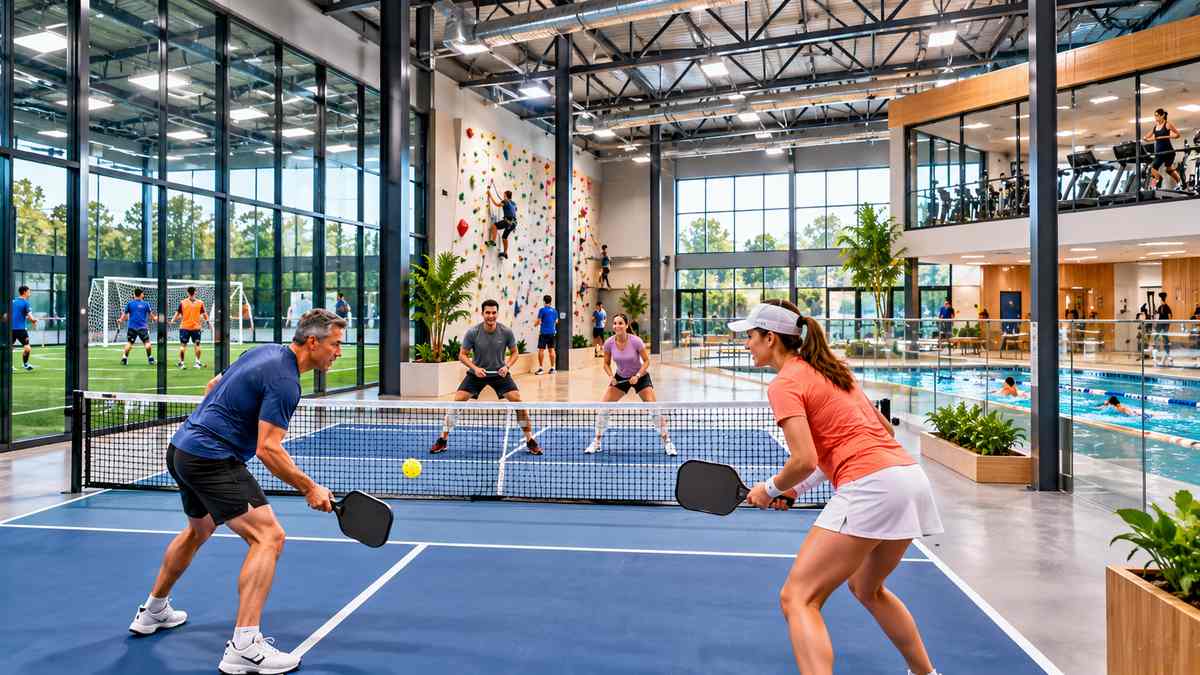
Multi-sport complexes offer flexibility because different areas can serve different activities. A property might combine basketball courts, volleyball space, indoor turf, fitness studios and training rooms. This can widen the potential tenant pool, provided the building layout allows activities to operate without interfering with one another.
Single-purpose facilities can also work, but they require more careful tenant research. Swimming pools, ice rinks and specialised gymnastics centres need equipment and building systems that may be expensive to replace or adapt. A standard warehouse conversion may be more practical for court sports than for an aquatic centre, where water treatment, humidity control and mechanical infrastructure create additional costs.
Where Could Investors Find Suitable Properties?
Large-format industrial buildings and former retail premises may provide the floor area required for indoor recreation. High ceilings, open layouts, accessible entrances and parking can make certain properties attractive to sports operators. TwikUp's guide to explores the broader industrial property market, while its Canada retail real estate guide discusses opportunities involving large commercial spaces.
Investors should investigate growing residential catchments, family-oriented communities, school and club networks, and access to major roads. Ontario, Quebec and British Columbia deserve research because of their large population centres and established recreation markets. Pickleball Canada's 2026 survey estimated 702,000 players in Ontario, 432,000 in Quebec and 306,000 in British Columbia. These figures indicate participation, not guaranteed demand for a particular property.
How Can an Indoor Sports Property Generate Rental Income?
The simplest model is a conventional lease in which a sports operator pays rent for the premises. Depending on the agreement, the tenant may also pay some operating expenses, utilities, maintenance costs and property-related charges. The lease must clearly explain responsibility for specialised equipment, repairs, insurance and building systems.
A second model involves leasing separate areas to multiple operators. For example, one tenant could operate indoor courts while another rents studio space for coaching or fitness classes. Shared facilities can improve space utilisation, but the landlord must consider scheduling conflicts, noise, access and common-area costs.
Consider an illustrative investment: a property purchased for $5 million produces annual net operating income of $350,000. Its initial capitalisation rate would be:
Cap rate = Annual net operating income ÷ Property purchase price
$350,000 ÷ $5,000,000 = 7%
This is a hypothetical calculation, not a Canadian market benchmark or a forecast. Actual returns depend on acquisition costs, vacancy, financing, capital repairs and the reliability of rental income.
What Risks Should Property Investors Examine?
Conversion costs can quickly change the investment case. A building that looks affordable may require new washrooms, changing rooms, accessible entrances, fire-safety upgrades, ventilation, lighting, flooring and additional parking. Swimming facilities can be particularly demanding because of water treatment, heating and humidity management.
Zoning and building approval are equally important. Canada's model building codes must be adopted by provincial or territorial authorities before they become enforceable, and local rules can differ. A change from industrial or retail use to recreation may require professional assessments, permits and upgrades. Investors should confirm the permitted use with the municipality before purchasing.
Tenant concentration is another concern. A property leased to one sports operator may become difficult to reposition if that business closes. Multi-tenant arrangements can diversify rental income, but they may increase management responsibilities and shared maintenance expenses.
What Should Investors Check Before Buying?
Start with the local market. Identify competing venues, membership prices, court-booking availability, nearby schools, sports clubs and population growth. Speak with potential operators to understand the space, ceiling height, flooring, parking and lease terms they actually need.
Next, commission building, structural, mechanical, electrical and environmental inspections. Review zoning, occupancy requirements, accessibility, fire protection, insurance conditions and the cost of converting the premises. For pool properties, obtain specialist engineering advice on water systems and indoor air quality.
Finally, examine the tenant's financial statements, operating history, business plan and ability to fund its fit-out. A signed lease is useful only when the tenant can meet its obligations.
TwikUp's Perspective
Indoor sports facilities deserve consideration as a specialised property category, but the strongest opportunity may not be a ground-up sports complex. An existing building with suitable dimensions, parking and permitted recreational use could offer a more manageable starting point than a costly purpose-built project.
For investors, the central question is not simply whether Canadians want more places to play. It is whether a specific building can serve a viable operator at a rent that supports the property's full ownership and maintenance costs. That distinction separates a promising recreational concept from a sound real estate investment.
Disclaimer
This article is for general educational and informational purposes only. It does not constitute financial, investment, legal or tax advice. Commercial property investments involve risks, including vacancy, tenant default, construction costs, regulatory approvals and changes in market demand. Readers should consult qualified legal, financial, engineering and real estate professionals before making investment decisions.