
Key Takeaways
- The 90+ day mortgage delinquency rate hit 0.32% in Q3 2026, up 31.1% year over year — the highest since Equifax began tracking in 2013.
- Nearly one in four of Canada's 9.1 million mortgage holders could feel added stress if the Bank of Canada raises rates on December 9.
- Total consumer debt reached $2.74 trillion, up 4.68% from a year earlier, with Ontario and B.C. driving 91% of the growth in severely delinquent mortgages.
Four years of rising mortgage trouble — and the numbers are getting harder to ignore
Canada's mortgage stress has reached a new milestone. The share of mortgages at least 90 days past due climbed to 0.32% in the third quarter of 2026, according to Equifax Canada — up 31.1% from a year earlier and the highest since Equifax began tracking the measure in 2013.
This isn't a one-quarter problem. It is the 16th straight quarterly increase, with delinquencies climbing for four years. Ontario and British Columbia alone accounted for 91% of the annual growth in severely delinquent mortgage accounts.
And the pressure may not stop there.
One in four mortgage holders could feel the next rate move
The Bank of Canada's next decision arrives December 9. Equifax warns that its first rate increase since 2023 could affect nearly one in four of Canada's 9.1 million mortgage holders.
The exposure is substantial. About 1.4 million Canadians hold variable-rate mortgages, while another 1.3 million carry a home equity line of credit balance over $50,000.
A quarter-point increase isn't just a small adjustment on paper. It adds roughly $860 million a year in interest on variable-rate mortgages and $419 million on HELOCs.
For borrowers already stretched by housing costs, that is another bill they may have to absorb.
The trouble is spreading beyond home loans
Mortgage stress is part of a much bigger debt picture. Total Canadian consumer debt reached $2.74 trillion, up 4.68% year over year.
Mortgage holders who also fell behind on other debts rose 9.8%. Meanwhile, people without a mortgage actually improved.
There is another warning sign hiding in the housing market: negative equity.
Ontario holds an estimated 70% of the country's underwater mortgages — about 5% of all mortgages in the province. The situation is even more pronounced among condo owners, where the figure is 7.2%, against 2.7% for freehold houses.
The Twikup Take
Canada's mortgage problem isn't just about borrowers missing payments. It's about how many households are running out of room to absorb another financial shock.
Delinquencies have risen for sixteen straight quarters, Ontario and B.C. account for most of the annual growth, and a potential rate increase could put even more pressure on borrowers.
The delinquency rate is still small in absolute terms. But the direction matters. If you're carrying a variable-rate mortgage or a large HELOC, knowing what a quarter-point increase could cost you is no longer optional. It's part of preparing for what comes next.
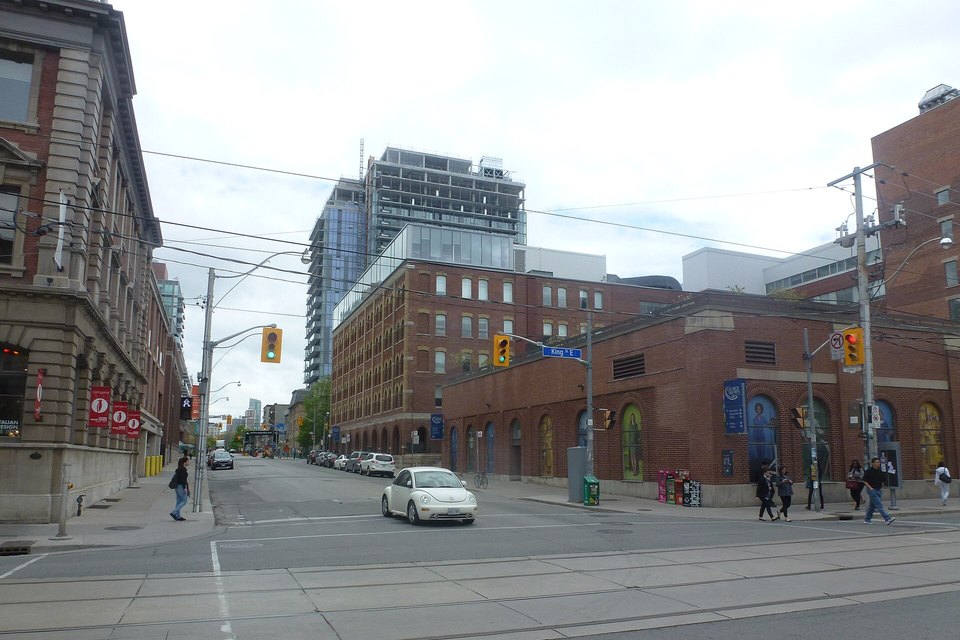
Image: New residential building on George Street, Toronto, by booledozer, public domain. (https://commons.wikimedia.org/wiki/File:New_residential_building_on_George_Street,_2014_05_23_(1)_(14074720468).jpg)