
Key Takeaways
- The ICJ's 15 judges are elected by the UN General Assembly and Security Council for nine-year terms; only states can be parties to its cases.
- Jurisdiction requires consent: a special agreement, a compromissory clause in a treaty, or an optional-clause declaration.
- Judgments are final and binding on the parties, but enforcement runs through the Security Council.
The world court in The Hague
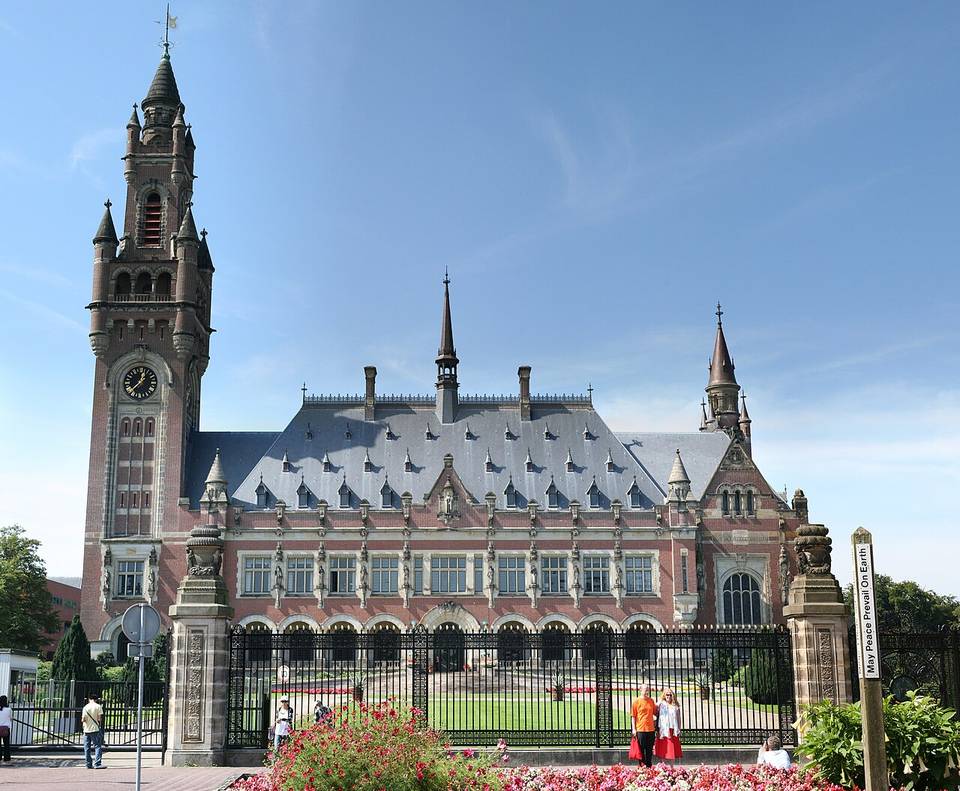
The International Court of Justice is the United Nations' principal judicial organ — the only one of the UN's six main organs not in New York. Established in June 1945 and at work since April 1946, it sits at the Peace Palace in The Hague and is made up of 15 judges, no two from the same country, elected independently by the UN General Assembly and the Security Council for nine-year, renewable terms. Every UN member state is automatically a party to the Court's Statute. Its most important limitation is also its founding bargain: only states can bring cases, and only against states that have consented to be sued.
Consent is everything
The Court's jurisdiction rests on consent given in one of three ways: a special agreement, where the disputing states jointly refer a case; a compromissory clause in a treaty, where signing the treaty means accepting the Court for disputes about it; or an optional-clause declaration, where a state accepts the Court's compulsory jurisdiction toward any other state that has done the same. If a state argues the Court has no jurisdiction, the Court itself decides that question. Separately, the General Assembly and Security Council can request advisory opinions on legal questions — other UN bodies need the Assembly's authorization, and states cannot request opinions at all.
Binding judgments, no police force
An ICJ judgment is final, with no appeal, and it binds only the parties to that case. Every UN member undertakes to comply — but the Court has no enforcement arm. If a state refuses, the other side can take the matter to the Security Council, which may recommend or decide on measures. Canada has used the Court itself: on June 8, 2023, Canada and the Netherlands jointly sued Syria under the Convention against Torture, and on November 16, 2023 the Court ordered binding provisional measures — by 13 votes to 2 — requiring Syria to prevent acts of torture and preserve evidence. And one confusion worth ending: the ICJ is not the International Criminal Court. The ICC, a separate court created by the Rome Statute, prosecutes individuals for genocide, war crimes, crimes against humanity and aggression. The ICJ judges states; the ICC judges people.
The Twikup Take
The ICJ's power is real but borrowed: it runs entirely on states having agreed, in advance, to be bound — and on the political cost of defying a judgment once given. That is why its docket is a map of which treaties contain compromissory clauses, and why Canada's Syria case was built on a torture convention rather than a general complaint. When a country "takes another to The Hague," the first legal battle is always the same one: did the defendant ever actually agree to be there?
Photo: Peace Palace The Hague by Iamthestig, via Wikimedia Commons, licensed under CC BY-SA 3.0.