
Key Takeaways
- Google's Project Suncatcher will test Tensor Processing Units in space for the first time.
- The prototype mission will examine how AI hardware handles radiation, extreme temperatures and other conditions in low Earth orbit.
- Google is researching whether networks of AI satellites could eventually provide scalable machine-learning infrastructure using solar power and laser communications.
Google Project Suncatcher Prepares First AI Chip Test in Space
Google is preparing to test artificial intelligence computing hardware in space as part of Project Suncatcher, a research effort exploring whether low Earth orbit could eventually support scalable machine-learning infrastructure.
The first mission will send a prototype satellite carrying Google's Tensor Processing Units, or TPUs, into orbit for an early hardware test.
Google's First In-Orbit Suncatcher Test
The upcoming mission will be an initial test of the hardware and engineering concepts behind Project Suncatcher.
The prototype satellite is scheduled to fly on SpaceX's Transporter-18 rideshare mission in partnership with satellite company Planet.
Google says the purpose of the first mission is to learn how its AI computing hardware performs under the conditions encountered during spaceflight.
The company will use the test to identify engineering challenges and determine which parts of the concept can work in an orbital environment.
What Will Google Test in Space?
The prototype will carry Google TPUs, specialized processors designed for machine-learning workloads.
During the mission, Google plans to examine how the hardware handles the physical conditions of low Earth orbit.
These include radiation and extreme temperature changes, both of which can create challenges for electronic systems operating in space.
The test is therefore an early hardware demonstration rather than a fully operational orbital AI data centre.
Why Put AI Computing in Space?
Google is investigating whether space could provide an alternative environment for large-scale machine-learning infrastructure.
One of the main factors is sunlight.
Satellites in low Earth orbit can receive sunlight for much of their time in orbit. Google says solar panels operating in suitable orbits could potentially generate up to eight times more power than comparable panels on Earth.
That could provide an energy source for computing systems without relying on terrestrial electricity infrastructure.
Cooling AI Hardware in Orbit
Cooling is another major engineering challenge.
Computing hardware generates heat, and conventional data centres commonly use airflow and other cooling systems to remove that heat.
Those methods cannot operate in the same way in the vacuum of space.
Google is therefore researching thermal systems based on heat pipes and radiators to move heat away from the computing hardware and release it into space.
The first tests will help researchers understand how these systems perform under actual orbital conditions.
Future Suncatcher Satellites Could Work Together
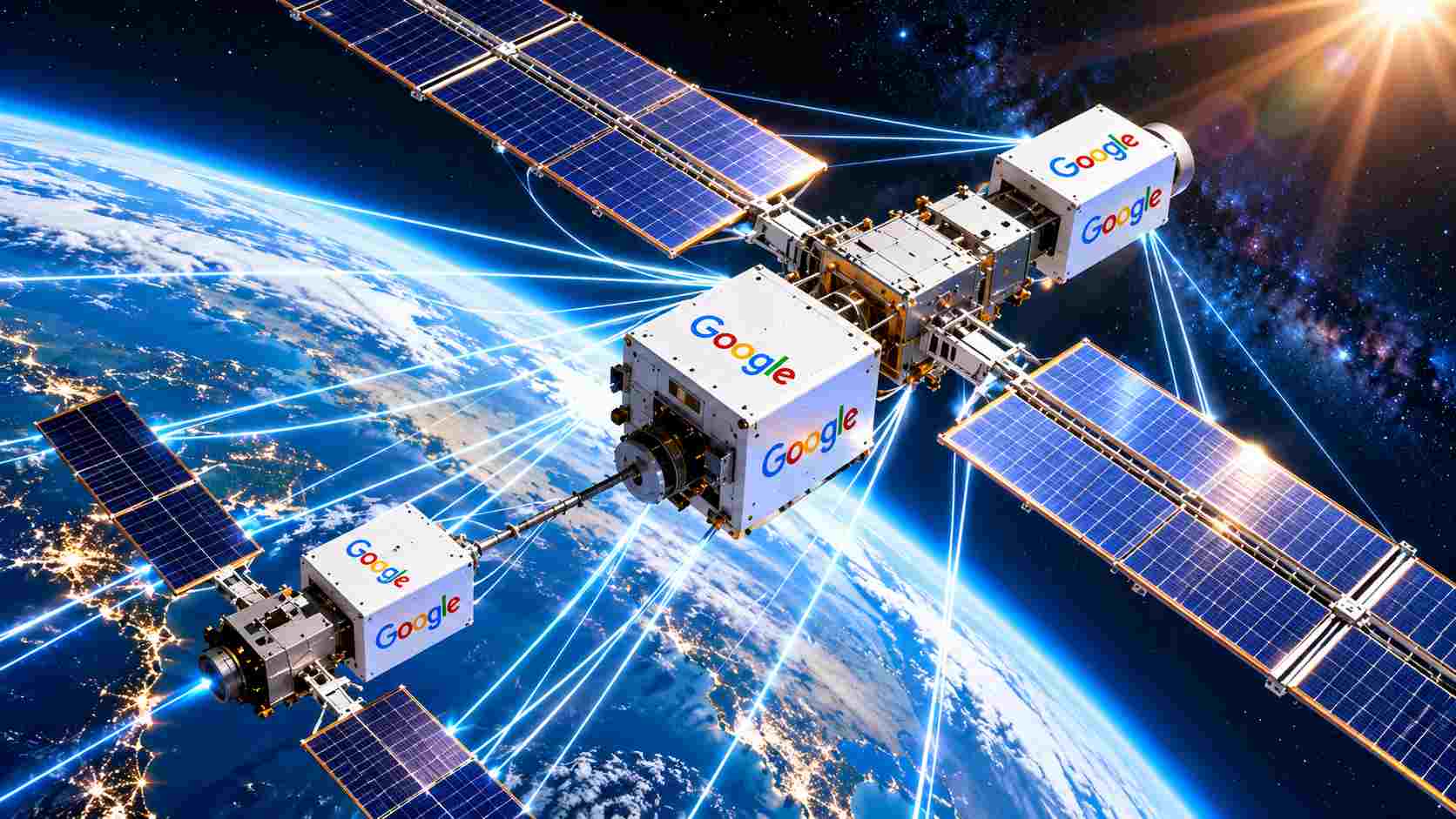
Google's longer-term concept involves networks of satellites rather than a single spacecraft.
Future designs could include multiple satellites carrying dozens of TPUs and working together as a distributed machine-learning system.
The satellites could communicate with one another using optical or laser links.
This approach could allow computing workloads to be distributed across a network of spacecraft while taking advantage of the energy available from sunlight.
Project Suncatcher Is Still Experimental
Google describes the initial launch as an early hardware test.
The company is not presenting the mission as an operational space-based data centre. Instead, the first flight is intended to provide practical information about the technologies required to make the broader concept possible.
The results could help Google understand how AI processors, power systems, thermal management and communications technologies perform together in space.
What Happens After the First Test?
The initial mission is expected to provide data that can guide future development of Project Suncatcher.
Google's research will need to address several engineering questions before a larger orbital AI infrastructure system could become practical.
These include the reliability of AI hardware in radiation environments, efficient thermal management, power generation, satellite communications and the coordination of computing resources across multiple spacecraft.
For now, Project Suncatcher remains a research effort exploring the possibility of putting AI computing infrastructure in space.