
Key Takeaways
- A four-letter DNA deletion inherited from Neanderthals, near the DAAM1 gene on chromosome 14, is linked to an occipital brain region about 0.85 cm³ smaller per copy.
- Carriers of two copies had almost 10% lower schizophrenia risk, with no meaningful effect on intelligence or cognition.
- The variant is found only in people with non-African ancestry and appears in all five detailed Neanderthal genomes.
Your brain carries a Neanderthal edit
Tens of thousands of years after Neanderthals vanished, pieces of their DNA still sit in ours — and some of those pieces are still doing things. In a study published this week in PNAS, researchers Hugo Zeberg and Svante Pääbo — the Nobel laureate who first sequenced the Neanderthal genome — show that one inherited variant measurably reshapes the modern human brain.
The variant is tiny: a deletion of just four DNA letters on chromosome 14, near a gene called DAAM1 that helps guide brain development. It appears in every detailed Neanderthal genome sequenced so far, and in living people it is found only in those with non-African ancestry.
A smaller visual region, by the largest margin known
Comparing the variant against brain scans and genetic data from sources including the UK Biobank and the 1000 Genomes Project, the researchers found that each copy of the deletion is linked to an occipital lobe — the brain's visual-processing region, including the cuneus — that is about 0.85 cm³ smaller. That is, per Nature's coverage, the largest effect any single known variant has on that part of the brain.
Smaller sounds worse. It does not seem to be. The team found no meaningful effect on intelligence or cognition: the variant's association with schooling amounts to at most about two weeks of education per copy, against an average of roughly 15 years. A slightly smaller visual region, it appears, is simply a different configuration — not a defect.
And an unexpected shield
The surprise came from the medical data. People carrying two copies of the Neanderthal variant had a schizophrenia risk almost 10% lower than non-carriers — an effect specific to this variant, since Neanderthal ancestry in general shows no such pattern. Schizophrenia is thought to involve, in part, how the brain's visual and association regions develop and connect, and a variant that fine-tunes DAAM1 expression may nudge that development in a protective direction.
None of this makes the variant "good" or "bad" overall — evolution rarely deals in such simple verdicts. It is better read as a reminder that the Neanderthal inheritance modern humans carry is not junk or baggage. It is working code, still quietly adjusting how our brains are built.
The Twikup Take
We tend to picture Neanderthal DNA as a curiosity — a percentage on an ancestry test. This study shows it is something stranger and more interesting: a living influence on the shape of your brain and, possibly, on your risk of one of psychiatry's most serious illnesses.
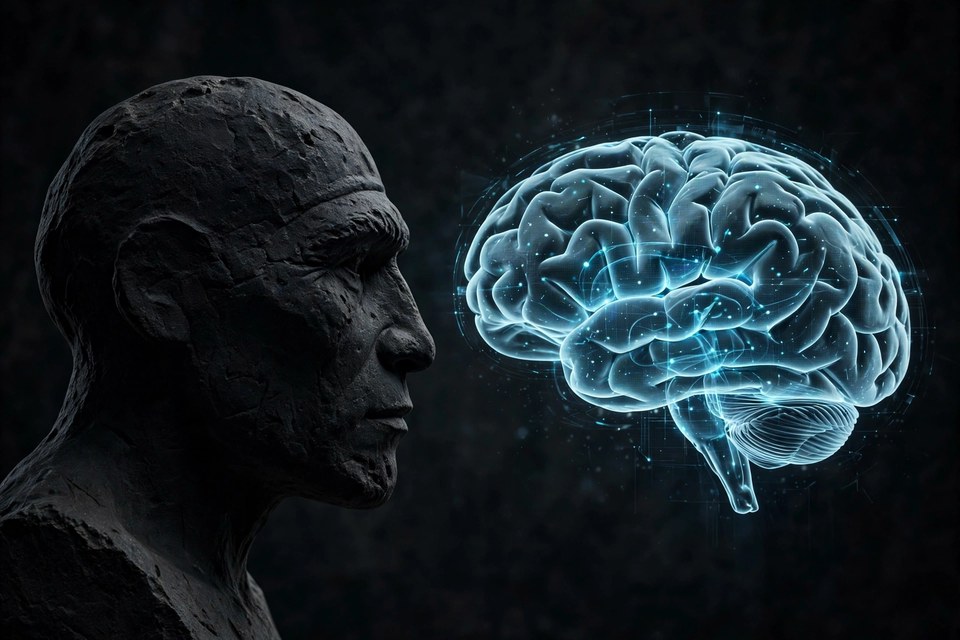
Image: Illustrative image.