
Key Takeaways
- An estate may have to sell investments, vehicles or property to settle outstanding obligations before beneficiaries receive their inheritance.
- The legal difference between being an authorized cardholder and a joint borrower can determine who remains responsible for a balance.
- Estate administration rules vary by jurisdiction, and distributing assets too early can expose an executor to financial consequences.
What Happens to Debt When You Die?
When someone dies, their unpaid debts generally do not disappear. Instead, they become financial obligations handled through the person's estate, which includes assets, money and liabilities left behind. Creditors may claim payment from the estate before the remaining property is distributed to beneficiaries.
However, this does not mean children, spouses or other relatives automatically inherit someone's personal loans or credit card balances. In most situations, family members are not personally responsible unless they shared the legal obligation or a specific law creates an exception.
For families in Canada and the United States, understanding this distinction is essential before responding to creditors or distributing inherited property.
Who Pays Outstanding Debts After Someone Dies?
The executor named in a will or another legally appointed estate representative generally handles the financial settlement.
Their responsibilities include identifying bank accounts, property, investments and outstanding loans, notifying relevant institutions, reviewing creditor claims and arranging payments from estate assets.
For example, imagine someone dies leaving $180,000 in assets and $65,000 in outstanding debts. If all claims are valid and the estate has sufficient funds, those obligations are generally settled before beneficiaries receive their remaining inheritance. The amount ultimately available depends on estate expenses, taxes and applicable payment priorities.
If the estate has insufficient assets, creditors may receive only the amounts permitted under local law. Beneficiaries generally cannot be required to cover the shortfall from their personal savings simply because they were related to the deceased.
Are Spouses and Children Responsible for a Deceased Person's Debt?
Usually, no. Being a spouse, adult child, sibling or beneficiary does not automatically make someone responsible for another person's individual borrowing.
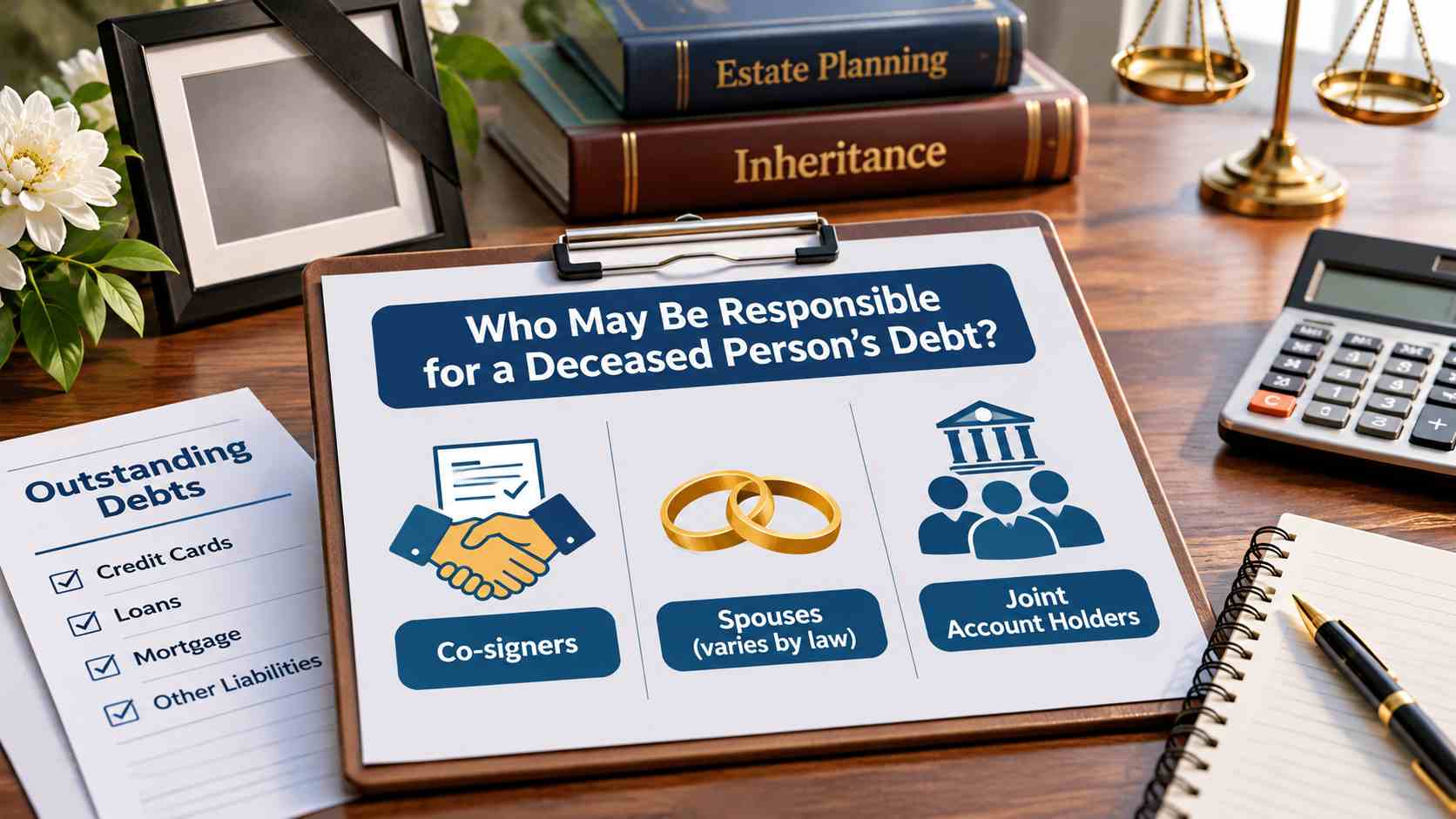
However, important exceptions exist:
- Co-signed loans: If you signed as a co-borrower or guarantor, the lender may pursue you under the agreement.
- Joint credit cards: A person who is legally a joint borrower may remain responsible for the outstanding balance.
- Spousal obligations: Certain US state laws can make spouses responsible for particular debts, including rules in community property states.
- Estate administration: Executors can face personal liability if they mishandle estate distributions or fail to meet specific legal obligations.
In Canada, the Financial Consumer Agency of Canada distinguishes joint borrowers from additional credit cardholders. An additional cardholder generally does not become responsible for the primary account holder's balance simply by using the card.
What Happens to Credit Card, Mortgage and Student Loan Debt?
Different debts require different treatment.
Credit card debt: An individually held credit card balance is generally an estate obligation. A joint borrower may remain liable, depending on the agreement. Authorized users should not assume they owe the balance personally.
Mortgage debt: A mortgage does not automatically disappear when its borrower dies. The property remains subject to the secured loan. The estate or someone inheriting the property must address the outstanding mortgage, often by continuing payments, refinancing, selling the property or arranging another permitted solution.
Student loans: Government student loans have special rules. In Canada, federal student loan obligations generally terminate when the borrower dies, subject to the applicable statutory process. In the United States, federal student loans can be discharged following the borrower's death. Private student loans may have different contractual requirements and co-signer obligations.
What If Someone Dies With More Debt Than Assets?
This situation is commonly described as an insolvent estate.
Suppose someone leaves $40,000 in assets but has $75,000 in valid outstanding debts. The executor cannot simply divide the available $40,000 among family members and ignore creditors.
Instead, assets must be handled according to applicable estate and insolvency rules. Certain claims may receive priority over others, and the payment order differs across jurisdictions.
In most circumstances, beneficiaries receive nothing if the estate's available assets are insufficient to satisfy higher-priority obligations. Relatives do not automatically become responsible for the remaining $35,000.
Canada vs United States: Important Legal Differences
Canada: Estate administration is governed primarily by provincial and territorial law. The Canada Revenue Agency requires legal representatives to settle outstanding tax obligations and obtain a clearance certificate when appropriate before distributing estate property. An executor who distributes assets prematurely can become personally liable for certain unpaid tax amounts.
United States: Probate and debt responsibility are affected by state law. Most relatives are not responsible for individual debts, but co-signing, joint accounts, community property rules and certain state-specific obligations can create exceptions. The Federal Trade Commission and Consumer Financial Protection Bureau provide guidance on dealing with deceased relatives' debts and collection practices.
What Should Families Do After a Loved One Dies?
Before paying bills or transferring property, families should take a careful approach:
- Obtain certified copies of the death certificate.
- Identify the executor or legally appointed representative.
- Prepare an inventory of assets and outstanding liabilities.
- Contact banks, lenders and relevant government agencies.
- Verify creditor claims and identify joint borrowing arrangements.
- Avoid distributing estate property before debts and taxes are properly addressed.
- Seek local legal or professional advice when the estate has complicated obligations.
Keeping written records of creditor communications, account statements and payments can also help prevent disputes.
TwikUp's Perspective
Insurance should protect your financial stability, not create another financial problem when an emergency happens. A deductible that looks attractive on a quote may become expensive if paying it requires using a credit card or taking out a loan.
The smarter decision is to compare annual premium savings against the additional amount you would personally carry during a claim. Before choosing a policy, read our guide on what an insurance deductible is and how much you should choose to understand how deductible decisions affect your out-of-pocket costs. For households with limited emergency savings, paying a somewhat higher premium may provide valuable breathing room. Those with stronger reserves can consider higher deductibles without automatically accepting unnecessary financial risk.
Disclaimer
This article is for general educational purposes only and does not constitute legal, tax or financial advice. Estate laws, creditor priorities, joint debt obligations and executor responsibilities vary between Canadian provinces, territories and US states. Consult a qualified estate lawyer or tax professional for guidance on an individual estate.