
Key Takeaways
- AI infrastructure creates several investment opportunities beyond semiconductor manufacturers, particularly in electricity, networking and thermal management.
- Suppliers with specialised equipment and established customer relationships may benefit from repeated infrastructure upgrades.
- Strong industry demand does not automatically make an infrastructure stock attractive at its current valuation.
What Is the Second-Order AI Trade?
The first wave of AI investing focused heavily on semiconductor manufacturers and companies building massive data centres. The next opportunity may extend further into the businesses that make these facilities operate reliably.
These companies supply electricity distribution systems, cooling equipment, fibre-optic connections, networking hardware and other essential components. They are often described as second-order AI beneficiaries because their products support the infrastructure rather than directly producing AI models.
For investors researching AI infrastructure stocks, this broader supply chain deserves attention. Computing capacity cannot expand indefinitely without sufficient electricity, cooling and data movement.
Why Does AI Infrastructure Need More Than Chips?
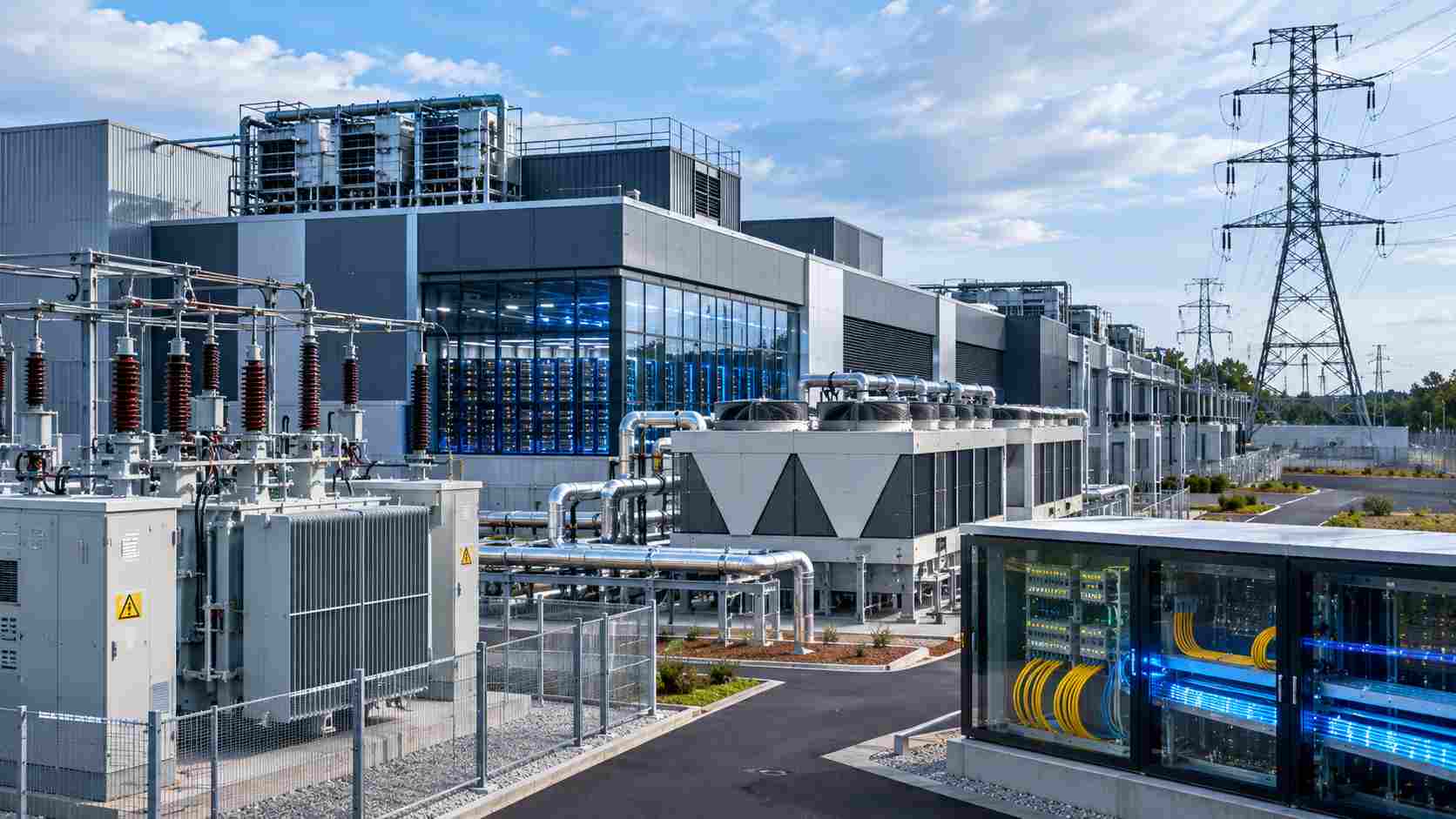
An AI data centre is an interconnected industrial system. Processors perform calculations, networking equipment transfers information, power systems deliver electricity and cooling equipment removes heat.
The International Energy Agency estimates that global data-centre electricity consumption could rise from approximately 485 TWh in 2025 to 950 TWh in 2030. It also highlights supply-chain pressure involving transformers and power electronics.
This creates opportunities across multiple infrastructure categories, although actual demand depends on construction schedules, grid availability and how quickly computing capacity becomes operational.
Five Areas Where Second-Order AI Companies Operate
1. Power infrastructure
Data centres need transformers, switchgear, backup power systems and electrical distribution equipment. Companies such as Vertiv participate in this market through critical power and infrastructure solutions.
2. Cooling technology
High-density computing produces substantial heat. Liquid cooling, chillers and thermal management systems help maintain reliable operating conditions. Vertiv and Modine are examples of businesses with exposure to data-centre cooling.
3. Networking equipment
AI processors must communicate rapidly across large computing clusters. Arista Networks supplies networking systems designed for data centres and AI infrastructure.
4. Optical connectivity
Copper connections face physical limitations over certain distances and speeds. Optical fibre, lasers and photonic components help move information efficiently. Corning and Lumentum operate in parts of this supply chain.
5. AI semiconductor supply chain
Beyond chip designers, semiconductor production depends on specialised manufacturing equipment, testing, packaging and materials suppliers. These businesses can benefit when production capacity expands, although their demand is also influenced by broader semiconductor cycles.
Which Companies Are Showing Actual AI Infrastructure Exposure?
Company disclosures provide useful examples.
Corning reported that Optical Communications sales increased 32% year over year to $2.07 billion in Q2 2026. Its Enterprise Networks business grew 65%, with generative AI product sales growing significantly faster.
Arista Networks reported its first quarterly revenue above $3 billion in Q2 2026 and introduced networking platforms designed for AI infrastructure.
Vertiv reported strong Q2 2026 performance and raised its full-year guidance, while continuing to expand manufacturing capacity for data-centre infrastructure.
These results demonstrate commercial exposure, not proof that every company will maintain the same growth rate or deliver attractive stock returns.
What Should Investors Check Before Buying AI Infrastructure Stocks?
The first consideration is revenue exposure. A company may sell products to data centres, but its total business could still depend heavily on unrelated industries.
Next, examine operating margins, order growth, backlog conversion and customer concentration. Large contracts can look impressive, but delayed projects or cancellations may affect future revenue.
Valuation matters too. Even a supplier benefiting from AI expansion can become an expensive investment if its share price already assumes years of exceptional growth.
Our guide to whether a low P/E stock is genuinely cheap explains why business quality and valuation need to be considered together.
TwikUp's Perspective: Follow the Bottlenecks, Not Just the Headlines
The second-order AI opportunity is attractive because it reaches businesses solving practical infrastructure problems. A data centre cannot operate without reliable power, effective cooling and fast connectivity. However, investors should avoid treating every supplier as an automatic AI winner. Competition, manufacturing capacity, pricing pressure, project delays and customer concentration can change the economics quickly.
Disclaimer
This article is for educational and informational purposes only and should not be considered financial or investment advice. Companies mentioned are examples of businesses with potential AI infrastructure exposure, not stock recommendations. Investors should conduct independent research and consult a qualified financial advisor before making investment decisions.