
Key Takeaways
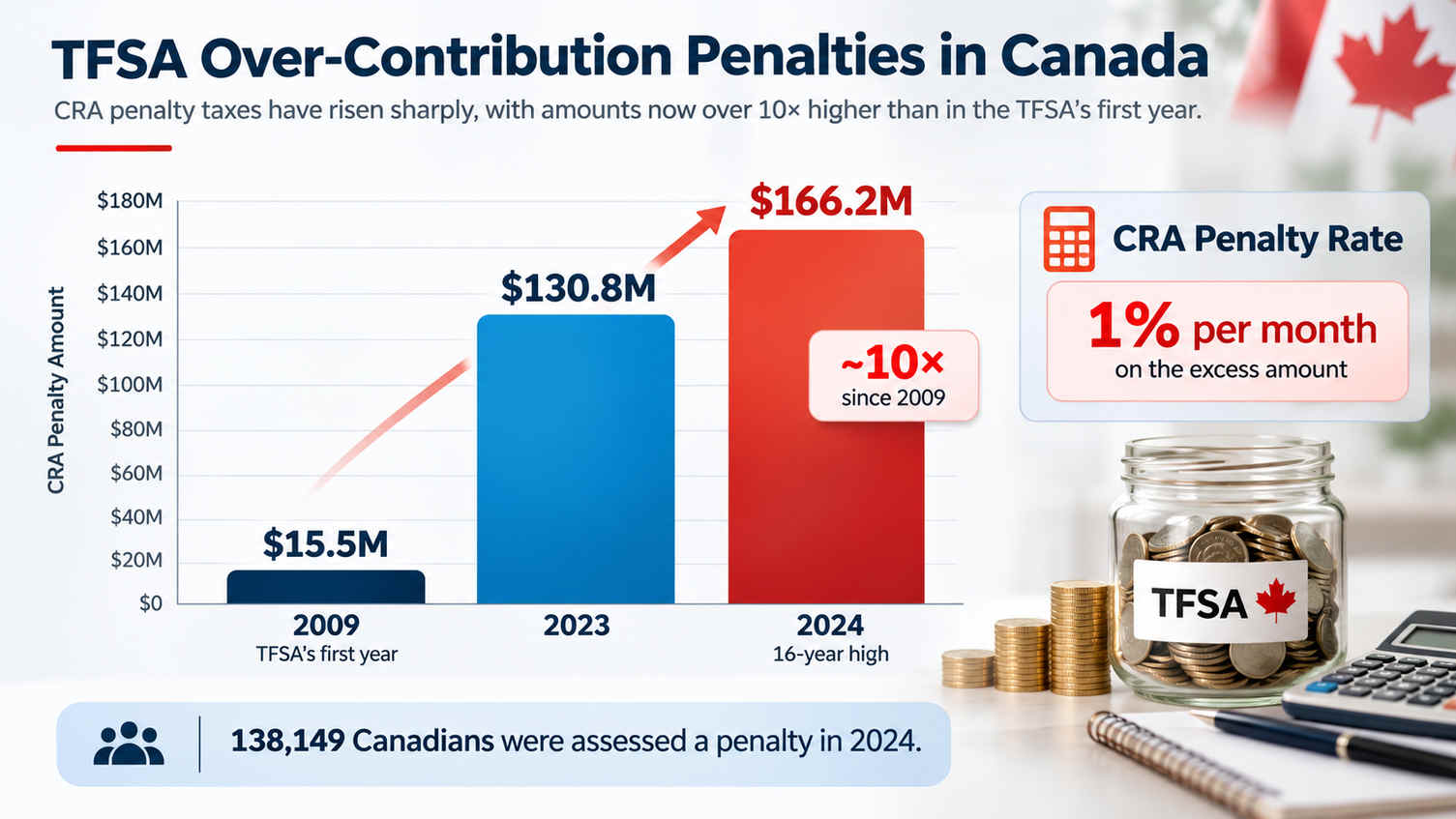
- CRA generally charges a 1% monthly tax on the highest excess TFSA amount during each month.
- TFSA contribution room is shared across all your TFSA accounts, not calculated separately for each institution.
- Removing an excess contribution can prevent future monthly charges, but withdrawing money does not immediately restore contribution room.
How Much Is the TFSA Over-Contribution Penalty in Canada?
A Tax-Free Savings Account (TFSA) is one of Canada's most useful savings and investment accounts. You can earn interest, receive dividends and generate investment gains without paying tax on qualifying TFSA income. However, contributing more than your available room can turn a tax-free account into an unexpected tax bill.
The Canada Revenue Agency (CRA) generally charges a 1% monthly tax on the highest excess TFSA amount during each month. This is not a one-time penalty. If the excess remains in your account for several months, the tax can continue to accumulate.
For example, imagine you exceed your available contribution room by $3,000. If that amount remains an excess throughout three months, the monthly tax could be $30 per month, resulting in $90 in total tax.
What Counts as a TFSA Over-Contribution?
A TFSA over-contribution happens when the combined amount you contribute to all your TFSAs exceeds your available contribution room.
This is where some Canadians make an expensive mistake. Opening accounts at different banks or investment platforms does not create separate contribution limits. Your available room applies across all your TFSA accounts combined.
For 2026, the annual TFSA dollar limit is $7,000. However, your actual contribution room may be higher because unused room from previous years carries forward. Eligible withdrawals from earlier years can also increase your available room.
Your personal limit depends on your eligibility, contribution history, withdrawals and residency status. Simply adding this year's annual limit to your account balance will not tell you how much you can contribute.
How Does CRA Calculate the 1% Monthly Tax?
CRA calculates the excess contribution tax using the highest excess amount in your TFSA during each month.
The general formula is:
1% × highest excess amount during the month.
Consider this example:
Suppose you accidentally contribute $3,000 more than your available room on September 12. You withdraw the excess on November 5.
- September: $30 tax
- October: $30 tax
- November: $30 tax
Your potential total tax is $90.
The important detail is that removing the money during a month does not necessarily eliminate that month's tax. CRA looks at the highest excess amount during the month, not simply the amount remaining on the last day.
Why Can Replacing a TFSA Withdrawal Create Another Excess?
One common mistake happens when someone withdraws money from a TFSA and deposits it again too soon. Suppose you withdraw $10,000 in August. That withdrawal generally becomes available as additional contribution room on January 1 of the following calendar year. If you deposit the same $10,000 back into your TFSA in September without having enough unused room, you could exceed your limit.
The same issue can arise when transferring money between financial institutions. A direct TFSA-to-TFSA transfer arranged between institutions is different from withdrawing the money yourself and making a new contribution.
What Should You Do If You Have Over-Contributed?
If you discover an excess contribution, do not ignore it. Start by reviewing your contribution history across every TFSA account.
Check your bank and investment statements, including deposits, withdrawals and transfers. Remember that CRA My Account information may not reflect every recent transaction. Financial institutions generally report TFSA information after the calendar year ends, and updated records are typically available later.
If you confirm an excess, consider withdrawing the amount needed to bring your contributions within your available room. Removing the excess can prevent additional monthly tax from accumulating, although the tax for a month in which an excess existed may still apply.
Keep transaction confirmations and account statements. If the excess tax applies, you may also need to file the applicable TFSA return and pay the amount owing.
Can CRA Waive or Cancel the Tax?
Yes. CRA can waive or cancel all or part of the TFSA excess contribution tax when the circumstances meet its relief requirements. However, relief is not automatic. You generally need to explain why the excess happened, describe the steps you took to correct it and provide supporting documents.
CRA considers the facts of each case. A genuine mistake followed by prompt corrective action may support a request, but taxpayers should not assume that the penalty will automatically disappear.
There is also a separate tax rule for deliberate over-contributions. In certain circumstances, a 100% tax can apply to a benefit or income reasonably attributable to a deliberate excess contribution. This is not simply an automatic 100% tax on every accidental excess deposit.
TwikUp's Perspective
The biggest TFSA mistake is often not making one large contribution. It is losing track of several smaller transactions across different financial institutions. Someone might deposit money into a bank TFSA, invest through a brokerage account and later replace a withdrawal without realizing that all these transactions affect the same contribution limit.
There is another important part of managing TFSA savings: understanding where your money is held and how it is protected. Our guide, Canadian Bank Failure Explained: How Much of Your Money Is Actually Protected?, explains how CDIC protection works for eligible TFSA deposits and why investment products such as stocks and ETFs are treated differently.
A simple habit can prevent expensive mistakes: maintain one record of every TFSA contribution and withdrawal, check your available room before making another deposit, and understand the protection attached to the financial products you hold.
Disclaimer
This article is for general educational purposes only and does not provide personalized tax or financial advice. TFSA contribution limits and tax treatment depend on individual circumstances. Consult the CRA or a qualified tax professional if you are unsure about your contribution room or tax obligations.