
Key Takeaways
- The $2,000 cushion is cumulative. It does not reset with each new contribution year.
- The monthly tax applies to the amount above the permitted cushion, not automatically to every dollar contributed beyond the deduction limit.
- Correcting an excess contribution involves more than withdrawing money. The withdrawal method, tax reporting and CRA forms all matter.
What Is the RRSP Over-Contribution Penalty in Canada?
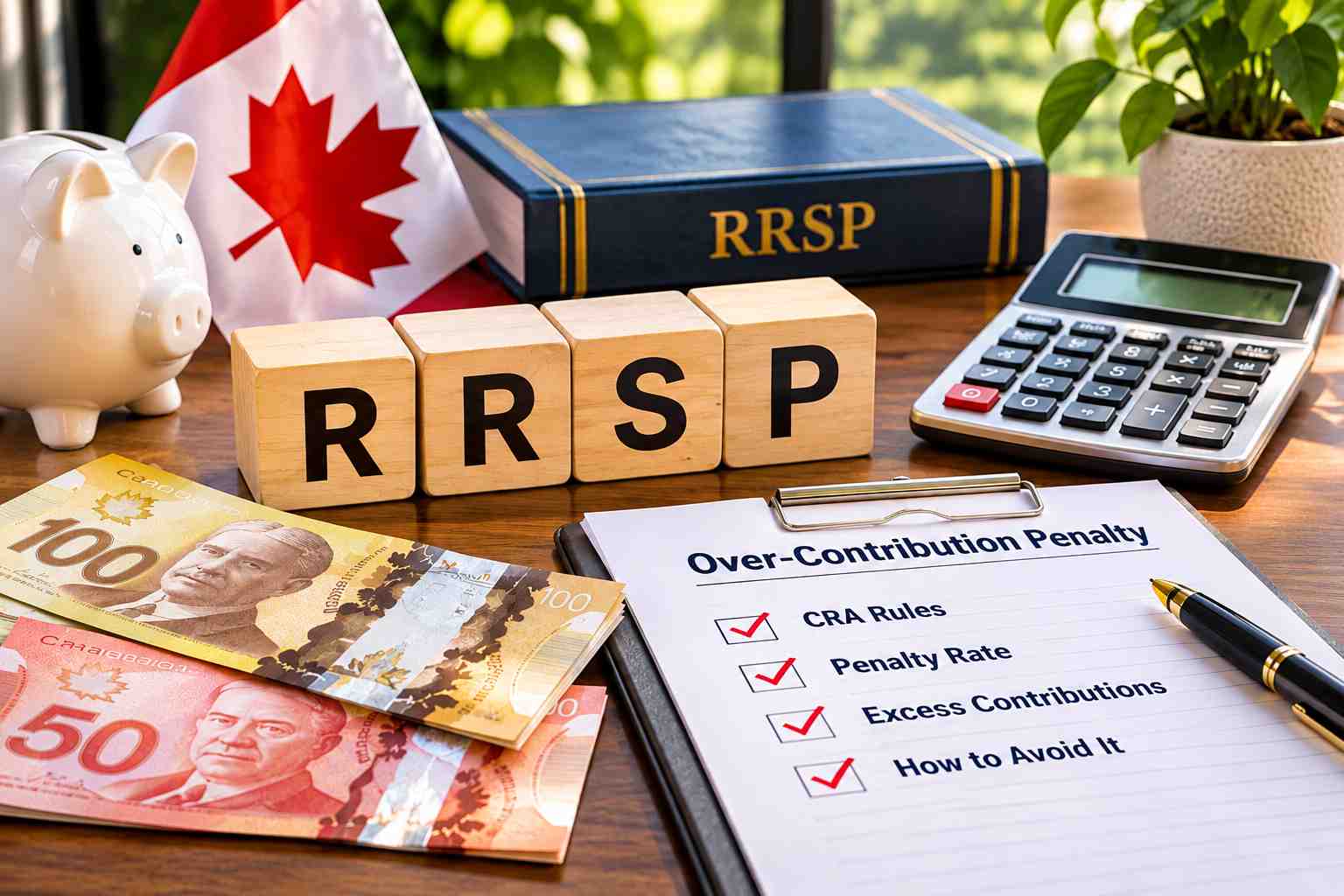
Contributing more than your available Registered Retirement Savings Plan (RRSP) deduction limit can lead to a special tax from the Canada Revenue Agency (CRA). Generally, the penalty is 1% per month on the portion of your unused contributions that exceeds your deduction limit by more than $2,000.
The $2,000 amount is a limited cumulative cushion, not a separate allowance that becomes available every January. If you have already used it in an earlier year, another contribution can push you into penalty territory even when the new deposit looks relatively small.
How Does the $2,000 RRSP Cushion Work?
The CRA generally considers unused RRSP, pooled registered pension plan (PRPP) and specified pension plan (SPP) contributions from previous years together with contributions made during the current year. It compares that total with your RRSP deduction limit plus $2,000.
For example, assume your deduction limit is $30,000 and you have made $32,500 in contributions that remain unused. Your excess above the cushion is $500.
The calculation is:
- RRSP deduction limit: $30,000
- Permitted cushion: $2,000
- Total contributions: $32,500
- Amount exposed to the monthly tax: $500
The cushion is generally available only if you meet the CRA's age requirement. For its 2025 excess-contribution guidance, the CRA specifies that an individual must have been at least 18 at some point in 2024. Check the instructions for the relevant tax year rather than assuming the same date applies to every return.
Importantly, the cushion does not mean you can deduct an additional $2,000 from taxable income. Contributions above your available deduction room cannot be claimed until sufficient room becomes available.
How Much Can CRA Charge You Each Month?
The general tax rate is 1% per month on the excess amount above the $2,000 cushion. The longer the taxable excess remains, the more the amount can add up.
Consider someone whose deduction limit is $40,000 and whose unused contributions total $47,000. After accounting for the $2,000 cushion, the amount subject to the monthly tax is $5,000.
At 1% per month:
$5,000 × 1% = $50 per month
If the same excess remains for six months, the illustrative tax would be $300, assuming the taxable excess stays unchanged throughout that period.
This is a separate tax from the ordinary income-tax treatment of an RRSP withdrawal. It is therefore important to calculate the excess correctly instead of treating the full account balance or the full contribution as automatically taxable under this rule.
Which Contributions Can Cause an RRSP Overcontribution?
An excess can arise from more than a personal deposit made through online banking. Contributions to your own RRSP, a spousal RRSP and certain registered plans can all affect the calculation.
Workplace arrangements deserve particular attention. Employer contributions to a PRPP and contributions made through qualifying group arrangements can have specific treatment under CRA rules. Do not assume that payroll deductions are automatically outside the calculation.
A common problem occurs when someone changes employers and continues making contributions through a new workplace plan without checking the room already used elsewhere. Another risk arises when a person contributes based on an old notice of assessment instead of checking their latest CRA information.
How Can You Correct an RRSP Overcontribution?
Start by checking your latest notice of assessment or CRA My Account. Compare the deduction limit with all contributions made during the relevant period, including deposits to a spousal RRSP and applicable registered plans. If an excess exists, consider whether withdrawing unused contributions or waiting for future contribution room is appropriate. Do not withdraw money without checking the tax consequences first.
The CRA allows certain eligible taxpayers to request a waiver of withholding tax on a withdrawal of unused contributions using Form T3012A. The form must be completed and approved by the CRA before the financial institution makes the qualifying payment. If you withdraw without an approved waiver, the institution generally withholds tax. The amount may also need to be reported as income, although a deduction may be available when the CRA's conditions are satisfied.
When Do You Need to File Form T1-OVP?
Form T1-OVP is used to calculate and report tax on excess RRSP, PRPP and SPP contributions. If you determine that the 1% tax applies, the return and payment are generally due within 90 days after the end of the calendar year in which the excess contributions occurred.
Keep records showing the exact dates or months of contributions and withdrawals. The CRA explains that standard RRSP receipts and certain tax slips may not contain enough detail to establish the precise month of each transaction.
For eligible situations, the CRA also provides a simplified T1-OVP-S return. Check the current form instructions to determine which version applies to your circumstances.
Missing the deadline can create another bill. CRA guidance states that the late-filing penalty is generally 5% of the balance owing, plus 1% for each complete month the return is late, up to 12 months. Interest may also apply to unpaid amounts.
Can CRA Waive the RRSP Overcontribution Tax?
In some circumstances, you can ask the CRA to waive or cancel the Part X.1 tax using Form RC2503. This is a request, not an automatic exemption.
Your explanation should describe how the excess happened, why it was a reasonable error and what steps you took to correct it. Simply saying that you did not know the limit is not a guarantee that the CRA will approve the request.
TwikUp's Perspective
An RRSP overcontribution is often a record-keeping problem before it becomes a tax problem. People may focus on the amount deposited during the current year while overlooking unused contributions carried forward from earlier years.
A useful habit is to reconcile every RRSP-related deposit against CRA records before making a large contribution, especially after changing jobs or setting up a spousal plan. Keep transaction dates, not just annual totals, because timing can affect the monthly calculation.
There is also a broader retirement-planning question. Contributing more is not automatically better if the deposit creates a penalty or cannot be deducted when expected. Readers considering how to balance retirement accounts can also review TwikUp's guide to RRSP vs TFSA in Canada.
Disclaimer
This article is for general educational purposes and is not personalized tax or financial advice. RRSP overcontribution calculations can depend on contribution history, age, plan type and withdrawal timing. Check your CRA records and consider speaking with a qualified Canadian tax professional before withdrawing funds or filing a T1-OVP return.