
Key Takeaways
- The $30,000 threshold is tested across a single calendar quarter and four consecutive calendar quarters, not simply against annual revenue.
- Crossing the limit in one quarter can make the very transaction that pushes revenue over $30,000 subject to GST/HST.
- Voluntary registration can help eligible businesses recover GST/HST on qualifying business purchases, but it also creates collection and filing responsibilities.
When Must a Canadian Small Business Register for GST/HST?
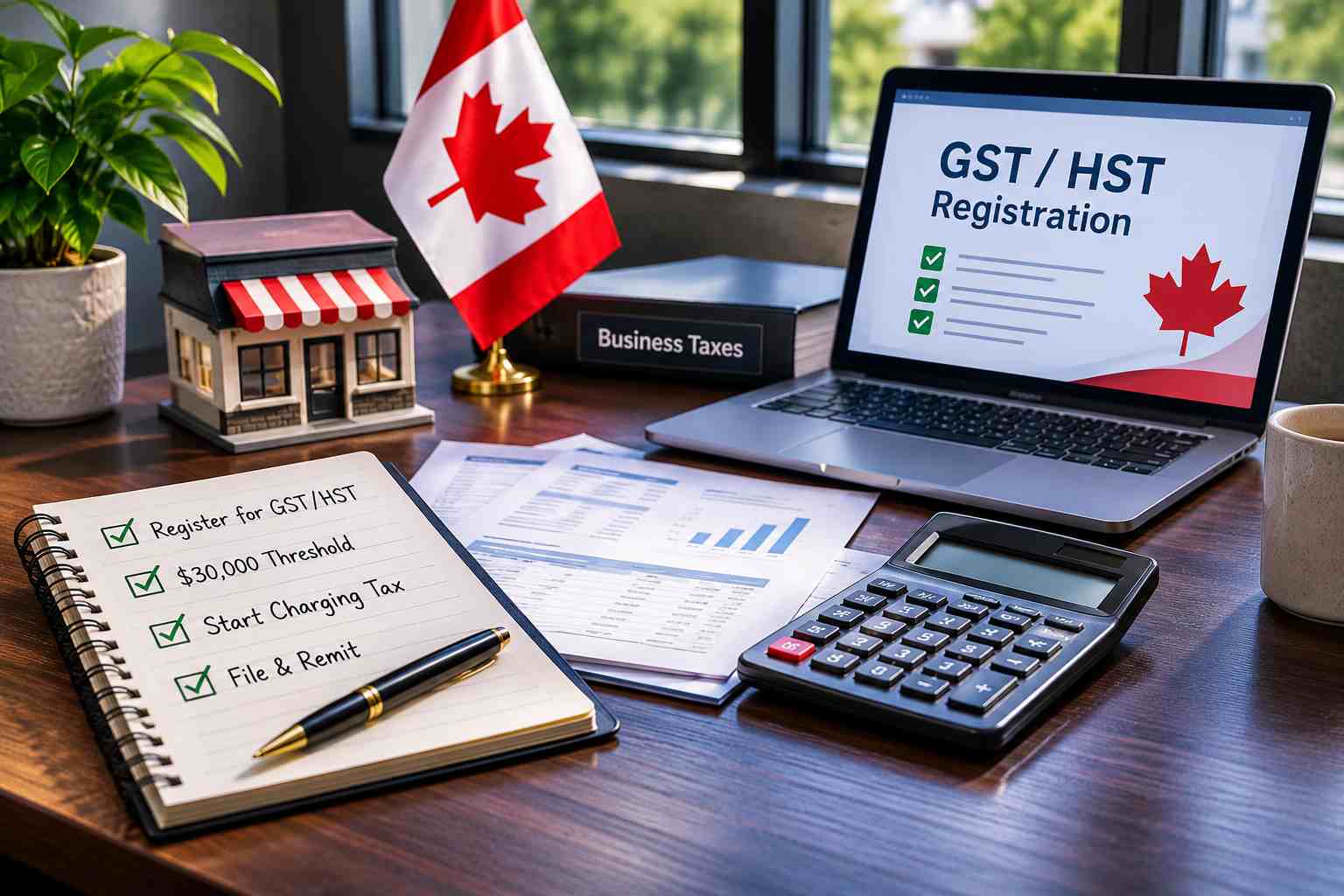
Most Canadian businesses must register for GST/HST when their revenue from worldwide taxable supplies exceeds $30,000 under the Canada Revenue Agency's small-supplier rules. However, the timing depends on how the business crosses that limit. A business that exceeds $30,000 in one calendar quarter faces a different registration date from one that crosses the threshold gradually over several quarters.
The rule generally applies to sole proprietors, partnerships and corporations making taxable supplies in Canada. Businesses that provide only exempt supplies generally do not register under the ordinary rules.
How Does the $30,000 GST/HST Threshold Work?
The CRA uses two tests for most businesses:
- Single-quarter test: If taxable supplies exceed $30,000 in one calendar quarter, the business stops being a small supplier on the transaction that pushes it over the limit.
- Four-quarter test: If taxable supplies exceed $30,000 across four or fewer consecutive calendar quarters, but no single quarter exceeds $30,000, the business generally stops being a small supplier at the end of the month following the quarter in which it crossed the limit.
The calculation generally includes worldwide revenue from taxable supplies, including zero-rated supplies, before expenses. It also considers the relevant revenue of associated persons. Financial services, goodwill and sales of capital property are generally excluded from this calculation.
What Happens If You Cross $30,000 in One Quarter?
Suppose a consulting business earns $12,000 in January and February. In March, it makes another taxable sale worth $22,000. Its quarterly total becomes $34,000. The business crosses the threshold on the March transaction that takes its total above $30,000.
It must charge GST/HST on that entire transaction, not just on the $4,000 above the threshold. Its effective registration date is no later than the date of that sale. The business must apply for registration within 29 days of that date. This is why owners should monitor sales throughout each quarter instead of waiting until year-end.
What If Revenue Exceeds $30,000 Across Four Quarters?
Consider a business with taxable supplies of $7,000, $8,000, $9,000 and $9,000 across four consecutive calendar quarters. Its total reaches $33,000, but no individual quarter exceeds $30,000.
Under the four-quarter test, it generally stops being a small supplier at the end of the month following the quarter in which the threshold was exceeded. It must begin charging GST/HST on its first taxable supply after that date.
The important distinction is that the business does not automatically start charging tax on the transaction that takes its rolling four-quarter total above $30,000. The effective date follows the separate timing rule.
Are There Businesses That Must Register Below $30,000?
Yes. Commercial taxi operators and self-employed commercial ride-sharing drivers, including qualifying app-based drivers, generally have to register and collect GST/HST on their fares from the start of their taxable passenger transportation activity.
The ordinary small-supplier exemption does not protect these drivers. The CRA also has separate rules for certain non-resident businesses and digital-economy activities. Their obligations should be checked independently rather than assuming the standard threshold applies.
Can a Small Business Register Voluntarily?
A business that remains below the threshold can choose to register if it makes taxable supplies in Canada. Voluntary registration may be useful when the business has significant GST/HST-bearing expenses.
For example, a consultant buying computers, office equipment and professional services may be able to claim eligible input tax credits for GST/HST paid on business purchases. This can reduce the net tax payable to the CRA.
But registration also means collecting the applicable tax from customers, filing GST/HST returns and remitting amounts owed. A business that registers voluntarily generally has to remain registered for at least one year before cancelling, unless it stops its commercial activities.
What Should You Check Before Registering?
First, identify whether your products or services are taxable, zero-rated or exempt. Zero-rated supplies are taxable at 0% and generally count toward the small-supplier calculation. Exempt supplies generally do not create the same registration requirement.
Next, review revenue across the relevant calendar quarters, including applicable associated-business revenue. Keep invoices, contracts and payment records so you can identify the transaction that changes your status.
Once registered, confirm the correct GST/HST rate for the place of supply, display your registration details where required, issue compliant invoices, track collected tax and file returns by the assigned deadlines. Registration does not mean every sale is taxed at the same rate.
TwikUp's Perspective
The $30,000 threshold is best treated as a monitoring point, not a year-end administrative task. A business with uneven sales can cross the limit through a single large contract, while another may reach it gradually through steady monthly work.
Owners should build a quarterly revenue review into their bookkeeping routine and flag any large upcoming transaction before accepting it. This simple habit can prevent a pricing problem: if a contract is agreed without accounting for GST/HST, the business may have to absorb the tax rather than comfortably pass it on to the customer.
Cash flow deserves equal attention. Registration may increase the amount of money moving through a business, but GST/HST collected from customers is not business income. It must be tracked and set aside for remittance. If an owner considers using personal borrowing to manage a temporary cash-flow gap, understanding the difference between a hard credit check and a soft credit check in Canada can help them understand how a credit application may affect their personal credit score.
The right registration decision also depends on the customer base and the cost of business purchases. A business selling mainly to GST/HST-registered customers may approach voluntary registration differently from one serving individual consumers. The key is to understand both the tax collected and the administrative obligations before choosing.
Disclaimer
This article provides general educational information about Canadian GST/HST rules. Registration requirements depend on the nature of supplies, business structure, associated persons and other circumstances. Check current CRA guidance or consult a qualified Canadian tax professional before making a registration decision.