
Key Takeaways
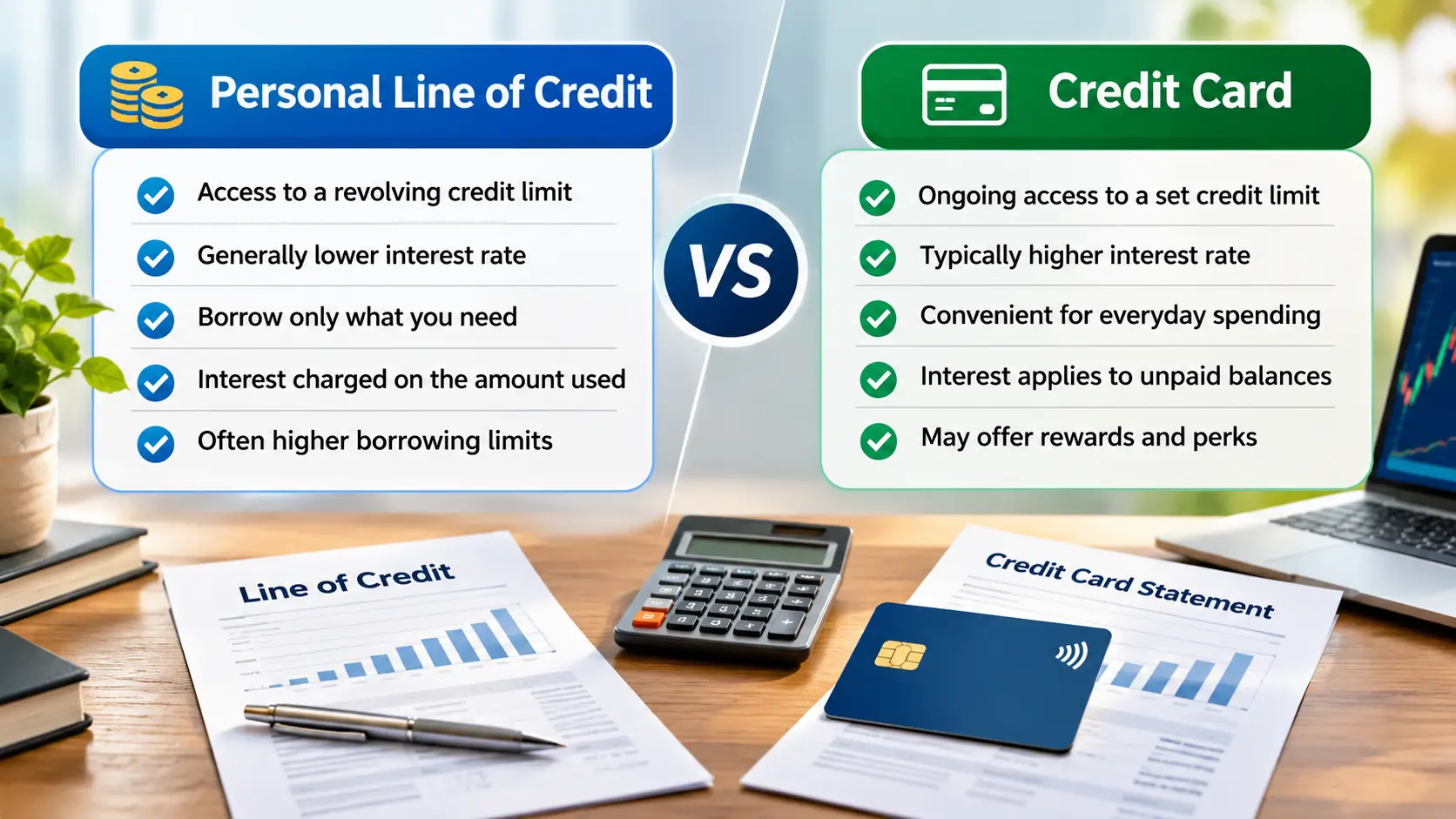
- A personal line of credit generally suits planned borrowing that may need to remain outstanding, while credit cards are designed for convenient transactions.
- A line of credit's variable interest rate can rise, changing the cost of carrying debt even when your balance stays the same.
- Rewards, payment protections, access methods and account fees can matter as much as the advertised interest rate.
Personal Line of Credit vs Credit Card: What Is the Difference?
A personal line of credit and a credit card both let you borrow repeatedly up to an approved limit. The difference is how you access the money, what borrowing costs apply and how each product fits your spending habits.
A personal line of credit generally provides direct access to borrowed funds through a bank transfer, cheque or other approved method. A credit card lets you pay merchants directly, online or in person. Both are revolving credit, meaning repaid amounts usually become available again.
For borrowers who expect to carry a balance, a personal line of credit may cost less because its interest rate is often lower. However, a credit card can be more practical when purchases are paid in full by the due date.
1. How Do Interest Rates Compare?
Interest is often the biggest difference. Personal lines of credit commonly have lower rates than standard credit cards, although the rate depends on the lender, creditworthiness and product terms.
Many personal lines of credit have variable rates linked to a benchmark such as the lender's prime rate. If that benchmark increases, borrowing becomes more expensive. Credit cards may have fixed or variable rates depending on the agreement, and different rates can apply to purchases, cash advances and balance transfers.
A lower advertised rate does not tell the whole story. Check whether the line of credit has an annual fee, access fee or administration charge before deciding.
2. When Is a Personal Line of Credit More Useful?
A personal line of credit can suit expenses that are larger, irregular or spread over several months. For example, someone managing a series of home repairs may need to borrow different amounts as invoices arrive.
You generally pay interest on the amount actually borrowed, not the entire approved limit. This can make a line of credit useful when the final cost of a project is uncertain.
However, easy access can encourage repeated borrowing. If you only make interest payments, the principal may remain unchanged. A repayment plan should include regular reductions in the amount owed.
3. When Does a Credit Card Make More Sense?
Credit cards are usually more convenient for everyday purchases, subscriptions, travel bookings and online payments. They may also provide rewards, purchase protection or other benefits, depending on the issuer and card agreement.
A key advantage is the purchase grace period offered by many cards. If your card provides one and you pay the eligible balance in full by the due date, you may avoid purchase interest.
That advantage disappears when you regularly carry a balance. Cash advances generally have separate fees and often begin accruing interest immediately, so they should not be treated like ordinary purchases.
4. Compare the Cost With a Practical Example
Imagine borrowing $5,000 and repaying it through 12 equal monthly payments. For illustration, assume a personal line of credit charges 12% annual interest and a credit card charges 22%.
Using a simplified monthly repayment calculation:
- Personal line of credit: approximately $444 per month, with about $331 in total interest.
- Credit card: approximately $468 per month, with about $616 in total interest.
The difference is roughly $285 in interest over the repayment period.
These are hypothetical rates, not current market offers. The example assumes the rates remain unchanged, payments are made monthly and no fees apply. Actual lender calculations may differ because of daily balances, payment dates and account terms.
The lesson is to compare the total repayment cost, not simply the monthly minimum.
5. What Fees and Repayment Rules Should You Check?
A personal line of credit may include annual administration, registration or transaction fees. A credit card may charge an annual fee, late-payment fee, foreign transaction fee or cash-advance fee.
Minimum payments also deserve attention. Some lines of credit allow payments that cover little more than the interest charged. This can keep the account current without meaningfully reducing the debt.
Credit cards also have minimum-payment requirements, but paying only that amount can extend repayment and increase interest costs. Ask the lender how payments are calculated and how long repayment could take at different monthly amounts.
6. Canada and USA: Important Differences
In Canada, the Financial Consumer Agency of Canada explains that personal lines of credit usually have variable rates and that interest begins when funds are borrowed. It also advises consumers to review fees and understand the risks of borrowing more than they can repay.
Canadian credit cardholders should compare purchase rates, cash-advance rates, annual fees and the conditions for keeping an interest-free grace period.
In the United States, the Consumer Financial Protection Bureau recommends comparing a personal line of credit's APR, rate-change terms, access fees and annual fees. Approval commonly depends on creditworthiness and income. US credit card agreements also disclose APRs and transaction-specific terms. Consumers should review the agreement rather than assume every card offers the same grace period or fee structure.
7. How Can You Choose the Right Option?
Start with the reason you need credit. If you want a payment method for routine purchases and can clear the statement balance each month, a credit card may be the more convenient choice.
If you need access to cash for a larger expense and expect to repay it over time, compare personal lines of credit from several lenders. Look at the rate, fees, minimum payment and whether the interest rate can change.
TwikUp's Perspective
The better borrowing option is not necessarily the one with the largest credit limit or the lowest introductory rate. It is the one that fits the timing of your expense and the amount you can realistically repay.
A line of credit can reduce interest costs, but it can also make debt feel less urgent because there is no single purchase statement demanding full repayment. A credit card can be expensive when balances roll over, yet useful when its grace period and payment features are managed carefully.
The same principle of matching a financial product to a genuine need applies to insurance. Before choosing permanent coverage simply because it offers additional features, compare it with the protection your family actually requires. Our guide to term life vs. whole life insurance and which policy makes more financial sense explains how coverage periods, premiums and cash value can affect long-term financial decisions.
Before opening either credit account, write down the amount you expect to borrow, the monthly payment you can afford and the date you want the balance cleared. If the numbers do not work without relying on minimum payments indefinitely, reconsider the expense or look for a different financing arrangement.
Disclaimer
This article is for general educational purposes only and does not constitute individualized financial, credit or debt-management advice. Interest rates, fees, approval requirements and repayment terms vary by lender, product and country. Review the relevant credit agreement before borrowing.