
Key Takeaways
- A monthly budget becomes more useful when expenses are organised around actual paydays and bill due dates.
- Small, planned savings transfers can create a financial buffer without requiring a large monthly contribution.
- Separating essential spending from flexible purchases helps prevent the same income from being committed more than once.
Why Does Your Money Disappear Before the Next Payday?
You receive your salary, pay a few bills, buy groceries, cover transport and handle a couple of unexpected expenses. Then you check your account and realise the next payday is still several days away. Sound familiar?
Living paycheck to paycheck does not always mean someone earns too little. Sometimes the problem is that income arrives on one schedule while expenses follow another. Rent may be due at the beginning of the month, a credit card payment may fall in the middle, and groceries and transport costs continue throughout the month.
The pressure is real. Statistics Canada reported that 39% of Canadians aged 15 and older said their household found it difficult or very difficult to meet financial needs in spring 2025. In the United States, the Federal Reserve's 2025 household survey found that 41% of adults always or often had money left over at the end of the month. These findings show why managing the timing and use of income matters, not just the amount earned.
Step One: Build Your Budget Around Your Paydays
A traditional monthly budget lists income and expenses for the month. That is useful, but it may not show whether you have enough money available on the exact day a bill is due.
Start by writing down your take-home income and the dates it reaches your account. Then list your regular expenses with their due dates. Include rent or mortgage payments, utilities, insurance, loan instalments, subscriptions, groceries and transportation.
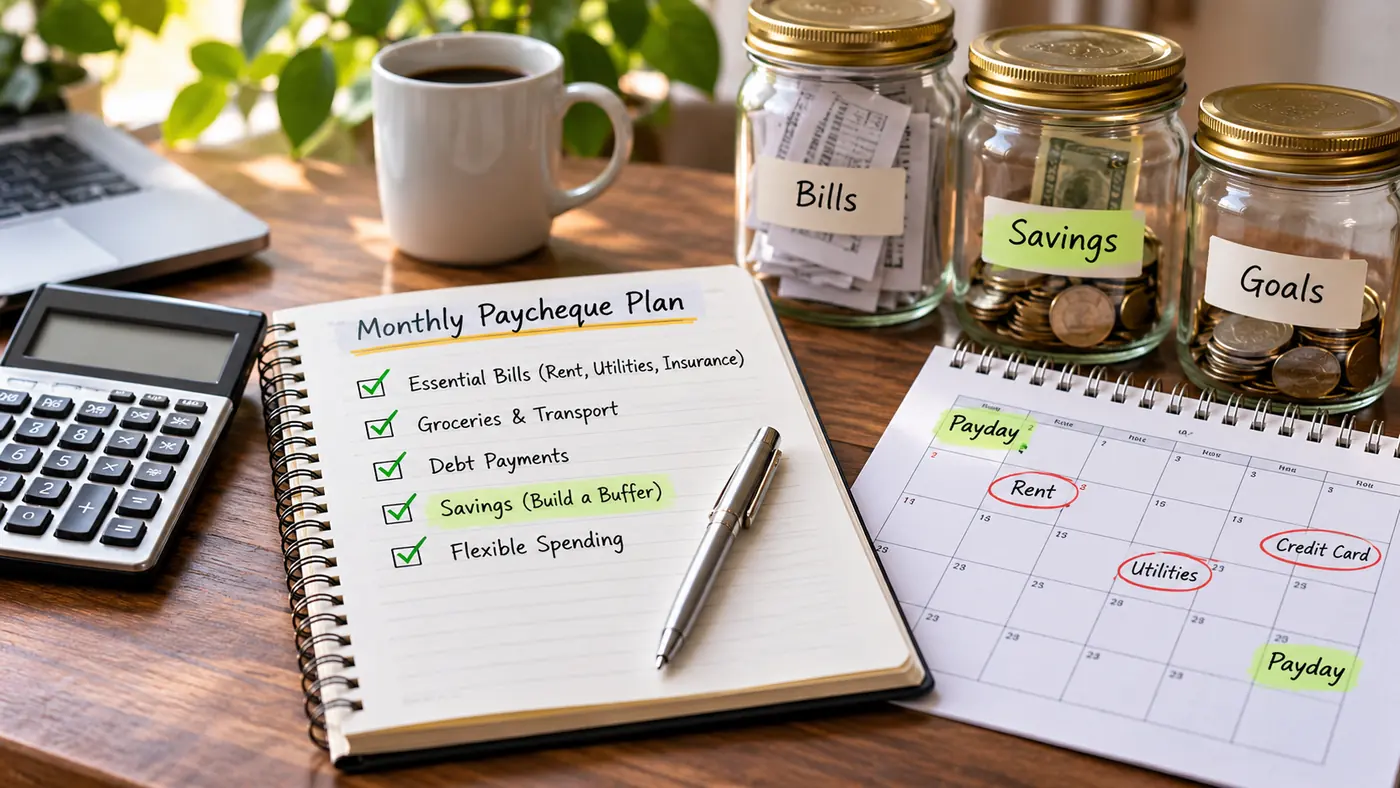
Next, assign each bill to the payday that will fund it. If rent is due on the first, the money for rent should be reserved from the previous paycheque whenever possible. Do not treat that amount as available spending money simply because it is still sitting in your account.
For example, someone paid twice a month might receive $2,000 on the 1st and $2,000 on the 15th. If rent of $1,300 is due on the 1st, setting aside $650 from each paycheque can make the next rent payment easier to manage. The money is being prepared gradually instead of creating a large financial shock on one payday.
Step Two: Give Every Dollar a Job Before Spending It
Once you know your income and bill dates, divide your money into clear priorities.
Start with essential commitments: housing, basic utilities, food, necessary transport, insurance and minimum debt payments. These expenses protect your household and should be covered before discretionary purchases.
Then identify flexible spending, such as restaurant meals, entertainment, shopping and optional subscriptions. These categories are not automatically bad. The important question is whether they fit after essential expenses and savings have been accounted for.
Consider a household receiving $4,000 in monthly take-home income. It might allocate $2,300 to essential bills, $700 to groceries and transport, $400 to debt payments, $200 to savings and $400 to flexible spending. These are illustrative figures, not a recommended formula for every household.
If the numbers do not balance, do not hide the shortfall by relying on a credit card. Identify which flexible expenses can be reduced, whether a bill date can be changed, and whether a debt payment needs to be discussed with the lender.
Step Three: Schedule Bills to Match Your Cash Flow
A bill can be affordable on paper and still cause trouble if it arrives before your next paycheque.
Where providers allow it, ask whether payment dates can be moved closer to a payday. This can help spread large commitments across the month rather than concentrating them in one difficult week.
Create a simple bill calendar showing the payment amount, due date and account from which it will be paid. Set reminders several days before each due date. If you use automatic payments, make sure enough money will be available in the account to avoid overdraft charges or missed payments.
Also review recurring subscriptions and annual renewals. A small monthly charge may seem harmless, but several renewals landing together can create an avoidable cash-flow squeeze.
Step Four: Start Saving Before the Money Gets Spent
Saving whatever remains at the end of the month sounds sensible, but people living close to their financial limit may rarely have anything left.
Instead, choose a small amount and transfer it automatically after payday. Even $10 or $20 per pay period can establish the habit. Increase the transfer only when your budget can comfortably support it.
The Financial Consumer Agency of Canada recommends setting an amount, date and frequency for automatic savings. It also advises keeping emergency savings accessible and separate from everyday spending.
Your first goal does not need to be a large emergency fund. Start with a modest buffer that can cover a small unexpected expense. Once that amount is established, gradually work towards a larger reserve based on your essential monthly costs.
Step Five: Stop Debt Payments From Taking Over Your Paycheque
Minimum payments, interest charges and instalment plans can quietly reduce the money available for everyday needs. Review every debt and record its balance, interest rate, minimum payment and due date.
Pay at least the required amount on time, then direct any additional repayment money towards a clear priority, such as the highest-interest balance. Avoid taking on new buy now, pay later instalments simply because the individual payments look small. Several overlapping instalments can make future paycheques harder to manage.
For a broader look at how interest obligations affect financial pressure, see TwikUp's Interest Coverage Ratio Explained. The corporate measure is different from household budgeting, but the underlying lesson is relevant: recurring interest costs reduce the money available for other priorities.
What Canadian and American Households Should Consider
Canadian readers can use the Financial Consumer Agency of Canada's budgeting and emergency-fund guidance to organise bills, savings and debt payments. The agency recommends aiming for savings equivalent to three to six months of regular expenses over time, while recognising that starting with a manageable amount is better than waiting for the perfect moment.
In the United States, the Federal Reserve's 2025 report found that 63% of adults would cover a hypothetical $400 emergency expense using cash or its equivalent. That also means 37% would use another method or could not cover it that way. A small cash buffer can help reduce dependence on borrowing when an unexpected bill arrives.
The right system will depend on local costs, pay frequency, taxes, benefits and household responsibilities. Use local currency and local bill schedules when building your plan.
TwikUp's Perspective: Create Breathing Room Before Chasing a Bigger Paycheque
A higher income can help, but it does not automatically solve a cash-flow problem. If every extra dollar is absorbed by new subscriptions, larger purchases or additional debt, the pressure can return.
The first meaningful milestone is not saving a huge amount. It is reaching the next payday without borrowing, missing a bill or using money already reserved for another expense. That change creates room to make better financial decisions.
Review your plan after every payday. Adjust it when rent changes, a debt is paid off or household income shifts. A budget should reflect real life, not punish people for having an imperfect month. Consistency, realistic limits and a small financial cushion can gradually turn payday from a deadline into a fresh start.