
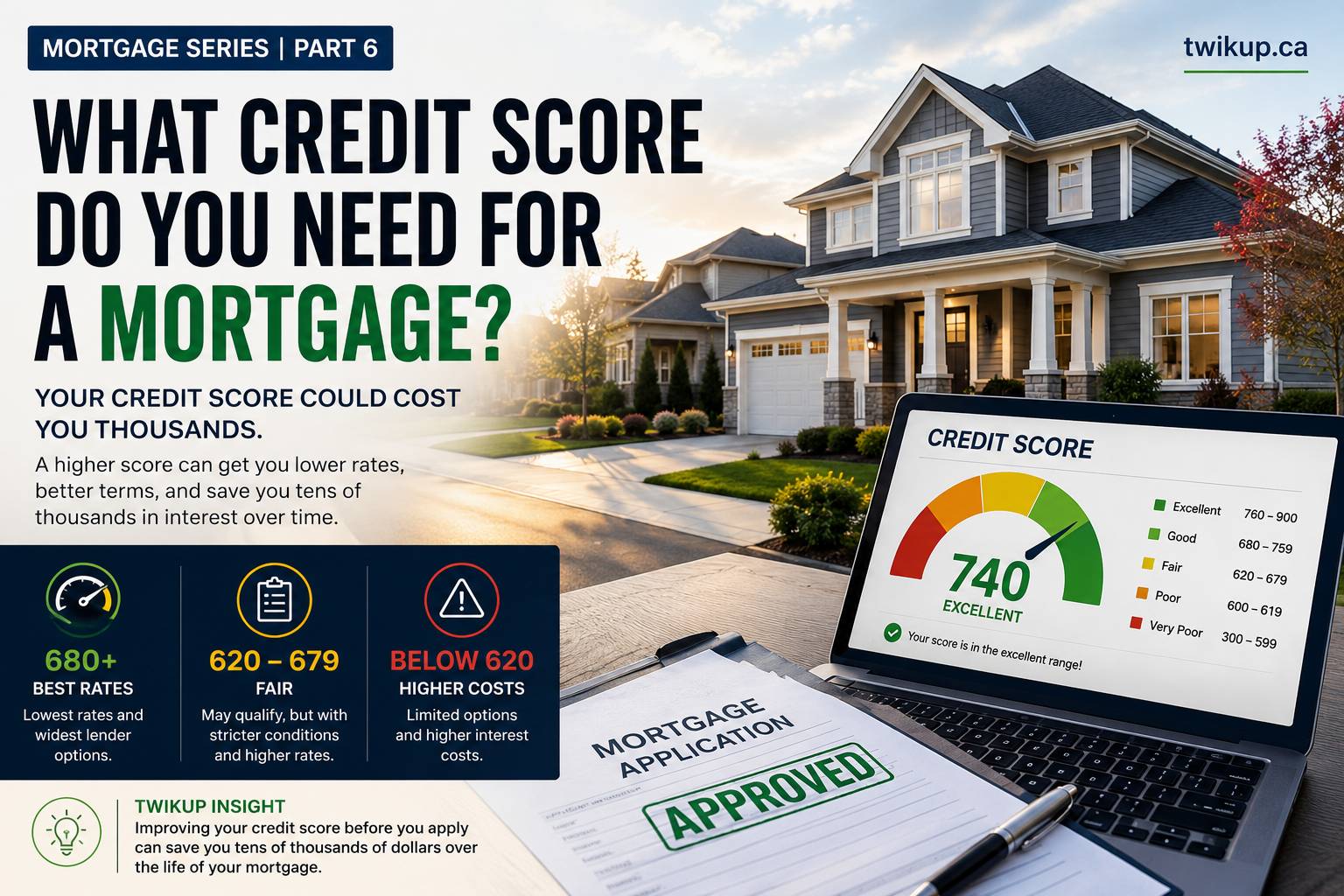
What Credit Score Do You Need for a Mortgage in Canada? (2026 Guide)
Part 6 of Twikup's Mortgage Series
Before reading this article, check out the earlier guides in the series:
-
Part 1: What Is a Mortgage and How Does It Work in Canada? (2026 Guide) https://twikup.ca/money/mortgages/what-is-a-mortgage-and-how-does-it-work-in-canada-2026-guide
-
Part 2: How Much House Can You Really Afford in Canada? Most Buyers Get This Wrong https://twikup.ca/money/mortgages/how-much-house-can-you-really-afford-in-canada-most-buyers-get-this-wrong
-
Part 3: How to Get Mortgage Pre-Approval in Canada (2026 Guide) https://twikup.ca/money/mortgages/how-to-get-mortgage-pre-approval-in-canada-2026-guide-the-critical-step-most-homebuyers-skip
-
Part 4: Down Payments in Canada Explained (2026): How Much Do You Really Need to Buy a Home? https://twikup.ca/money/mortgages/down-payments-in-canada-explained-2026-how-much-do-you-really-need-to-buy-a-home
-
Part 5: Mortgage Stress Test Explained (2026): The Hidden Rule That Determines How Much Home You Can Actually Buy in Canada https://twikup.ca/money/mortgages/mortgage-stress-test-explained-2026-the-hidden-rule-that-determines-how-much-home-you-can-actually-buy-in-canada
Quick Answer
Most Canadian homebuyers need a credit score of at least 680 to qualify for the best mortgage rates from major banks and traditional lenders.
However, getting a mortgage is still possible with a lower score:
| Credit Score | Mortgage Options |
|---|---|
| 680 – 900 | Best rates and widest lender choice |
| 620 – 679 | Usually eligible, but may face stricter conditions |
| 600 – 619 | Limited lender options and higher rates |
| Below 600 | Typically requires alternative or private lenders |
A higher credit score doesn't just improve approval odds—it can save tens of thousands of dollars in interest over the life of your mortgage.
Why Your Credit Score Matters More Than Most Buyers Realize
Many Canadians spend months saving for a down payment.
Others focus on getting mortgage pre-approval.
But surprisingly few buyers pay attention to the number that lenders often examine first:
Their credit score.
Your credit score helps lenders estimate how likely you are to repay borrowed money.
The higher your score:
- Lower perceived risk
- Better mortgage rates
- More lender options
- Greater borrowing power
- Easier approval process
The lower your score:
- Higher interest rates
- Fewer lender choices
- Larger required down payments
- Additional documentation requests
- Increased risk of denial
In a high-cost housing market, even a small difference in interest rate can have a massive impact on your monthly budget.
What Is a Credit Score?
A credit score is a three-digit number ranging from approximately 300 to 900.
In Canada, scores are primarily calculated by:
- Equifax Canada
- TransUnion Canada
The score reflects your borrowing history, including:
- Credit cards
- Personal loans
- Auto loans
- Lines of credit
- Payment history
- Credit utilization
- Length of credit history
Credit Score Ranges Explained
Excellent: 760–900
Borrowers in this range are considered very low risk.
Benefits include:
- Best available mortgage rates
- Faster approvals
- More negotiating power
- Access to premium lending products
Good: 680–759
This is the sweet spot for most Canadian mortgage approvals.
Benefits include:
- Competitive mortgage rates
- Approval from major banks
- Strong lender options
Most mortgage professionals recommend reaching at least 680 before applying whenever possible.
Fair: 620–679
Mortgage approval is still possible.
However, you may encounter:
- Slightly higher rates
- Additional lender scrutiny
- Reduced flexibility
Some lenders may require stronger supporting factors such as:
- Stable employment
- Lower debt ratios
- Larger down payment
Poor: 600–619
Traditional lenders become more cautious.
You may need:
- Alternative ("B") lenders
- Mortgage brokers specializing in credit challenges
- Higher down payment
Expect noticeably higher borrowing costs.
Very Poor: Below 600
Approval through major banks becomes difficult.
Homeownership may still be possible through:
- Alternative lenders
- Private lenders
- Credit rebuilding programs
However, borrowing costs can increase substantially.
Can You Get a Mortgage With Bad Credit?
Yes.
Many Canadians assume a low credit score automatically means they cannot buy a home.
That is not necessarily true.
Lenders also evaluate:
- Income
- Employment stability
- Debt levels
- Down payment size
- Existing assets
- Overall financial profile
A buyer with a 590 score and a 25% down payment may sometimes be approved while a buyer with a 680 score but excessive debt could be denied.
Credit score matters—but it is not the entire story.
Real Example: How Credit Score Can Cost You Thousands
Let's compare two buyers purchasing the same home.
Home Price
$625,000
Mortgage Amount
$500,000
Mortgage Amortization
25 Years
Borrower A
Credit Score: 740
Example Mortgage Rate: 4.5%
Monthly Payment:
$2,773
Interest Paid During First 5 Years:
Approximately $82,140
Borrower B
Credit Score: 640
Example Mortgage Rate: 5.5%
Monthly Payment:
$3,071
Interest Paid During First 5 Years:
Approximately $102,660
The Difference
Borrower B pays:
- Nearly $300 more per month
- More than $20,000 additional interest over five years
Simply because lenders view them as a higher credit risk.
What Credit Score Do Major Canadian Banks Prefer?
While approval criteria vary, many major lenders prefer:
| Lender Type | Preferred Score |
|---|---|
| Major Banks | 680+ |
| Credit Unions | 650+ |
| Insured Mortgages | Often 600+ |
| Alternative Lenders | 550+ |
| Private Lenders | Flexible |
Remember:
Approval depends on your entire application, not just your score.
How to Improve Your Credit Score Before Applying
If you plan to buy a home within the next 6–12 months, improving your score can significantly reduce your borrowing costs.
Pay Bills On Time
Payment history is one of the biggest scoring factors.
Even a few late payments can hurt your score.
Lower Credit Card Balances
Try to keep utilization below:
- 30% ideally
- 50% maximum
Example:
A $10,000 credit card should ideally carry less than $3,000 balance.
Avoid Applying for Multiple Credit Products
Every hard credit inquiry can temporarily reduce your score.
Avoid:
- Store cards
- Financing offers
- Multiple loan applications
Before applying for a mortgage.
Keep Older Accounts Open
Longer credit history often helps improve scores.
Closing your oldest credit card can sometimes lower your score.
Check Your Credit Report for Errors
Mistakes happen.
Incorrect late payments or duplicate accounts can negatively affect your score.
Review your reports regularly through:
- Equifax Canada
- TransUnion Canada
Does Mortgage Pre-Approval Affect Your Credit Score?
Yes—but usually only slightly.
When you seek mortgage pre-approval, lenders perform a hard credit inquiry.
For most Canadians, the impact is small and temporary.
The benefits of understanding your borrowing capacity generally outweigh the minor score reduction.
If you haven't completed this step yet, read:
How to Get Mortgage Pre-Approval in Canada (2026 Guide)
Should You Delay Buying a Home to Improve Your Credit Score?
Sometimes.
Consider waiting if:
- Your score is below 620
- You recently missed payments
- You carry high credit card balances
- You expect meaningful score improvement within a few months
Improving your score could save thousands in interest and improve lender options.
However, delaying homeownership also comes with risks if home prices or interest rates rise.
Every situation is different.
Common Credit Score Myths
Myth 1: Checking Your Own Credit Score Hurts Your Score
False.
Checking your own credit report is considered a soft inquiry.
It does not affect your score.
Myth 2: You Need Perfect Credit to Buy a Home
False.
Many Canadians qualify with scores well below 700.
Myth 3: Income Can Replace Poor Credit
Partially false.
Strong income helps, but lenders still evaluate repayment history.
Myth 4: Paying Off Debt Instantly Fixes Your Score
Not always.
Credit improvement usually takes time as new information updates your report.
Key Takeaways
✅ A credit score of 680+ generally provides access to the best mortgage rates.
✅ Scores between 620 and 679 can still qualify for many mortgages.
✅ Scores below 620 often require alternative lending options.
✅ Better credit can save tens of thousands of dollars in interest.
✅ Improving your score before applying may significantly increase affordability.
✅ Your credit score is only one part of the mortgage approval process.
Twikup Insight
Many first-time buyers believe saving for a down payment is the hardest part of buying a home.
In reality, improving a credit score from 640 to 700 can sometimes save more money than increasing a down payment by several thousand dollars.
The hidden lesson is this:
A mortgage is not just about getting approved. It's about getting approved at the lowest possible cost.
Before shopping for homes, spend time improving your financial profile.
A few months of credit improvement today could save you tens of thousands of dollars over the next 25 years.
The smartest homebuyers don't just shop for houses—they shop for the best mortgage terms possible.
Coming Next in the Mortgage Series
Part 7: Fixed vs Variable Mortgage Rates in Canada (2026): Which One Actually Saves More Money?
Many Canadians focus entirely on interest rates while overlooking the mortgage decision that can impact their finances for years. In the next guide, we'll break down fixed and variable mortgages, historical performance, risks, rewards, and how to choose the right option in today's market.