
Key Takeaways
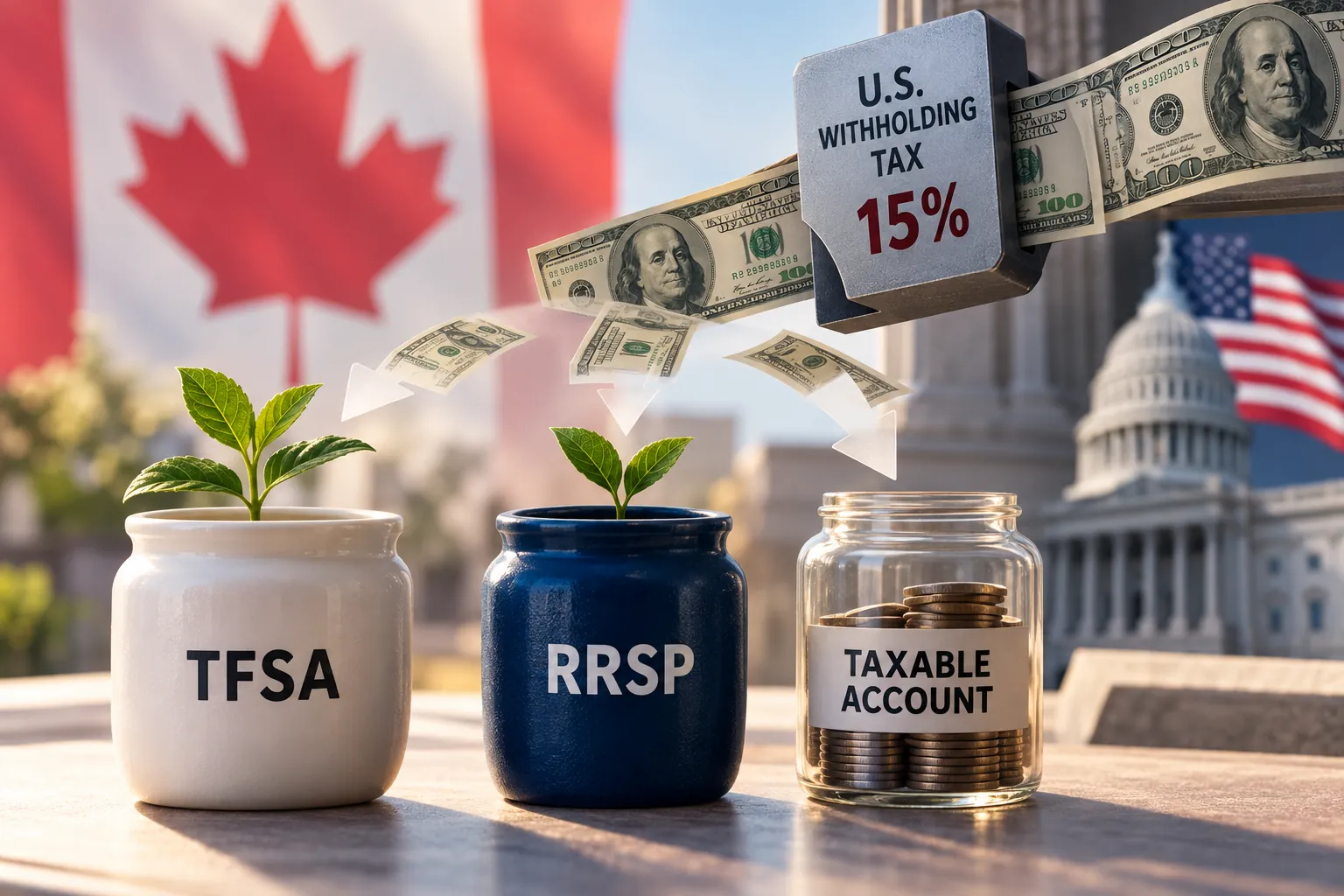
- A TFSA shelters income from Canadian tax but generally cannot recover foreign withholding tax through the Canadian foreign tax credit.
- An RRSP can avoid U.S. dividend withholding on qualifying U.S.-listed ETFs holding U.S. stocks, but ETF structure matters.
- Compare withholding savings with currency conversion, fees and trading costs before choosing an ETF or account structure.
You buy a U.S. ETF inside your TFSA.
The account literally has the words “Tax-Free” in its name.
So when the ETF pays a dividend, you expect to keep the whole thing.
Not necessarily.
For Canadian investors, there is a small tax that can quietly disappear before a U.S. dividend ever reaches the account. And whether you can avoid or recover that tax can depend on something surprisingly specific:
whether the investment sits in your TFSA, RRSP or taxable account — and even whether the ETF itself is Canadian-listed or U.S.-listed.
This is foreign withholding tax, and over decades of investing, understanding it can make your portfolio a little more efficient.
The Tax That Disappears Before You See the Dividend
Suppose you own an ETF holding U.S. companies and those companies collectively pay you the equivalent of $1,000 in dividends.
Under the Canada-U.S. tax treaty, U.S.-source dividends paid to a Canadian resident generally qualify for a reduced 15% U.S. withholding rate rather than the standard 30% rate when the treaty requirements are satisfied.
That could mean:
$1,000 dividend
− $150 U.S. withholding tax
= $850 reaching the investor
The important part is that Canada didn't necessarily charge that $150.
The United States did.
That distinction explains why putting an investment inside a TFSA does not automatically make foreign withholding tax disappear.
TFSA: Tax-Free in Canada Doesn't Mean Tax-Free Everywhere
The TFSA is enormously valuable because interest, dividends and capital gains earned inside it are generally not taxed by Canada.
But another country does not have to treat a TFSA the same way Canada does.
For U.S. dividends, a TFSA generally does not receive the same treaty withholding-tax treatment available to qualifying retirement arrangements such as RRSPs.
So U.S. dividend withholding can still apply.
And there is another catch.
The CRA says foreign taxes paid on income earned inside a TFSA are not included when calculating the Canadian foreign tax credit.
In practical terms, if foreign withholding tax is taken from investments inside your TFSA, you generally cannot simply claim it back on your Canadian tax return.
Your TFSA is still tax-free from Canada's perspective.
It just isn't necessarily withholding-tax-free from the perspective of another country.
RRSP: This Is Where Things Get Interesting
An RRSP can receive more favourable treatment under the Canada-U.S. tax treaty.
Qualifying Canadian retirement arrangements are recognized under the treaty, which can allow U.S.-source dividends to avoid U.S. withholding tax in circumstances where the investment is held appropriately.
But this is where many investors miss an important detail:
The ETF's structure matters.
Imagine your RRSP directly owns a U.S.-listed ETF that holds U.S. stocks.
That structure can generally benefit from the treaty exemption on U.S. dividend withholding within an RRSP.
Now imagine your RRSP owns a Canadian-listed ETF that invests in those same U.S. companies.
The result can be different.
The Canadian ETF itself receives the dividends before distributing investment income onward. U.S. withholding tax can therefore occur at the fund level, and putting units of that Canadian ETF inside your RRSP does not magically reverse tax already withheld from the fund.
So two portfolios can own essentially the same U.S. companies and still experience different withholding-tax treatment.
A Simple Comparison
For straightforward U.S. equity exposure, the basic picture often looks like this:
| Account | U.S.-Listed ETF Holding U.S. Stocks | Canadian-Listed ETF Holding U.S. Stocks |
|---|---|---|
| TFSA | U.S. withholding generally applies and isn't recoverable through the foreign tax credit | U.S. withholding can occur inside the fund and is generally unrecoverable by the TFSA investor |
| RRSP | U.S. dividend withholding can generally be avoided when treaty conditions are met | Withholding can still occur at the Canadian fund level |
| Taxable account | U.S. withholding generally applies, but a Canadian foreign tax credit may be available | Foreign tax paid by the fund may generally be reported to investors, potentially allowing a foreign tax credit |
This is a simplified comparison. ETF structure, underlying investments, country of origin, account type and individual tax circumstances can change the result.
What About International ETFs?
This is where the tax map becomes more complicated.
Suppose you buy an ETF containing companies from Japan, France, Switzerland, Australia and other countries.
There may now be multiple layers between the company paying the dividend and you receiving it.
For example:
Foreign company → U.S.-listed ETF → Canadian investor
The country where the company is located may withhold tax before the dividend reaches the U.S. ETF.
Depending on the account and fund structure, another withholding-tax consideration can arise when income moves from the U.S. fund to the Canadian investor.
And if a Canadian ETF owns a U.S. ETF that itself owns international stocks, another wrapper has entered the chain.
That is why simply asking, “Is this ETF Canadian or American?” isn't always enough.
You also need to ask:
What does the ETF itself own?
How Much Does This Actually Matter?
Withholding tax sounds dramatic until you put it into context.
Suppose $100,000 of U.S. equities produces a 2% annual dividend yield.
That's $2,000 of dividends.
A 15% withholding tax on those dividends equals:
$300 per year.
It is not 15% of your entire $100,000 portfolio.
It is 15% of the applicable dividend.
If the investment grew 8% during the year but only 2% came from dividends, the withholding calculation applies to the relevant dividend income — not the entire investment return.
That distinction matters.
Foreign withholding tax is worth understanding, but it shouldn't automatically become the single factor determining which ETF you buy.
Don't Save $100 in Tax and Spend $200 Somewhere Else
Suppose a U.S.-listed ETF offers slightly better withholding-tax treatment inside your RRSP.
Great.
But now consider everything else.
You may have to convert Canadian dollars into U.S. dollars. Your brokerage may charge a foreign-exchange spread. The alternative ETF may have different management fees, trading spreads or tracking characteristics.
A theoretically tax-efficient structure can therefore become less attractive if getting into and out of it costs more than the tax you are trying to save.
This is especially relevant for smaller portfolios.
Saving 15% withholding on a modest amount of annual dividends may not justify repeatedly paying expensive currency-conversion costs.
TwikUp Perspective: Think in Layers, Not Tickers
The biggest mistake is treating “Canadian ETF versus U.S. ETF” as if one is universally better.
It isn't.
A better way to think about ETF tax efficiency is as a three-layer question:
Account → Fund → Underlying investment
First, where are you holding it?
TFSA, RRSP or taxable account?
Second, where is the ETF itself domiciled?
Canada or the United States?
Third, what does that ETF actually own?
U.S. stocks directly? International stocks? Another ETF?
That third question is especially important because the withholding tax may happen inside the fund before you ever receive a distribution.
For many investors, the practical priority should still be getting the big decisions right first: saving consistently, keeping fees reasonable, staying diversified and using registered accounts effectively.
Once the portfolio becomes larger, optimizing which assets sit in which accounts can become increasingly worthwhile.
In other words:
Choose the portfolio first. Optimize the tax plumbing second.
A beautifully tax-optimized portfolio that you cannot stick with is unlikely to beat a simple diversified portfolio you consistently fund for decades.
The Bottom Line
A TFSA can shelter your investment income from Canadian tax without protecting every foreign dividend from foreign withholding tax.
An RRSP can receive particularly favourable treatment for certain U.S. investments, but ETF structure matters.
And in a taxable account, foreign withholding tax isn't necessarily permanently lost because you may be eligible for a Canadian foreign tax credit.
So before buying a U.S. or international ETF, don't ask only:
“What does this ETF own?”
Ask one more question:
“Where am I going to hold it?”
That small question can change what ultimately stays in your portfolio.
This article is for general educational purposes and does not constitute tax or investment advice. Tax treatment depends on an investor's circumstances, the investment structure and applicable tax treaties.