
Most people remember Apple's IPO because it created instant millionaires.
Few remember what came next.
The investors who bought Apple shares in 1980 and held on were forced to watch the company lose its founder, struggle through years of failed products, and drift dangerously close to collapse. For nearly two decades, there was little reason to believe their patience would be rewarded.
Yet history often reserves its greatest rewards for those willing to endure its longest tests.
Apple's journey from market darling to near-bankruptcy and back again remains one of the most powerful examples of why conviction, patience, and resilience can matter more than perfect timing.
The Day Apple Captured Wall Street's Imagination
December 12, 1980, felt like a turning point for the technology industry.
Apple Computer Inc. entered public markets amid extraordinary excitement. Investors viewed the company as one of the most promising businesses of the emerging personal computer era, and demand for shares reflected that optimism immediately.
Several milestones defined the historic debut:
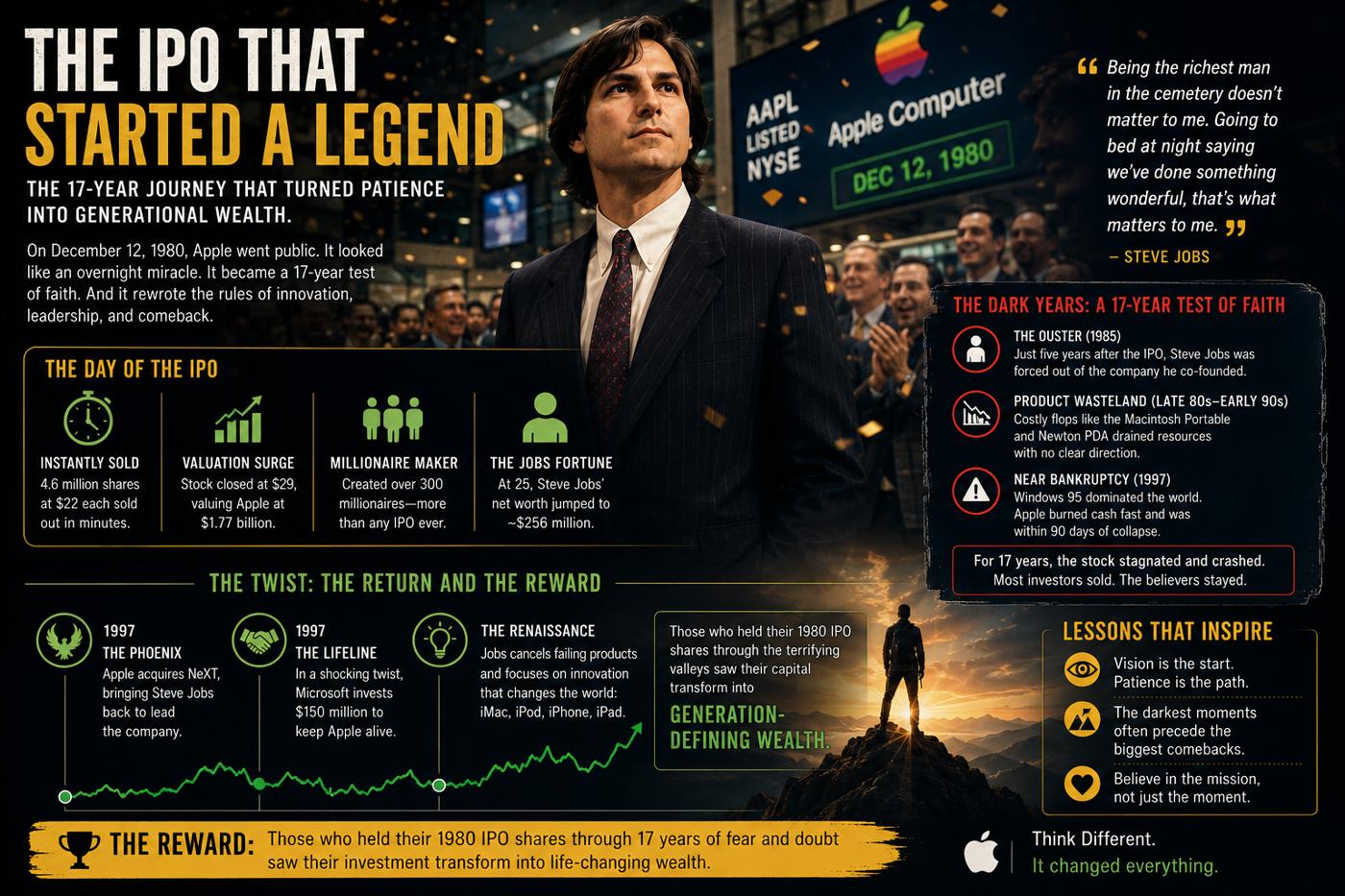
- Apple offered 4.6 million shares at $22 each.
- The shares sold out within minutes.
- By the end of trading, the stock climbed to $29.
- Apple's market value reached approximately $1.77 billion.
- More than 300 people became millionaires overnight.
- Steve Jobs, only 25 years old, saw his personal fortune grow to roughly $256 million.
To the outside world, the future seemed obvious.
Apple appeared destined for greatness.
What investors could not see was that the company's toughest challenges were still ahead.
From Market Darling to Corporate Turmoil
The optimism of 1980 gradually faded as Apple entered a period of uncertainty.
The first major shock arrived in 1985 when Steve Jobs was forced out of the company he had helped build. Internal disagreements and leadership struggles created instability at a moment when the technology industry was evolving rapidly.
The years that followed brought a series of setbacks:
- Leadership changes weakened strategic direction.
- Several products failed to achieve commercial success.
- Competition intensified across the personal computer market.
- Apple's position within the industry became increasingly uncertain.
For many shareholders, the temptation to quit became overwhelming.
Every headline seemed to reinforce the same conclusion: Apple had missed its opportunity. Competitors were winning. Market share was shrinking. The company that once represented the future increasingly looked like a relic of the past.
Selling would have felt rational.
Holding required something far more difficult: faith in a future that nobody could clearly see.
When Apple Came Dangerously Close to Disappearing
By the mid-1990s, Apple's problems had intensified.
Microsoft's Windows ecosystem had become the dominant force in personal computing, while Apple struggled to maintain momentum. Financial losses mounted, investor confidence weakened, and the company's stock endured years of disappointing performance.
By 1997, Apple was reportedly within months of running out of viable options.
The contrast was staggering.
A company once celebrated as a technological pioneer was now being discussed as a potential corporate failure.
Many investors who had believed in Apple's vision finally surrendered. After years of disappointment, they concluded the company would never regain its former relevance.
Few could blame them.
After all, seventeen years is a long time to wait for proof that your belief was justified.
The Return That Changed Everything
Then the story took an unexpected turn.
In 1997, Apple acquired NeXT, bringing Steve Jobs back to the company he had co-founded years earlier. What followed would become one of the most remarkable corporate recoveries ever witnessed.
Several events helped reshape Apple's future:
| Turning Point | Impact |
|---|---|
| NeXT acquisition | Jobs returned |
| Microsoft investment | Financial support |
| Product simplification | Strategic focus |
| iMac launch | Consumer revival |
| iPod introduction | Ecosystem growth |
| iPhone development | Industry disruption |
| iPad launch | Category expansion |
One of the most surprising moments came when Microsoft invested $150 million in Apple, helping provide stability during a critical period.
Jobs responded by eliminating underperforming products, simplifying operations, and concentrating resources on innovation.
The results would eventually produce the iMac, iPod, iPhone, and iPad—products that transformed not only Apple but entire industries.
What once appeared to be a dying company became one of the most influential businesses in modern history.
Why Apple's Story Is Bigger Than Technology
Apple's IPO story is often presented as a tale of financial success.
In reality, it is a story about endurance.
The greatest investors were not necessarily those who predicted every product launch or market trend. They were the people who survived years of uncertainty, fear, and doubt without abandoning their long-term belief.
Success rarely arrives when confidence is highest.
More often, it emerges after years of struggle, when persistence becomes a competitive advantage and patience separates those who merely participate from those who ultimately transform their future.
That is the deeper lesson hidden behind Apple's historic IPO.
The highest rewards often belong to those willing to stay the course when the path ahead appears darkest.
Future Outlook and Lasting Lessons
More than four decades later, Apple's IPO remains one of the defining stories in modern investing.
The company's rise demonstrates that extraordinary businesses are rarely built through uninterrupted success. They are forged through setbacks, mistakes, reinvention, and resilience.
For investors, entrepreneurs, and leaders alike, Apple's journey serves as a reminder that temporary failure and long-term success are not mutually exclusive.
Sometimes, the greatest opportunities hide inside the moments when belief is hardest to maintain.
FAQ: Brief Insights on Apple's IPO Journey
Why was Apple's IPO considered historic?
It was the most anticipated public offering since Ford's 1956 debut and instantly created more than 300 millionaires.
What was Apple's biggest challenge after going public?
The company struggled through leadership conflicts, unsuccessful products, declining market share, and severe financial pressure.
How did Steve Jobs return to Apple?
Apple acquired NeXT in 1997, bringing Jobs back to lead the company's turnaround.
What is the biggest lesson from Apple's story?
Long-term success often requires enduring periods of uncertainty that cause many people to give up before the rewards arrive.