
Quick Answer
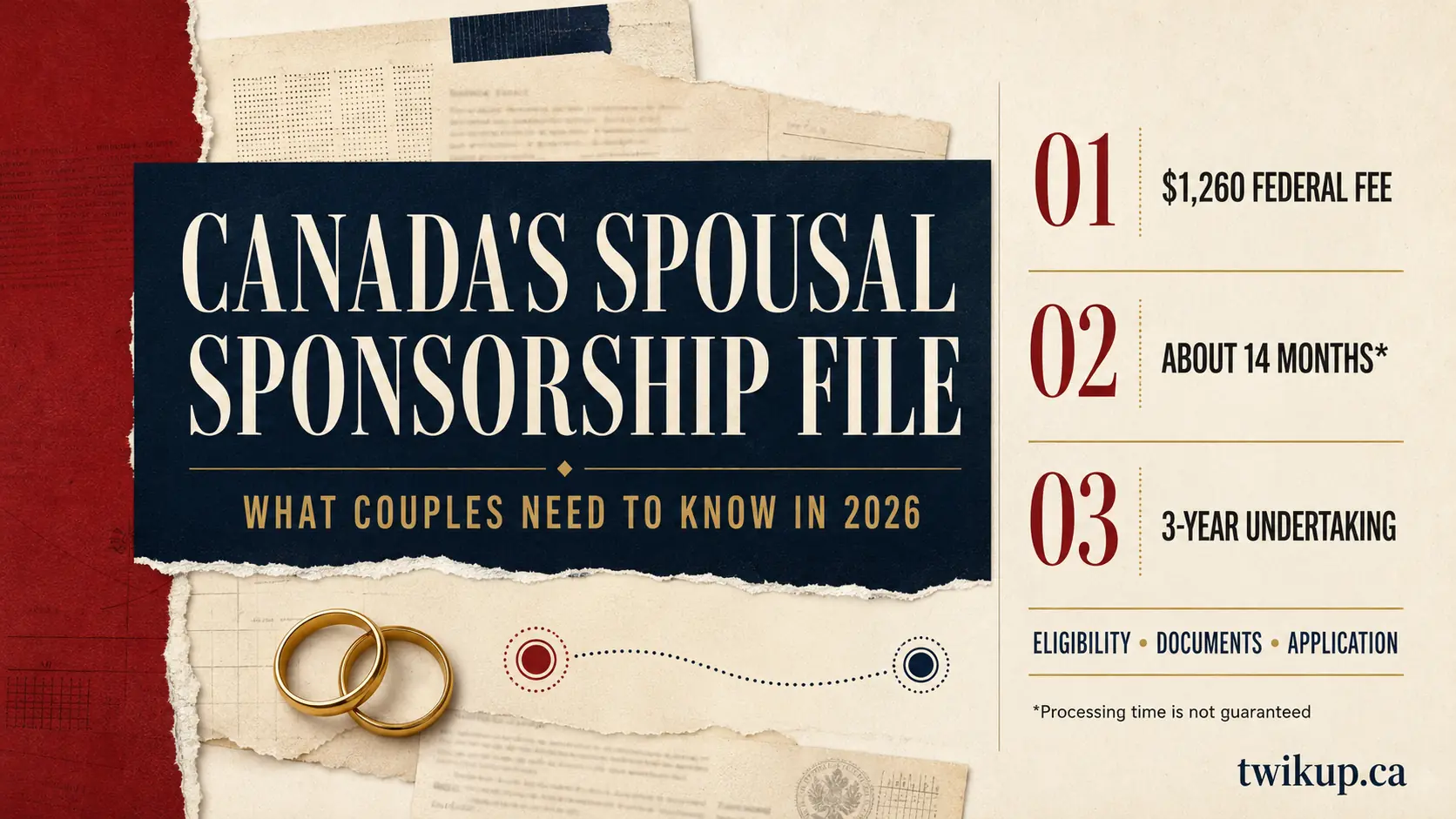
Canada’s spousal sponsorship program allows an eligible Canadian citizen, permanent resident or person registered under the Indian Act to sponsor a spouse, common-law partner or conjugal partner for permanent residence.
In most cases, there is no minimum income requirement. However, the sponsor must sign a legally binding undertaking to provide financial support for three years after the sponsored partner becomes a permanent resident.
Applicants submit two connected applications:
- An application to become an approved sponsor
- The spouse or partner’s permanent residence application
As of July 2026, the federal government fee to sponsor a spouse or partner is $1,260. Biometrics, medical examinations, police certificates and translations may cost extra.
Processing is not necessarily quick. On July 21, 2026, Immigration, Refugees and Citizenship Canada reported that applications for spouses, partners and children—submitted from inside or outside Canada for destinations outside Quebec—had recently been processed in approximately 14 months.
That figure describes applications processed between June 2025 and May 2026. It is not a guaranteed timeline for a new application.
Key Takeaways
- Canada’s spousal sponsorship program remains open in 2026.
- A marriage certificate does not guarantee approval.
- The relationship must be legally recognized and genuine.
- Common-law partners generally need 12 continuous months of cohabitation.
- Most sponsors do not need to meet a minimum income threshold.
- The federal application fee is currently $1,260.
- The sponsor is generally financially responsible for three years after permanent residence begins.
- Eligible sponsored spouses living in Canada may apply for an open work permit.
- Quebec has an additional undertaking process, an intake schedule and application limits.
- A complete, truthful and consistent application can reduce avoidable delays.
One Marriage, Two Countries
At 10:47 p.m. in Toronto, Daniel opens a folder called “Priya Canada Application.”
Inside are 312 wedding photographs, months of WhatsApp messages, flight tickets, hotel reservations and a scanned marriage certificate.
Priya is watching from India through a video call.
“Do you think this is enough?” she asks.
Daniel scrolls through another page of nearly identical wedding photographs.
“It has to be. We’re married.”
Daniel and Priya are fictional applicants used to illustrate common sponsorship issues.
Their assumption reflects a real problem: a marriage certificate proves that a legal marriage was registered, but it does not automatically prove that the relationship is genuine, continuing and not primarily created for immigration purposes.
Their challenge is not simply to collect more evidence. It is to turn years of records into one clear, truthful and consistent account of their relationship.
Who Can Sponsor a Spouse in Canada?
You may be eligible to sponsor your spouse or partner if you:
- Are at least 18 years old
- Are a Canadian citizen, permanent resident or person registered in Canada under the Indian Act
- Live in Canada, subject to an exception for eligible Canadian citizens living abroad
- Are not receiving social assistance for a reason other than disability
- Can provide for the sponsored person’s basic needs
- Are prepared to sign the sponsorship undertaking
- Are not disqualified because of a previous sponsorship, financial default, removal order, incarceration or certain criminal convictions
A Canadian citizen living outside Canada may be able to sponsor a spouse or partner by demonstrating a genuine plan to return to Canada when the sponsored person becomes a permanent resident.
A permanent resident living outside Canada cannot sponsor a spouse or partner while residing abroad.
Applicants should review the complete IRCC sponsorship eligibility requirements before applying.
How Much Income Does a Sponsor Need?
In most spousal sponsorship cases, Canada does not require the sponsor to earn a specific minimum income.
This differs from programs such as parent and grandparent sponsorship.
A formal financial assessment may still apply in limited circumstances, including when the sponsored spouse or partner has a dependent child who also has a dependent child.
Even without a standard income threshold, sponsorship is a serious financial commitment. The sponsor must demonstrate an ability to provide basic support and cannot generally be receiving social assistance for a reason other than disability.
Losing a job does not automatically make a sponsor ineligible. However, an unemployed sponsor may need to explain how the couple intends to support itself.
Who Can Be Sponsored?
Canada recognizes three principal partner categories.
Spouse
A spouse is someone legally married to the sponsor.
The marriage must be valid in the country where it occurred and recognized under Canadian law. Both partners generally must have been physically present at the marriage ceremony.
IRCC does not normally recognize marriages conducted by proxy, telephone, fax or the internet when one or both partners were not physically present. A narrow exception may apply to certain members of the Canadian Armed Forces.
Common-Law Partner
A common-law partner is generally someone who has lived with the sponsor in a marriage-like relationship for at least 12 continuous months.
Evidence of a shared household and interdependent life may include:
- A joint lease or property ownership
- Utility bills showing the same address
- Joint bank or credit accounts
- Shared insurance
- Government documents carrying the same address
- Correspondence delivered to the shared residence
- Evidence of shared expenses and household responsibilities
Short, temporary separations may not necessarily interrupt the qualifying period if the couple maintained their home and relationship. Longer or repeated separations may require a detailed explanation.
Conjugal Partner
The conjugal-partner category is not a shortcut for couples who have not lived together or are not ready to marry.
It generally applies when a couple has maintained a genuine, mutually dependent relationship for at least one year but serious legal, immigration, religious, social or cultural barriers prevented marriage or cohabitation.
Distance, work commitments or a personal decision to postpone marriage will not necessarily establish eligibility. A conjugal partner must be living outside Canada.
In-Canada Class or Family Class?
“Inland” and “outland” are commonly used informal terms. IRCC formally processes couples through the Spouse or Common-Law Partner in Canada Class or the Family Class.
| Consideration | Spouse or Common-Law Partner in Canada Class | Family Class |
|---|---|---|
| Typical situation | The couple lives together in Canada | The sponsored person usually lives outside Canada |
| Applicant’s location | Living with the sponsor in Canada | May be living inside or outside Canada |
| Conjugal partners | Not eligible under this class | Must apply under the Family Class |
| Open work permit | May be available if the requirements are met | May also be available to certain sponsored partners living in Canada |
| Travel | Travel can create practical risks if re-entry is refused | Often better suited to applicants who expect to travel or live abroad |
| Refusal | No sponsorship appeal to the Immigration Appeal Division | The sponsor may have a right of appeal, subject to legal exceptions |
| Processing estimate | Changes regularly | Changes regularly |
A sponsor whose Family Class application is refused may have a right to appeal to the Immigration Appeal Division. That statutory sponsorship appeal is generally unavailable for a refusal under the Spouse or Common-Law Partner in Canada Class.
Federal Court judicial review may be possible in some cases, but it is different from an appeal and is subject to strict deadlines. Applicants dealing with a refusal should promptly consider obtaining advice from an authorized immigration professional.
The appropriate class depends on where the applicant lives, whether the couple resides together in Canada, the applicant’s immigration status, travel plans and the couple’s circumstances. The choice should not be based only on whichever class appears faster at a particular moment.
What Documents Are Required?
The exact document package depends on the relationship, countries involved, previous marriages, dependent children and personal history.
Applicants should download the current IRCC spousal sponsorship checklist and review any country-specific instructions. An old checklist saved from another website may no longer be valid.
Sponsor’s Documents
The sponsor may need:
- Proof of Canadian citizenship, permanent residence or registration under the Indian Act
- A passport, citizenship certificate or permanent resident card
- Proof of residence in Canada
- Employment or financial information, when applicable
- Evidence of plans to return to Canada if a Canadian citizen is sponsoring from abroad
- Divorce, annulment or death certificates relating to previous marriages
- Information about previous sponsorships
- Completed sponsorship forms
Sponsored Person’s Documents
The principal applicant may need:
- A valid passport or travel document
- Birth certificate
- National identity documents
- Marriage certificate
- Documents relating to previous marriages or relationships
- Police certificates
- Digital photographs meeting IRCC specifications
- Personal, address, travel and employment history
- Documents for dependent children
- Country-specific records
Relationship Evidence
Depending on the applicable checklist, relationship evidence may include:
- The Relationship Information and Sponsorship Evaluation form
- Photographs taken at different times and places
- Communication records covering different periods
- Flight tickets, boarding passes and entry stamps
- Joint leases, accounts, bills or insurance
- Evidence of financial support or shared expenses
- Evidence that relatives and friends recognize the relationship
- Birth certificates of children together
- A clearly organized relationship timeline
The applicable IRCC checklist determines what must be submitted. For applicants asked to provide relationship photographs, the current checklist generally requests a maximum of 20 photographs, accompanied by brief descriptions identifying the people, place, date and context.
There is no universal ideal number of documents for every application. Applicants should follow their current checklist and prioritize relevant, representative evidence over unnecessary repetition.
Documents not written in English or French generally require an acceptable translation. Applicants must follow IRCC’s current translation and certification requirements.
How Do You Prove a Genuine Relationship?
Daniel originally planned to upload all 312 wedding photographs.
Priya notices that nearly every photograph comes from the same three-day celebration. The collection shows that a wedding occurred, but reveals little about the four-year relationship surrounding it.
They reorganize their evidence chronologically:
- Their first introduction
- Their first in-person meeting
- Messages showing how the relationship developed
- Visits and trips together
- Their engagement
- The wedding
- Post-wedding communication and financial planning
- Their plans to establish a home in Canada
They select a limited number of representative photographs in accordance with the checklist and add short captions. They also include travel records, communication samples from different periods and documents showing shared plans.
The application becomes smaller, but the relationship becomes easier to understand.
Good evidence does not need to make a couple appear perfect. If the couple experienced long separations, limited family involvement, a small wedding or an unusual living arrangement, they should explain the circumstances truthfully.
Attempting to conceal an uncomfortable detail can create a more serious credibility problem.
Why Consistency Matters
Suppose Daniel writes that he first met Priya in March 2022.
Priya’s form says May 2022, while a photograph identifies an event in February 2022 as their first meeting.
There may be an innocent explanation: they were introduced online in February, met in person in March and began dating in May. Unless they explain those distinctions, however, an officer sees three conflicting dates.
Before completing the forms, couples should prepare a master timeline covering:
- First introduction
- First in-person meeting
- Beginning of the relationship
- Important visits
- Start of cohabitation, if applicable
- Engagement
- Marriage
- Periods of separation
- Major family events
- Future settlement plans
Every form should be checked against the same timeline.
Police Certificates, Biometrics and Medical Examinations
The sponsored person and applicable family members may need police certificates from countries where they have lived.
Requirements differ by country. Some governments allow applicants to request a certificate directly, while others require instructions from IRCC. Canada’s police-certificate directory explains the procedure for each country.
Applicants may also need to provide biometrics consisting of fingerprints and a photograph.
In 2026, the biometrics fee is generally:
- $85 for one applicant
- A maximum of $170 for an eligible family applying together
An immigration medical examination must be performed by an IRCC-approved panel physician. A regular family doctor cannot complete the examination unless that doctor is also an approved panel physician.
Applicants should follow the instructions for their case rather than arranging an examination that does not meet IRCC’s requirements.
How Much Does Spousal Sponsorship Cost in 2026?
As of July 2026, the federal fee to sponsor a spouse or partner is $1,260.
| Federal fee | Amount |
|---|---|
| Sponsorship fee | $90 |
| Principal applicant processing fee | $570 |
| Right of permanent residence fee | $600 |
| Total | $1,260 |
Adding a dependent child generally costs $180 per child.
Other expenses may include:
- Biometrics
- Medical examinations
- Police certificates
- Certified translations
- Document certification
- Passport photographs
- Courier services
- Quebec provincial fees
Government fees can change. Confirm the amount using the official IRCC fee list before paying.
How to Apply for Spousal Sponsorship
Step 1: Confirm the Relationship Category
Determine whether the person qualifies as a spouse, common-law partner or conjugal partner.
Do not select the conjugal category simply because the couple has not completed 12 months of cohabitation.
Step 2: Check the Sponsor’s Eligibility
Review previous sponsorships, social assistance, support-payment obligations, immigration debts, criminal history and residency status.
A disqualifying issue discovered after the package has been prepared can waste time and money.
Step 3: Choose the Appropriate Application Class
Consider where the sponsored person lives, whether the couple resides together in Canada, the applicant’s temporary status, travel requirements and potential appeal rights.
Step 4: Download Current Forms and Instructions
Use current forms from IRCC. Do not assume that a form downloaded several months earlier is still valid.
The application contains two connected parts:
- The sponsorship application
- The permanent residence application
The principal applicant generally submits both parts together online through the Permanent Residence Portal.
Step 5: Create a Master Timeline
Prepare a chronological account of the relationship before completing the forms.
This helps prevent contradictory dates and makes it easier to select meaningful evidence.
Step 6: Gather and Organize the Documents
Follow the official checklist and country-specific instructions.
Use readable scans, descriptive file names and logical organization. If an upload field permits only one file, combine the related records into a single organized document.
Step 7: Explain Unusual Circumstances
A concise letter of explanation may be useful for:
- Long periods of separation
- A small or private wedding
- Limited photographs
- Previous marriages
- Different addresses
- Gaps in employment or address history
- Missing documents
- Name variations
- Inconsistencies requiring context
Explanations should be factual, truthful and supported by available evidence.
Step 8: Pay the Correct Fees
Pay the applicable fees online and include the receipt.
Paying the right of permanent residence fee with the initial application can prevent an additional payment request later.
Step 9: Complete a Final Review
Check:
- Names and spellings
- Dates of birth
- Passport numbers
- Addresses
- Employment and personal history
- Travel history
- Previous marriages
- Relationship dates
- Information about children and other family members
- Signatures and declarations
Failing to declare a family member can have serious consequences, even if that person is not accompanying the applicant to Canada.
Step 10: Submit and Save a Complete Copy
Upload both parts of the application and all supporting documents through the Permanent Residence Portal.
Save a copy of every form, document and payment receipt submitted.
Step 11: Wait for the Completeness Review
IRCC reviews the package to determine whether the required forms, documents and fees are present.
If the application is accepted as complete, IRCC generally issues an acknowledgement of receipt, commonly called an AOR. An incomplete application may be returned.
Step 12: Respond to Additional Requests
IRCC may request:
- Biometrics
- A medical examination
- Additional relationship evidence
- Updated police certificates
- An interview
- Clarification of conflicting information
- An updated passport
- Payment of an outstanding fee
Respond before the deadline and keep IRCC informed of changes to addresses, contact information, marital status and family composition.
Can a Sponsored Spouse Work While Waiting?
Submitting a sponsorship application does not automatically authorize the sponsored person to work in Canada.
A spouse, common-law partner or conjugal partner living in Canada may be eligible to apply for an open work permit if they meet IRCC’s requirements. The principal applicant generally needs an AOR confirming that the permanent residence application is being processed.
A limited exception may permit an application without an AOR when the person’s work or study permit, or temporary resident status, will expire within two weeks and the other requirements are met.
Applicants being processed under the spousal public policy because they lack valid temporary status generally must wait for approval in principle before applying for an open work permit.
The applicant cannot begin working until legally authorized. Review the current open work permit requirements before applying.
Can a Spouse Visit Canada During Processing?
A spouse or partner living outside Canada may apply for a visitor visa while a permanent residence application is in process.
Sponsorship does not guarantee visitor-visa approval or admission at the border. The applicant must still satisfy the temporary-resident requirements.
If admitted, the visitor must respect the authorized period of stay and cannot work without a valid work permit.
What Does the Three-Year Undertaking Mean?
The sponsor generally becomes financially responsible for the spouse or partner for three years from the date permanent residence begins.
The undertaking may cover basic needs such as:
- Food
- Clothing
- Housing
- Utilities
- Household supplies
- Personal requirements
- Health care not covered by public insurance
The undertaking does not automatically end if:
- The couple separates
- The marriage ends in divorce
- The sponsor loses employment
- The sponsored person becomes a Canadian citizen
- The sponsor experiences financial difficulty
- Either person moves to another province
If the sponsored person receives qualifying social assistance during the undertaking period, the government may require the sponsor to repay it.
Spousal sponsorship is therefore both an immigration application and a binding financial commitment to the government.
What Is the Processing Time in 2026?
On July 21, 2026, IRCC reported that applications for spouses, partners and children submitted from inside and outside Canada, for destinations outside Quebec, had been processed in approximately 14 months between June 2025 and May 2026.
This is historical processing information, not a guaranteed deadline for a new application.
Processing may be affected by:
- Application volume
- Whether the package is complete
- Background and security screening
- Medical requirements
- Country-specific verification
- Relationship concerns
- Interviews
- Dependent-family-member examinations
- Delayed responses to IRCC
- The intended province of residence
Applicants should use the IRCC processing-time calculator for the latest estimate.
Why Applications Are Returned or Delayed
Common problems include:
- Missing signatures
- Outdated forms
- Incorrect fees
- Missing country-specific documents
- Unreadable scans
- Incomplete personal history
- Unexplained address or employment gaps
- Conflicting relationship dates
- Improper translations
- Missing police certificates
- Failure to declare a family member
- Weak evidence of cohabitation
- Excessive evidence without organization
- Missed IRCC deadlines
- Concerns about whether the relationship is genuine
A thick application is not necessarily a complete application. The strongest package is truthful, organized and easy to follow.
Special Rules for Quebec Applicants
Couples intending to live in Quebec must complete an additional provincial undertaking process.
After the relevant federal stage, the sponsor generally applies to Quebec’s immigration ministry for an undertaking and the sponsored person’s provincial selection.
Quebec established a new family-reunification intake period from July 2, 2026, to June 30, 2028. During this period, the province may receive up to 13,300 undertaking applications involving a spouse, common-law partner or conjugal partner.
However, the cap is not the only restriction. Quebec uses a predetermined intake schedule based on the date of the sponsor’s IRCC eligibility letter or, in certain in-Canada cases, a qualifying acknowledgement of receipt.
Submitting an undertaking before the date permitted by that schedule can result in the application being returned. If the applicable maximum is reached, later applications may also be returned without processing.
Certain applications are exempt from the intake limit and schedule. Quebec applicants should review the province’s current family-reunification intake rules before submitting the provincial undertaking.
TwikUp Insight
The biggest evidence mistake is assuming that more documents always produce a stronger application.
IRCC does not need hundreds of nearly identical photographs. It needs the evidence required by the applicable checklist and enough reliable information to understand the relationship from its beginning to the present.
Daniel and Priya replace their oversized collection with:
- A limited selection of representative photographs
- Travel evidence from their visits
- Communication samples from different periods
- Documents showing shared financial planning
- A concise relationship timeline
- Explanations for the months they lived apart
Their relationship has not changed. Their application now communicates it more clearly.
The central lesson for couples applying in 2026 is simple: do not bury a genuine relationship beneath disorganized paperwork. Make every document support the same truthful account.
Final Application Checklist
Before submitting, confirm that you have:
- Verified the sponsor’s eligibility
- Selected the correct relationship category
- Chosen the appropriate application class
- Downloaded the latest forms and checklist
- Reviewed country-specific requirements
- Created a consistent relationship timeline
- Collected identity and civil-status documents
- Included meaningful relationship evidence
- Followed the checklist’s photograph requirements
- Obtained applicable police certificates
- Followed translation requirements
- Paid the correct fees
- Declared every family member
- Reviewed every name, date and address
- Added necessary explanations
- Saved a complete copy of the application
- Checked current processing estimates
- Reviewed Quebec’s additional rules, if applicable
Sources
- IRCC — Sponsor your spouse, partner or child
- IRCC — Complete application guide
- IRCC — Sponsorship eligibility requirements
- IRCC — Spousal sponsorship document checklist
- IRCC — Application-processing system
- IRCC — Citizenship and immigration fee list
- IRCC — Current processing times
- IRCC — Open work permits for sponsored partners
- Government of Quebec — Family-reunification intake rules
This article provides general information and does not constitute legal or immigration advice. Government fees, forms, policies, processing estimates and eligibility requirements may change. Applicants should confirm current instructions with IRCC and, where applicable, the Government of Quebec. People requiring advice about their circumstances should consult an authorized immigration professional.