
Key Takeaways
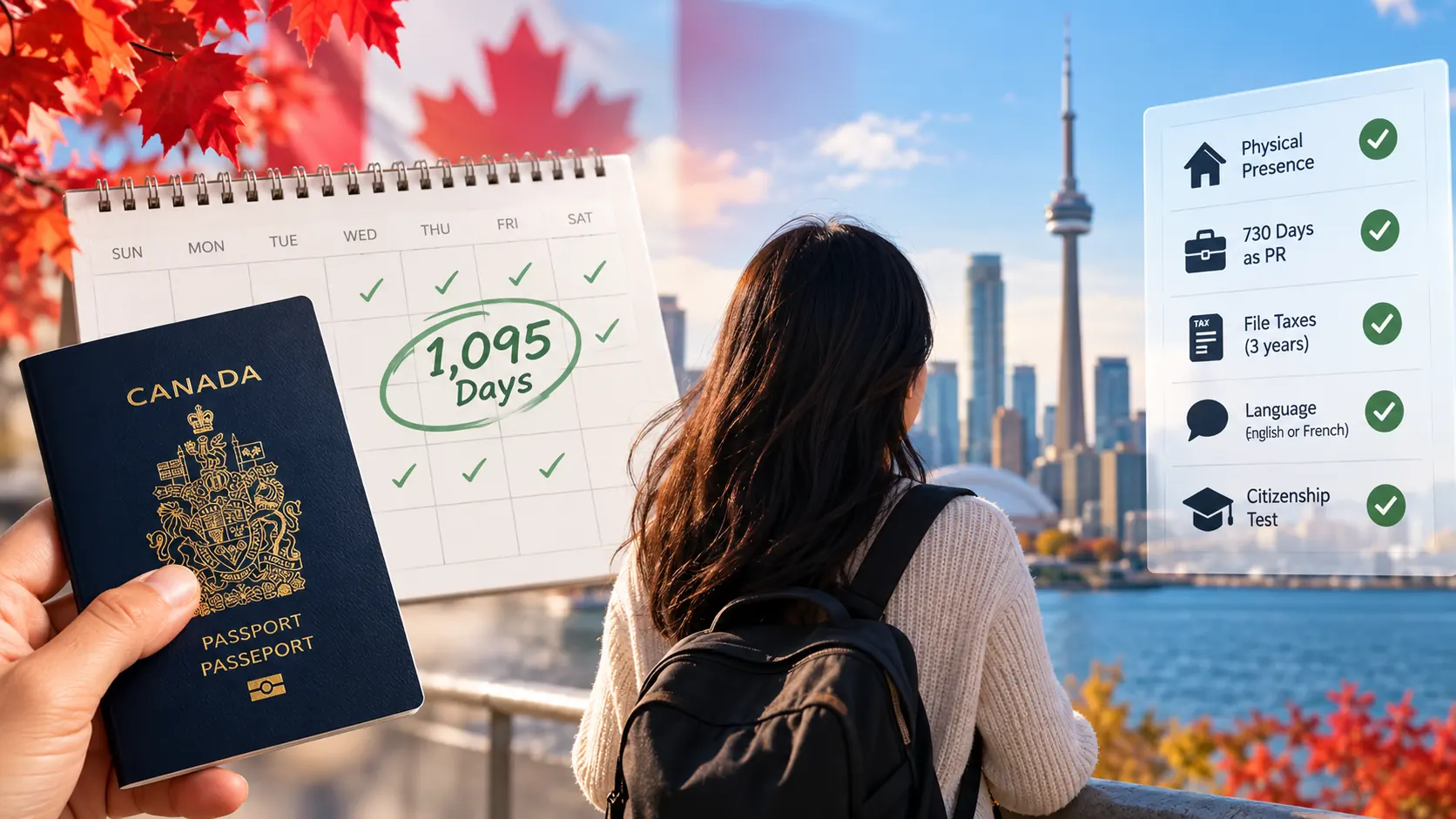
- Citizenship applicants generally need 1,095 qualifying physical-presence days within the five years before applying.
- Eligible pre-PR time can count at half-day credit, up to a maximum of 365 days.
- Travel, dates outside the five-year window and calculation errors can leave applicants short of the required total.
You arrived in Canada, studied or worked, became a permanent resident, and now you're thinking about citizenship.
But here's where things get confusing: Do you really need to wait three full years after becoming a permanent resident?
Not necessarily.
Canada allows certain days spent in the country before permanent residency to count toward citizenship. Depending on your immigration history, those days could help you qualify earlier than expected.
The important number is 1,095 days of physical presence in Canada within the five years immediately before you sign your citizenship application.
Here's how to calculate those days, what counts, and the mistakes that could delay your application.
Who Is Eligible for Canadian Citizenship in 2026?
For most adults applying for Canadian citizenship, Immigration, Refugees and Citizenship Canada (IRCC) requires:
- Permanent resident status: You must be a Canadian permanent resident.
- Physical presence: At least 1,095 qualifying days in Canada during the relevant five-year period, including at least 730 days as a permanent resident.
- Income taxes: You must have filed Canadian income taxes for at least three years within that five-year period if you were required to file.
- Language skills: Applicants aged 18–54 must demonstrate adequate English or French ability.
- Citizenship test: Applicants aged 18–54 generally need to pass the citizenship knowledge test.
- Other requirements: You must not be subject to a prohibition that prevents you from becoming a citizen, and you must take the citizenship oath if required.
You do not necessarily need a valid PR card to apply. An expired PR card does not mean your permanent resident status has expired.
How Does Canada's 1,095-Day Citizenship Rule Work?
Think of the citizenship calculation as a five-year window that moves forward every day.
IRCC looks at your eligible physical presence during the five years immediately before your application date.
Time outside that window does not count, even if you previously lived in Canada for several years.
Here's the basic calculation:
Qualifying days as a permanent resident + eligible pre-PR credit = total citizenship physical-presence days.
You need at least 1,095 days, subject to the rules governing absences and special circumstances.
And here's the part many applicants overlook: not every day you spent in Canada is necessarily worth one full day.
Can You Count Days in Canada Before Becoming a Permanent Resident?
Yes. This is particularly important for former international students, temporary foreign workers and protected persons.
Eligible time spent physically in Canada as a temporary resident or protected person during the relevant five-year period counts as half a day for each qualifying day, up to a maximum credit of 365 days.
| Immigration status | Credit toward citizenship |
|---|---|
| Permanent resident | 1 day per qualifying day |
| International student with eligible temporary resident status | 0.5 day |
| Work permit holder with eligible temporary resident status | 0.5 day |
| Visitor with eligible temporary resident status | 0.5 day |
| Protected person | 0.5 day for qualifying time |
| Maximum pre-PR credit | 365 days |
For example, 600 eligible pre-PR days could provide 300 days of citizenship credit. With 730 eligible days, you could receive the maximum 365-day credit.
However, time spent in Canada before the five-year eligibility window cannot be included.
Protected-person calculations have additional rules, including when that status begins. Refugee claimants should not assume that every day after making a claim qualifies.
What If Your PGWP Expires Before You Become a PR?
For international graduates, reaching permanent residency can be a separate challenge.
A Post-Graduation Work Permit (PGWP) does not automatically lead to permanent residence, and an expiring PGWP can create complications for someone planning to remain in Canada.
If you're approaching that deadline, our guide to PGWP expiring before PR: work permit options explained explores potential pathways and important decisions before your permit expires.
Remember that citizenship credit depends on eligible physical presence and immigration status, not simply having studied or worked in Canada.
Three Immigration Journeys: Who Qualifies First?
Let's compare three fictional applicants. These examples use simplified qualifying-day totals and assume all counted days fall within the relevant five-year window.
Example 1: The Former International Student
Meet Priya. She studied in Canada, received a post-graduation work permit and eventually became a permanent resident.
Her calculation:
| Category | Qualifying days |
|---|---|
| Eligible time before PR | 730 |
| Pre-PR credit at half-day rate | 365 |
| Physical presence after PR | 730 |
| Total citizenship credit | 1,095 |
Priya could reach the physical-presence threshold after approximately two years as a permanent resident, assuming she has enough eligible pre-PR time and no absences affecting the calculation.
She must still satisfy the other citizenship requirements.
Example 2: The Direct Permanent Resident
Arjun landed in Canada as a permanent resident without any previous eligible Canadian residence.
He has no pre-PR credit.
His calculation is straightforward:
1,095 qualifying days as a permanent resident = 1,095 citizenship days.
If Arjun remains physically present in Canada throughout that period, he can reach the minimum in approximately three years.
Example 3: The Frequent Traveller
Daniel became a permanent resident and has no eligible pre-PR credit.
By his intended application date, 1,200 days have elapsed since he became a PR. During that time, he spent 150 full days outside Canada.
His calculation:
1,200 − 150 = 1,050 days
Daniel is still 45 qualifying days short of the citizenship physical-presence requirement.
Even though more than three years have passed since he became a PR, he cannot apply successfully based on this calculation.
These examples demonstrate why the date you received PR is not always enough to determine citizenship eligibility.
Do Vacations and Trips Outside Canada Affect Citizenship Eligibility?
Yes, but the calculation is more precise than simply counting every international trip as an absence.
Under IRCC's physical-presence rules, the day you leave Canada and the day you return can generally count as days physically present in Canada.
For example, if you leave Canada on June 1 and return on June 10, the eight full days between those dates would ordinarily count as absences.
Keep accurate records of:
- Departure and return dates
- International vacations
- Work-related travel
- Visits to family outside Canada
- Trips to the United States, including short visits
Certain Crown servants and eligible family members may qualify for special treatment of time abroad. Ordinary remote work for a Canadian employer while living outside Canada does not automatically qualify.
Does Maintained Status Count Toward Canadian Citizenship?
It can, depending on the circumstances.
If you applied to extend your temporary resident status before it expired, you may be allowed to remain legally in Canada under maintained status while IRCC processes your application.
Eligible days physically spent in Canada during a period of maintained temporary resident status may contribute to your pre-PR citizenship calculation, subject to IRCC's requirements.
However, permission to remain in Canada and permission to work are not always the same thing.
For example, someone who applies to change from worker to visitor status before their work permit expires may be allowed to remain in Canada while waiting, but generally cannot continue working after the existing work authorization expires.
For a detailed explanation, read Work Permit Expired in Canada? Can You Still Work on Maintained Status?.
Applicants should verify how their specific status history affects citizenship credit rather than assuming every day awaiting an IRCC decision qualifies.
How to Use IRCC's Official Citizenship Calculator
You do not need to calculate everything manually.
IRCC provides a physical presence calculator designed to account for your immigration history and absences.
Before starting, gather your permanent residency date, relevant temporary resident or protected-person dates, and travel history for the applicable five-year period.
Then:
- Open the IRCC Physical Presence Calculator to estimate your eligibility.
- Enter your intended application date and immigration status details.
- Record your eligible time in Canada before permanent residency.
- Enter your travel dates accurately.
- Review the result and retain the calculation for your application.
If you apply for citizenship online, complete the physical presence calculation within your IRCC online application. The standalone calculator is used for paper applications and can also help estimate your days before applying.
Important: IRCC recommends applying with more than the minimum 1,095 days in case there is an error in your calculation.
The calculator helps establish physical presence. It does not determine whether you satisfy every citizenship requirement.
Five Mistakes That Could Delay Your Citizenship Application
1. Counting all pre-PR days as full days. Eligible pre-PR time generally earns half-day credit, not full-day credit.
2. Counting time outside the five-year window. Years spent in Canada earlier in your immigration journey may no longer contribute to your application.
3. Forgetting short international trips. Even weekend travel can affect your calculation, depending on the departure and return dates.
4. Assuming an expired PR card means lost PR status. PR card validity and permanent resident status are different matters.
5. Applying on exactly 1,095 days without checking your records. An overlooked absence or incorrect immigration-status date could bring your total below the minimum.
TwikUp Analysis: Your Immigration History Could Save You a Year
For many newcomers, the biggest citizenship advantage is not how quickly they received permanent residency, but how much eligible time they accumulated beforehand.
Someone who studied and worked in Canada may reach the physical-presence threshold sooner after becoming a PR than someone who arrived directly with permanent residency.
But that advantage can disappear if earlier days fall outside the rolling five-year window.
This makes timing important. Waiting unnecessarily long to apply can sometimes cause valuable pre-PR days to expire from the calculation.
At the same time, rushing an application with exactly 1,095 days leaves little room for errors.
The practical approach is to calculate your days, verify your travel history and build a reasonable buffer before submitting.
Conclusion: Know Your Days Before You Apply
Canadian citizenship eligibility is not simply about how many years you have lived in Canada or how long you have held permanent residency.
It depends on your qualifying physical presence, immigration history, absences and the five-year period immediately before your application.
If you previously studied or worked in Canada, you may already have valuable citizenship credit.
Calculate your days using IRCC's official tool before choosing your application date. A careful calculation today could prevent unnecessary delays later.
Rules last reviewed: October 21, 2026. Citizenship requirements and individual circumstances can change. This article provides general information, not legal or immigration advice.
Sources
- PGWP expiring before PR: work permit options explained
- Work Permit Expired in Canada? Can You Still Work on Maintained Status?
- IRCC Physical Presence Calculator
- IRCC — Canadian Citizenship Eligibility
- IRCC — Physical Presence Requirements
- IRCC — Physical Presence Calculator
- Government of Canada — Citizenship Act