
Key Takeaways
- VO2 max is measured in mL/kg/min; in a study of 122,007 patients, the least-fit group had about five times the mortality risk of the elite group, and researchers found no upper lim
- Median VO2 max falls steadily with age — from 48 (men) and 37.6 (women) in their 20s to 32.6 and 23.4 in their 50s, per the FRIEND registry
- It is trainable but unevenly: a standardized 20-week program raised VO2 max 17% on average, with individual responses from −4.7% to +47.8%
Why Do Longevity Researchers Keep Coming Back to One Fitness Number?
Ask a room of exercise scientists which single number best predicts how long someone will live, and most will give the same answer: VO2 max — the maximum amount of oxygen your body can take in and use during all-out effort, measured in millilitres per kilogram per minute (mL/kg/min).
It sounds like a metric for elite runners. The evidence says it's really a metric for everyone.
What VO2 Max Actually Measures
Every cell in your body burns oxygen to make energy. VO2 max is the ceiling on that system — the combined capacity of your lungs, heart, blood and muscles at maximum effort. Scientists often express it in METs, where 1 MET = 3.5 mL/kg/min, so a VO2 max of 49 equals about 14 METs of work capacity.
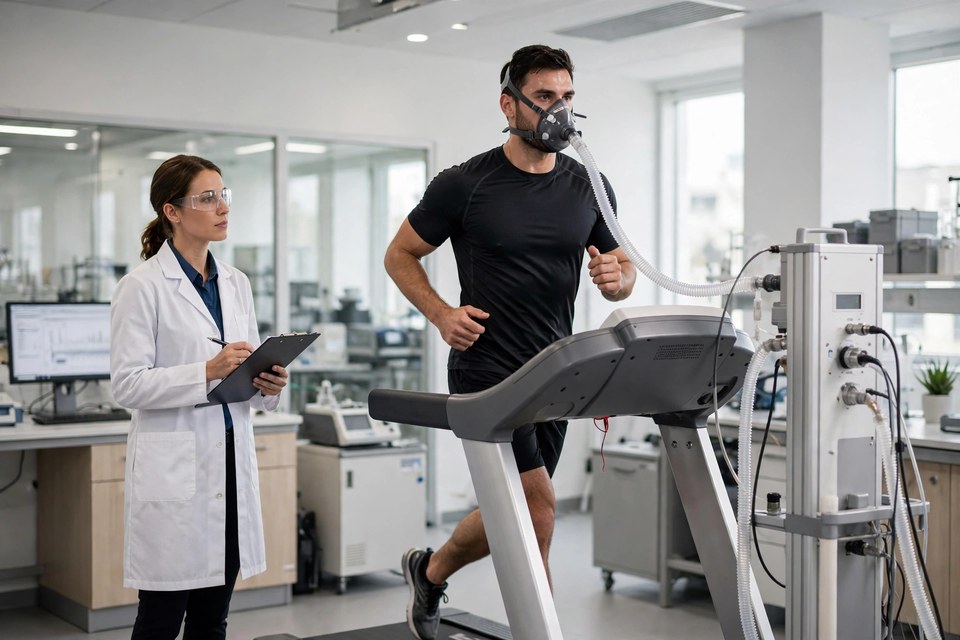
The gold-standard measurement is a lab test (CPET): you run or cycle to exhaustion wearing a mask that analyzes every breath. Here's the honest caveat most articles skip — the famous mortality studies usually estimated fitness from treadmill speed and grade rather than measuring it with a mask. The numbers are about cardiorespiratory fitness, closely related to VO2 max but not a direct reading of it.
Where Do You Stand? It Depends on Your Decade
The FRIEND registry collected maximal treadmill tests from 7,783 healthy U.S. adults. The median values show the pattern:
- Age 20–29: men 48.0, women 37.6
- Age 40–49: men 37.8, women 26.7
- Age 50–59: men 32.6, women 23.4
- Age 70–79: men 24.4, women 18.3
Two lessons hide in that table. Fitness declines with age for everyone — and the spread within an age group is enormous, which is where the mortality story lives.
The Study That Made Doctors Pay Attention
In 2018, researchers published a JAMA Network Open analysis of 122,007 patients who underwent treadmill testing between 1991 and 2014, followed for a median of 8.4 years. The finding was stark: people in the lowest fitness group had roughly five times the mortality risk of the elite group — a risk signal larger in the same data than smoking, diabetes or coronary artery disease.
And there was no ceiling. The authors' exact conclusion: fitness was associated with lower mortality "without an observed upper limit of benefit." The elite group (top ~2%) did better than the merely "high" group below them. A second landmark analysis, a 2009 JAMA meta-analysis of 102,980 people, found every 1-MET increase in fitness was linked to a 13% lower risk of death from any cause.
Association is not proof that raising the number extends your life — fit people differ from unfit people in many ways. But the size, consistency and dose-response of the effect is why the American Heart Association argues fitness should be treated as a vital sign.
Can You Actually Raise Yours?
Yes — unevenly. In the HERITAGE study, sedentary adults followed the same supervised 20-week endurance program. Average VO2 max rose 17% — but individual responses ranged from −4.7% to +47.8%, and about 47% of that variation was heritable. Same program, wildly different payoffs.
As for how to train: a meta-analysis comparing high-intensity intervals with regular endurance training found HIIT's head-to-head advantage was only about +1.2 mL/kg/min — real, but small. In already-trained athletes, mostly-easy "polarised" training actually beat HIIT-only training. The boring conclusion the evidence supports: total consistent volume matters more than any magic workout, and moving out of the bottom quarter of fitness is where the risk curve is steepest.
About That Number on Your Watch
Apple Watch and its rivals estimate VO2 max from heart rate and motion during outdoor walks, runs and hikes — Apple's Cardio Fitness range is 14–65 mL/kg/min, and indoor workouts don't count. One 2025 validation study found a popular watch underestimated lab-measured VO2 max by about 6 mL/kg/min on average. Treat the watch number as a personal trend line, not a lab result: same device, same conditions, you versus past you.
The Twikup Take
VO2 max earns its hype — no other single, measurable, changeable number tracks longevity this closely. But the useful version of the idea isn't chasing an elite score. It's knowing roughly where you sit for your age, and climbing one band. The steepest survival gains in every dataset live at the bottom of the table, waiting for the people willing to get merely decent.
Health note: This article is general information, not medical advice. Maximal exercise testing and new high-intensity training carry real risk for some people — if you have heart symptoms, a chronic condition, or have been sedentary for years, talk to a clinician before testing your limits.
Image: AI-generated illustration.