
Key Takeaways
- Creatine monohydrate is the most studied and effective form; 3–5 g a day raises muscle creatine stores by roughly 20–40%, and a loading phase is optional, not required.
- The gains are real but modest: paired with resistance training, creatine adds a small edge in strength and lean mass — about 1.4 kg extra lean mass in older-adult trials — not a tr
- In healthy people, the evidence finds no kidney harm and no support for the hair-loss claim; anyone with kidney disease should talk to a doctor before using it.
Why Creatine Deserves a Second Look
Creatine is everywhere in the gym: in shaker bottles, in supplement stacks, in conversations between sets.
It is also one of the most misunderstood products in fitness.
Some people treat it like a shortcut to muscle. Others worry it will harm their kidneys or make their hair fall out.
The truth is less dramatic, and more useful.
What Creatine Actually Does
Your muscles already use creatine every day.
It is stored as phosphocreatine and helps your body rapidly regenerate ATP, the energy used during the first seconds of a sprint or heavy lift.
When you take creatine, you increase those stores by roughly 20–40%. The biggest gains happen in people who start with the lowest levels.
The International Society of Sports Nutrition (ISSN) calls creatine monohydrate the most effective legal supplement for increasing high-intensity exercise capacity and lean body mass during training.
That conclusion is based on a literature of more than 1,000 studies.
Creatine is not a steroid, not a hormone, and not magic. It simply helps you train a little harder.
The Correct Dose Is Simpler Than You Think
Monohydrate is the form with the strongest evidence. More expensive versions have not beaten it in head-to-head trials.
The studied protocol is straightforward:
- Take 3–5 grams per day.
- Muscles become saturated in about three to four weeks.
- A loading phase of around 20 grams per day for five to seven days can speed up saturation, but it is not required. The final result is the same.
When combined with resistance training, the benefit is real but modest.
Meta-analyses in older adults found approximately 1.4 kilograms of extra lean mass compared with training alone.
Think of it as an extra rep or two, and slightly faster progress, not a new physique in a month.
Let's Check the Biggest Myths
Myth 1: "Creatine wrecks your kidneys."
In healthy people, the evidence does not support this claim.
The ISSN position stand reports no compelling evidence of harm, even at doses of up to 30 grams per day for five years.
Trials in clinical populations have also not demonstrated the feared effects.
Important distinction: this does not automatically apply to people who already have kidney disease. That group was not the population studied for safety, so they should speak to a doctor before using creatine.
Myth 2: "Creatine makes you bloated."
Creatine pulls water into muscle cells, which is part of how it works.
That is intracellular water, not the puffiness under the skin that people usually mean when they say "bloating."
Myth 3: "Creatine causes hair loss."
This claim comes from one small 2009 study in rugby players that found an increase in DHT, a hormone associated with hair loss.
The result has never been replicated.
A 2025 trial that measured hair directly found no effect.
The idea survives because it keeps being repeated, not because the evidence supports it.
Myth 4: "Only athletes need creatine."
Vegetarians and vegans get no creatine from food, so they start with lower muscle stores and often respond the most.
Research into creatine and cognition is also active, but the results remain mixed and unsettled.
The evidence for exercise performance is much stronger than the evidence for brain benefits.
The Twikup Take
Creatine is the rare supplement that survived its own hype cycle.
It is inexpensive, studied for decades, and honest about what it can do: a modest boost for people who train, not a transformation in a tub.
If you lift weights, 3–5 grams of creatine monohydrate per day is the closest thing sports science has to a settled answer.
Note: This article is general information, not medical advice. If you have kidney disease or another medical condition, or take medication, talk to your doctor before starting any supplement.
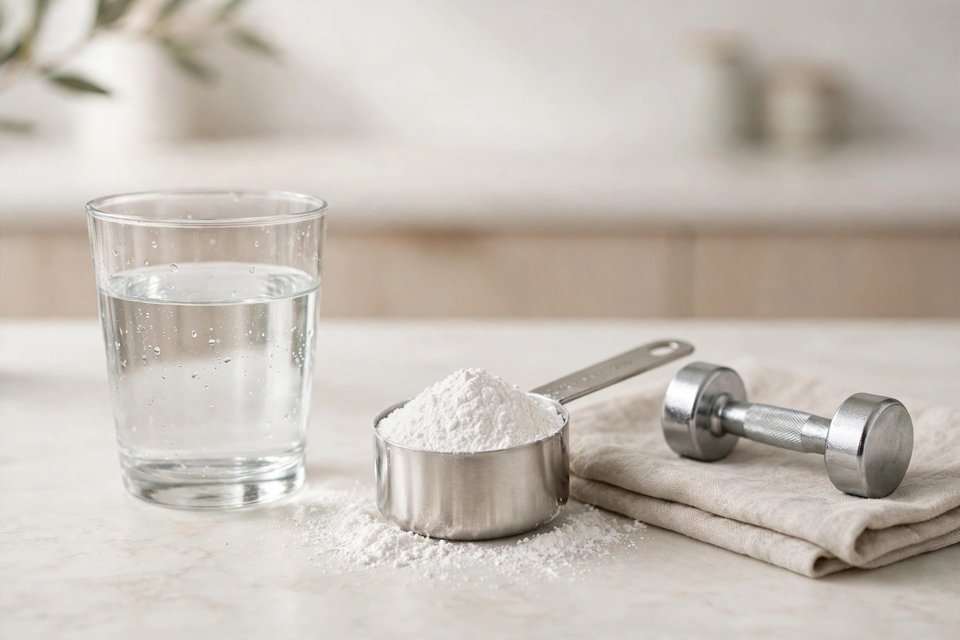
Image: AI-generated illustration.