
Key Takeaways
- In a JAMA Network Open study of 13,423 adults aged 65+, the highest combined fitness scores were linked to a 61% lower risk of death over seven years.
- Balance and agility showed the strongest links to longevity — ahead of lower-body strength and cardio fitness.
- A simple one-leg stand, practised for a few seconds at a time near a counter, is the article's featured way to start.
Can You Stand on One Leg for 30 Seconds? It May Say More About Your Future Than You Think
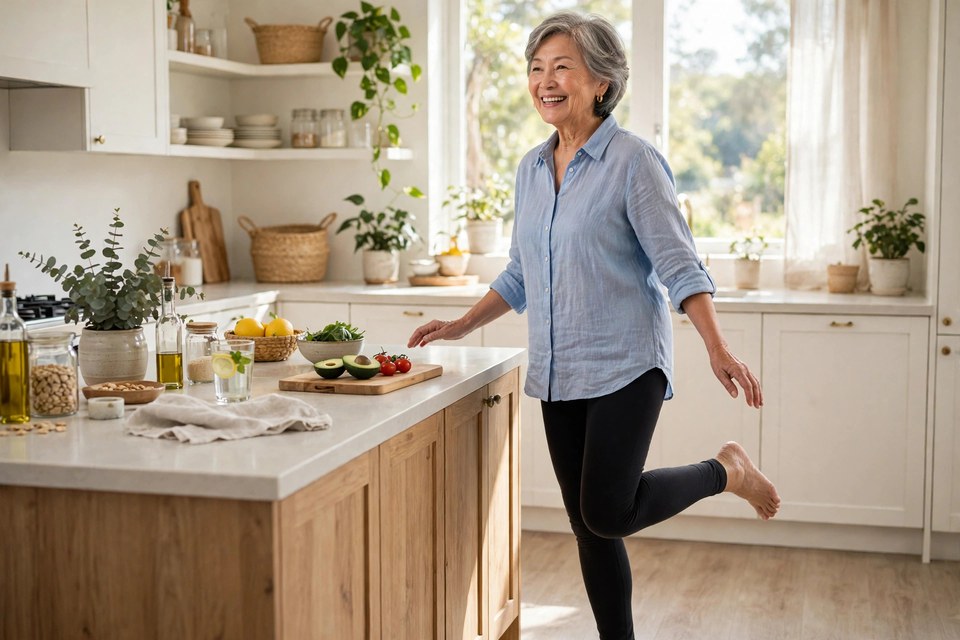
Try it next to a countertop: stand straight, lift one foot a few inches off the floor, and see how long you can hold. If standing on one leg for up to 30 seconds feels easy, Harvard Health Publishing says that's a genuinely good sign — and if it doesn't, it's one of the most trainable warning lights in aging.
The reason is a study published in JAMA Network Open covering 13,423 adults aged 65 and older. Between 2015 and 2016, each person ran a simple battery of tests: marching in place for two minutes (cardio fitness), hand-weight curls and sit-to-stands in 30 seconds (strength), a one-legged stand and an 8-foot up-and-go walk (balance and agility), and two reaching tests (flexibility).
Seven years later, 1,631 of the participants had died — and the pattern was striking. People with the highest combined scores for cardio, strength, and balance and agility had a 61% lower risk of dying than those with the lowest scores. Flexibility made no difference. And the strongest links of all belonged to balance and agility — ahead of lower-body strength and ahead of cardio fitness.
Why balance punches above its weight
Falls are the leading cause of injury and injury-related death in adults over 65, and the risk of dying from a fall climbs with age. "A fall can lead to serious injuries such as a hip fracture, which can significantly increase a person's risk of dying within the following year," says Kristina Dunlea, a physical therapist at Harvard-affiliated Brigham and Women's Hospital.
Train it in the moments you're already standing still
- The one-leg stand: hold a chair or counter if you need it, lift one foot several inches, and balance for five to 30 seconds. Switch legs — that's one rep. Do two or three reps, eyes fixed on one spot, chest lifted.
- Use dead time: "An easy way to build balance into your day is to stand on one leg during moments when you're already still, such as when you're brushing your teeth or waiting for the kettle to boil," Dunlea says. Stay close to a countertop for support.
- Start smaller if you need to: shift your weight gently side to side, or do heel raises holding a counter, and build up.
- Move like it matters: tai chi, yoga, dancing, walking and taking the stairs all train balance alongside strength and stamina.
One honest caveat, and Harvard states it plainly: the study shows an association, not proof. People were tested once, they may have been healthier than average to begin with, and good balance may simply mark someone who is less frail overall. Nothing here shows that practising the one-leg stand adds years — only that the ability travels with longer life.
The Twikup Take
Of every number in the study, the most useful is the cheapest: 30 seconds, one leg, no equipment. Whether balance is a cause of longevity or just its most honest mirror, it's the one fitness score most of us never check — and the quickest to start improving, one kettle boil at a time.
This article is general information, not medical advice. If you already have balance problems, Harvard's expert guidance is to work with a physical therapist before trying balance exercises on your own.
Image: AI-generated illustration.