
Key Takeaways
- Data centres of 10 MW or more would be barred within 600 metres of the nearest home and off top farmland.
- A new Data Centre Designation would make proponents pay their own power-infrastructure costs.
- The same bill would repeal the Oil Sands Emissions Limit Act, introduced in 2016 and never implemented.
Alberta's terms for the AI building boom
Alberta wants a piece of the artificial-intelligence boom — but on its own terms.
Bill 42, the Energy, Environment and Utilities Statutes Amendment Act, 2026, sets the conditions. If passed, data centres of 10 megawatts or larger could not be built within 600 metres of the nearest home, and would be barred from Alberta's highest-quality farmland — protecting about 14 million acres of Class 1 and 2 agricultural land, plus irrigated land.
But there's a catch: the same bill would repeal the Oil Sands Emissions Limit Act.
Water is another priority. The bill supports a provincewide standard to bring data centres' cooling water use "close to zero," and requires designs that let excess heat be recovered for greenhouses, industry or homes.
A new Data Centre Designation would ensure proponents pay for their own power infrastructure and cannot pass those costs on to Alberta ratepayers. Maximum corporate fines for serious environmental contamination rise to $6 million.
"Albertans told us what matters most: their communities, farmland and water. We listened," the province said in its release. "These proposed rules would make sure AI data centres grow in Alberta on Alberta's terms."
And the emissions cap comes off the books
The same bill would repeal the Oil Sands Emissions Limit Act — the 2016 legislation that established an oil sands emissions cap but was never implemented. The province argues oil and gas emissions are already regulated through its TIER system, and that repealing the act changes neither Alberta's environmental review processes nor federal review requirements.
Then there's the electricity bill. Bill 42 also carries the new well-closure security framework, stiffer illegal-dumping penalties (fines up to $100,000 for individuals and $1 million for corporations, plus possible jail time), and tools for northern Alberta residents facing disproportionately high electricity distribution costs.
The Twikup Take
Read together, the two halves of Bill 42 are one bargain: the province wants the data-centre investment badly enough to write the rules developers asked for — clear setbacks, clear costs — while removing a cap the industry never liked and that was never switched on anyway. The farmland and water protections are real; so is the trade.
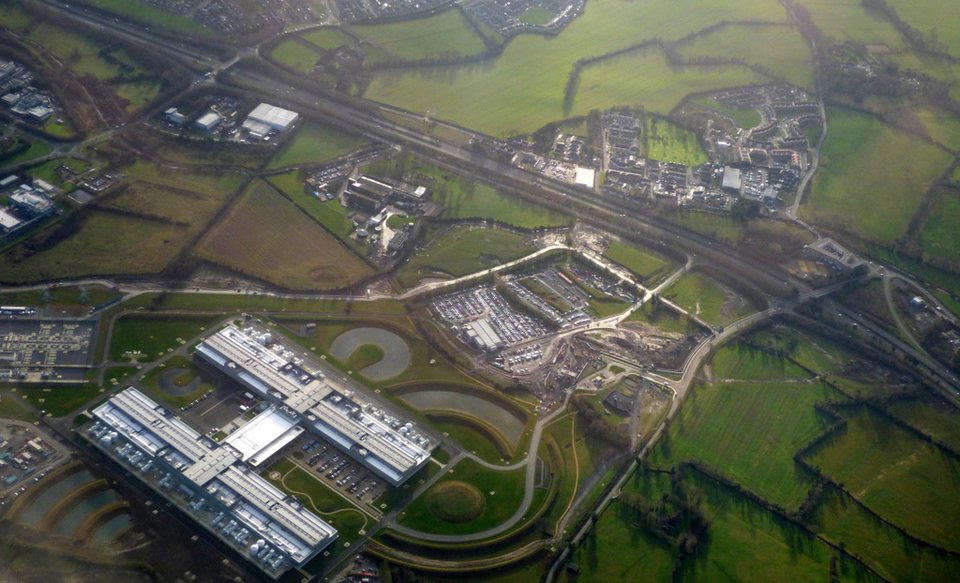
Image: A data centre campus surrounded by farmland, Clonee, Ireland by Thomas Nugent, via Wikimedia Commons, CC BY-SA 2.0.