
Key Takeaways
- Farm cash receipts totalled $79.7 billion in the first three quarters of 2026, up 7.7% from a year earlier, driven by crops (+$4.4 billion) and livestock (+$2.2 billion).
- Canola receipts jumped 38.2% (+$3.4 billion) on 28.4% higher marketings and stronger prices, with China demand and biofuel interest supporting the market.
- Government program payments fell 25.6% to $2.5 billion — a fourth straight annual decline — as crop insurance and AgriStability payouts dropped.
A $79.7 billion nine months for Canadian farms
Farm cash receipts in Canada totalled $79.7 billion from January to September 2026, up $5.7 billion (+7.7%) from the same period in 2025, Statistics Canada reported Tuesday. Crops contributed +$4.4 billion of the increase and livestock +$2.2 billion, while program payments fell $845.6 million. Nearly all provinces recorded higher receipts, led by Saskatchewan (+$2.1 billion) and Alberta (+$1.8 billion), mainly on stronger crop receipts.
Canola did the heavy lifting
Total crop receipts rose 11.5% to $42.4 billion, and canola alone explains most of it: receipts grew 38.2% (+$3.4 billion) on marketings up 28.4% and prices up 7.6%, with canola crushing up 23.0%. StatCan points to higher demand from China and increased exports, with strong biofuel interest keeping prices elevated through 2026. Wheat (excluding durum) added $722.0 million and barley $213.1 million on stronger export marketings, while dry peas (+$204.3 million) and lentils (+$149.4 million) rode export quantities up nearly 70% — helped by the removal of Chinese tariffs on Canadian peas.
Cattle prices carried livestock; hogs slipped
Livestock receipts rose 6.6% to $34.9 billion as prices increased for every livestock type except hogs. Cattle receipts rose $1.4 billion — about two-thirds of the livestock gain — on prices up 12.8%, even as marketings eased 1.8%. Hogs were the sole decline, down $186.9 million on prices 5.4% lower. Supply-managed receipts grew 5.2% to $12.3 billion, led by chicken for meat, eggs and dairy.
The support cushion keeps thinning
Direct program payments fell 25.6% to $2.5 billion, the fourth consecutive year of decline, led by Saskatchewan and Alberta. Crop insurance payments dropped $632.6 million and AgriStability $201.2 million. StatCan notes receipts are gross revenue, not profit — expenses, loans and depreciation still come off the top. Full-year 2026 receipts arrive February 26, 2027.
The Twikup Take
This is a market-driven year, not a subsidy-driven one: farmers earned more because canola, cattle and exports paid more, even as the insurance and stability cushion shrank for a fourth straight year. That is a healthier headline — and a thinner safety net if prices turn.
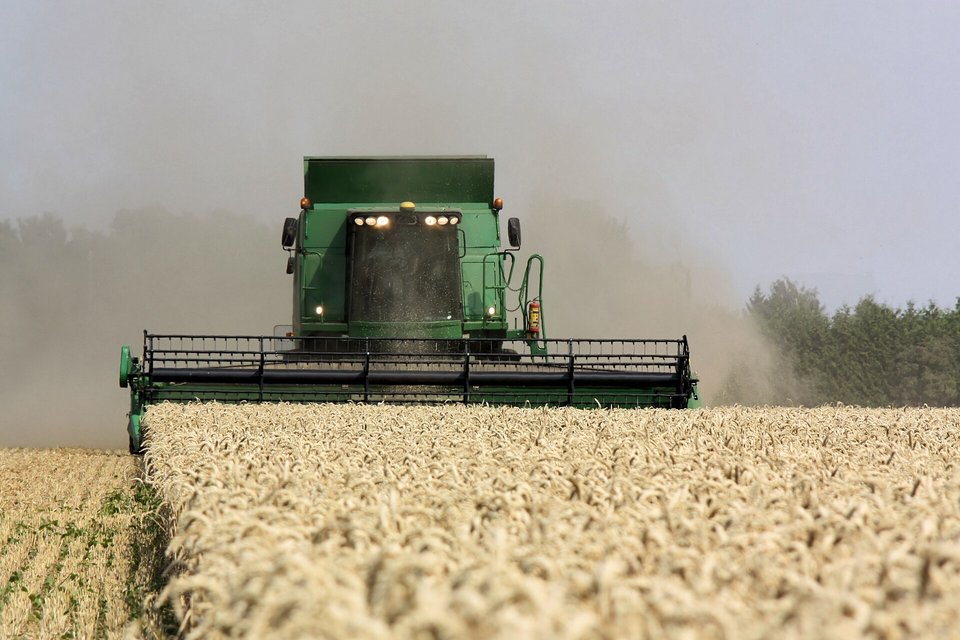
Image: Combine in wheat field by Dan Kollmann, CC BY-SA 3.0. (https://commons.wikimedia.org/wiki/File:Combine_in_wheat_field.jpg, https://creativecommons.org/licenses/by-sa/3.0)