
Key Takeaways
- Planck's final data give the universe's age as 13.787 ± 0.020 billion years, derived from the cosmic microwave background and the standard cosmological model
- The universe's recipe from Planck: ~4.9% ordinary matter, 26.8% dark matter, ~68% dark energy
- The Hubble tension — 67.4 (early universe) vs 73.04 (local) km/s/Mpc, a 5-sigma gap — is the main open challenge to that calculation
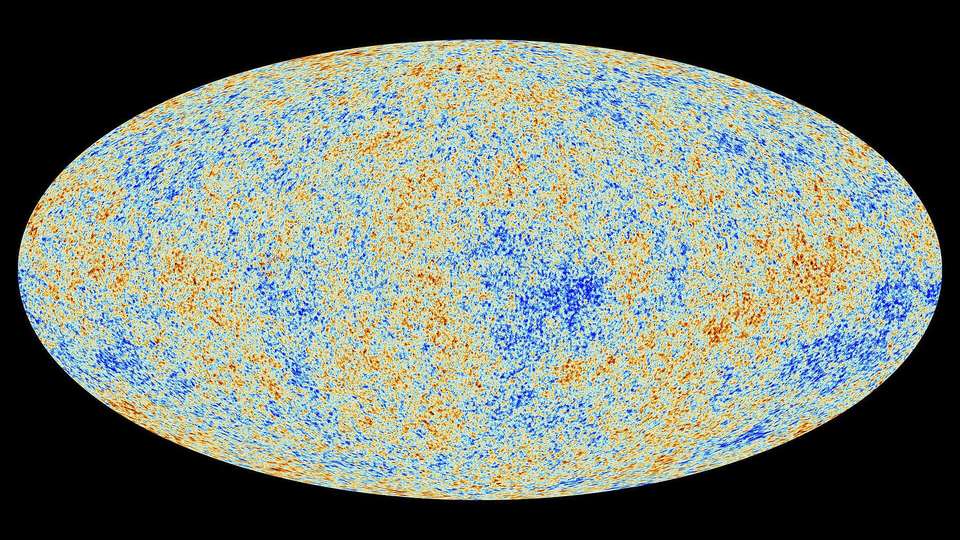
The age comes from a baby picture
The European Space Agency's Planck satellite spent years mapping the cosmic microwave background — the cooled remnant of the hot early universe, released when the cosmos was about 380,000 years old. The pattern of hot and cold spots in that map is a fingerprint: it encodes what the universe is made of and how fast it has expanded ever since.
Fitting the standard model of cosmology to Planck's final 2018 data gives the recipe — about 4.9% ordinary matter, 26.8% dark matter, and roughly 68% dark energy — and the expansion history that follows from it. Run that history backward and the universe converges on a beginning 13.787 billion years ago, plus or minus 0.020 billion — an age measured to better than two-tenths of one percent. (ESA and NASA round it to 13.8 billion years.)
The tension: two honest measurements, two different speeds
The catch is the expansion rate, the Hubble constant. From the early universe, Planck's data imply 67.4 kilometres per second per megaparsec, with an uncertainty of just 0.5. Measured the direct way — using Cepheid variable stars in 42 supernova host galaxies as mileposts — astronomers get 73.04, with an uncertainty of about 1. The two methods disagree at the 5-sigma level, and the local-measurement team reports no indication the gap is a measurement error.
This matters for the age because the age is not read off a clock — it is calculated from the expansion history. If the universe really is expanding faster now than the early-universe model says, the calculated age would come down. So far, the discrepancy has survived every attempt to explain it away, which leaves two possibilities: a subtle error hiding in one of the methods, or a standard model that is missing something real.
The Twikup Take
Thirteen point eight billion years is one of the most precise numbers in science — and it rests on a model whose two best measuring sticks currently disagree. That is not a crisis; it is how cosmology advances. Either the tension dissolves into a correction, or it is the first visible crack in the standard model. Both outcomes start from the same Planck baby picture.
Image: ESA and the Planck Collaboration, via Wikimedia Commons / NOIRLab, CC BY 4.0. This map of the Cosmic Microwave Background radiation, imprinted on the sky when the universe was 370,000 years old, shows tiny temperature fluctuations that correspond to regions of slightly different densities.