
Key Takeaways
- Fusion joins light atoms — deuterium and tritium — into helium, releasing 17.6 million electron volts per reaction, mostly carried by a neutron.
- ITER aims to heat plasma to 150 million degrees Celsius, ten times hotter than the Sun's core, because Earth cannot copy the Sun's crushing gravity.
- In December 2022 the US National Ignition Facility produced 3.15 MJ of fusion energy from 2.05 MJ of laser light — a target gain, not yet power-plant breakeven.
The Sun runs on it. Eighty years of engineering still cannot — and the gap is not the idea, it is the conditions
Every second, the Sun turns hydrogen into energy. It has been doing this for billions of years without a control room, a maintenance crew or a single moving part.
Humanity has spent roughly eighty years trying to recreate the same basic reaction inside a machine.
The idea sounds almost ridiculously simple: squeeze light atoms together until they merge into a heavier one, and collect the energy the merger throws off. It powers every star. The problem has never been whether fusion works. We know it does. The challenge is building a small, controlled piece of a star on Earth, keeping it together and getting more energy out than we put in.
And that last part is where things get complicated.
The reaction engineers actually use
Stars fuse ordinary hydrogen through a slow chain. Earth cannot wait that long, so reactors use the easiest fusion reaction known: deuterium plus tritium, two heavy forms of hydrogen.
Put them together and the reaction produces helium, a neutron, and 17.6 million electron volts of energy.
That energy splits into two parts. About 3.5 MeV stays in the helium nucleus, helping keep the plasma hot. The other 14.1 MeV rides out on the neutron.
That escaping neutron is both the opportunity and the headache. Capture it and you can generate heat, then electricity. But those same high-energy neutrons also batter the reactor materials, creating one of fusion's biggest engineering challenges.
The fuel story sounds almost too good to be true.
Deuterium is found in ordinary water — about one in every 6,500 hydrogen atoms, roughly 33 grams in every cubic metre of seawater.
Tritium is the catch. It barely exists in nature and today comes mainly as a by-product of CANDU reactors.
A working fusion economy would have to manufacture its own supply. The proposed solution is to breed tritium from lithium in a blanket surrounding the plasma — a system the IAEA describes as yet untested at scale.
The fuel is available. Building a machine that can continuously produce its own fuel is another matter.
Hotter than the Sun, on purpose
Here is the number that makes fusion sound like an engineering dare.
ITER, the international reactor under construction in France, is designed to heat its plasma to 150 million degrees Celsius — in ITER's own words, "ten times hotter than the core of the Sun."
Why would anyone deliberately make something hotter than the Sun?
Because the Sun has an advantage Earth cannot copy: gravity.
The Sun fuses hydrogen at a mere 15 million degrees because its enormous gravity crushes its core to densities no machine can match. It also has billions of years to keep the process going.
A reactor on Earth gets neither density nor time.
So engineers compensate with temperature. Particles moving ten times faster collide hard enough, often enough, to fuse in the seconds a machine can hold them.
The trick is not simply making something incredibly hot. It is making it hot enough, dense enough and stable enough for fusion to happen before the whole arrangement falls apart.
Two ways to hold a star
There is one immediate problem with creating star-like temperatures: nothing material can touch plasma that hot.
So engineers have developed two ways to keep the fuel contained without letting it touch the walls.
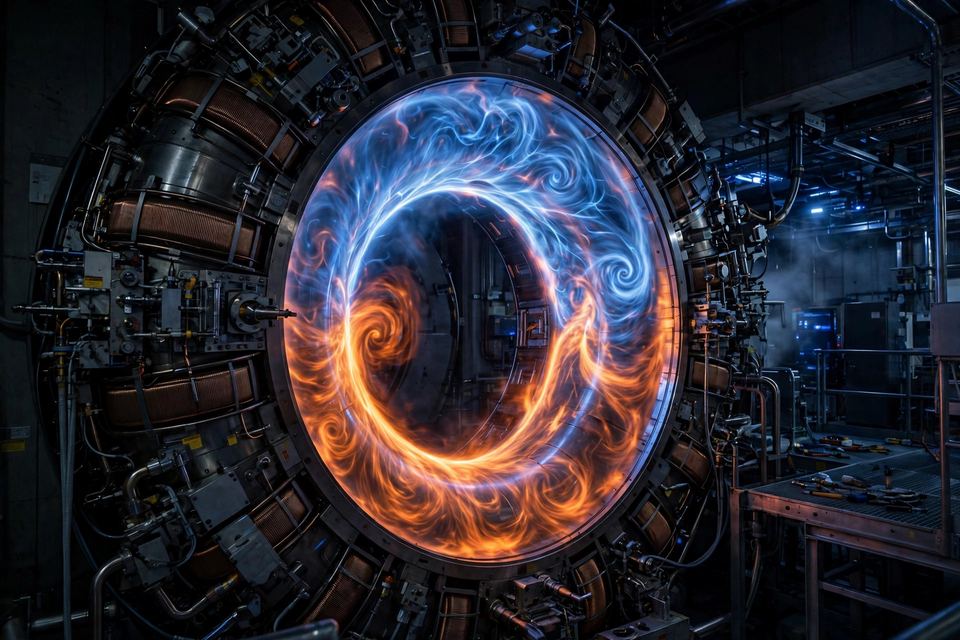
Magnetic confinement: building an invisible cage. In a tokamak — ITER, and Britain's JET before it — powerful magnetic fields hold the plasma inside a doughnut-shaped cage. A current driven through the plasma itself helps stabilise it.
A stellarator takes a different approach. It uses no plasma current at all. Instead, the entire twist of the magnetic field is built into fiendishly complex external coils.
The result is a plasma that is inherently steadier, but a machine that is far harder to build.
Inertial confinement: crush it before it escapes. The second approach does not try to hold the fuel in place. It crushes it faster than it can escape.
At the US National Ignition Facility, 192 lasers fire simultaneously on a peppercorn-sized fuel capsule, compressing and heating it so violently that it burns in the instant before it blows apart.
One method uses magnetic fields to keep plasma contained. The other uses an incredibly fast burst of energy to make fusion happen before the fuel has time to escape.
Both are attempts to solve the same problem: create the conditions for fusion without losing control of the reaction.
The milestones are real — and so is the fine print
Fusion has produced some remarkable results. But understanding what those records actually mean matters just as much as the headline numbers.
On December 5, 2022, the US National Ignition Facility crossed the line the field had chased for decades.
It delivered 2.05 megajoules of laser energy to a target and produced 3.15 megajoules of fusion energy.
More energy came out than went into the target — a target gain of about 1.5.
That was a genuine scientific milestone. But there is an important catch: the lasers themselves drew roughly 300 megajoules from the grid to deliver those 2.05.
In other words, this was scientific breakeven at the target, not a power plant paying its own electricity bills.
The magnetic side has its own record-breaking machine: JET.
It produced 59 megajoules in a single discharge and then 69 megajoules in October 2023 — still the record — using a fifth of a milligram of fuel, at a gain well below one.
Now comes ITER, designed to test whether magnetic confinement can deliver a much bigger result.
Its target is a gain of at least 10, producing 500 megawatts of fusion power from 50 megawatts of heating.
There is another important distinction: ITER will generate no electricity.
Under ITER's current official baseline, research operation starts in 2034 and full deuterium–tritium operation in 2039.
The milestones are real. So are the limitations. Producing fusion energy, achieving a positive energy balance and supplying electricity to the grid are three very different achievements.
Why it is taking so long
If fusion works, the fuel is available and scientists have already achieved remarkable results, why isn't every country building a fusion power plant?
Because three enormous engineering problems remain.
1. The plasma refuses to behave. Plasma is not a calm, obedient fuel source. Instabilities and disruptions can end a discharge in milliseconds, putting enormous stress on the machine.
Keeping it hot is difficult. Keeping it stable is another challenge entirely.
2. The reactor gets bombarded from the inside. Remember those 14.1 MeV neutrons?
They carry energy out of the fusion reaction, but they also smash into the reactor's first wall for years on end.
That bombardment damages materials in ways no existing test facility can fully replicate.
A commercial reactor must survive this punishment repeatedly, not just demonstrate that fusion can happen once.
3. The reactor must make its own fuel. Tritium barely exists naturally. A functioning fusion economy cannot depend indefinitely on external supplies.
The solution is a tritium-breeding blanket that uses lithium to manufacture the missing fuel while the reactor runs.
But that system has never been demonstrated as an integrated system.
And that is the bigger picture: fusion's physics is proven, but its engineering is a list of hardest-problem-in-the-room problems stacked in a trench coat.
Getting fusion to happen is one achievement. Building a reliable machine that survives the conditions, produces its own fuel and delivers usable energy is an entirely different one.
The Twikup Take
Fusion is not a mirage: ignition happened, records keep falling, and the fuel is seawater and lithium.
But every honest milestone comes with its caveat attached — target gain is not grid gain, and ITER's burning plasma is now a 2039 appointment.
The Sun had gravity and five billion years. We are trying to do it in a doughnut, in our lifetimes, and the remarkable thing is not that it is slow — it is that it is working at all.
Fusion's biggest breakthrough may not be making a star on Earth. It may be learning how to keep one running.
Image: Illustrative image.